Leadership support for the exhibition is provided by the Sandra and Tony Tamer Exhibition Fund, the Eyal and Marilyn Ofer Family Foundation, The International Council of The Museum of Modern Art, Sue and Edgar Wachenheim III, and the Dian Woodner Exhibition Endowment Fund.
Generous funding is provided by The Black Arts Council of The Museum of Modern Art.
Additional support is provided by Roberto S. and Elizabeth T. Goizueta.
The Bloomberg Connects digital experience is made possible through the support of Bloomberg Philanthropies.
Major support for the publication is provided by The Museum of Modern Art’s Research and Scholarly Publications endowment established through the generosity of The Andrew W. Mellon Foundation, the Edward John Noble Foundation, Mr. and Mrs. Perry R. Bass, and the National Endowment for the Humanities’ Challenge Grant Program. Generous funding is provided by the Jo Carole Lauder Publications Endowment Fund of The International Council of The Museum of Modern Art.
A Member’s Field Guide to Wifredo Lam: When I Don’t Sleep, I Dream
This is the first retrospective in the US to feature the full trajectory of Wifredo Lam’s remarkable vision, inviting us to see the world anew. Delve into his groundbreaking work through words, images, and more.
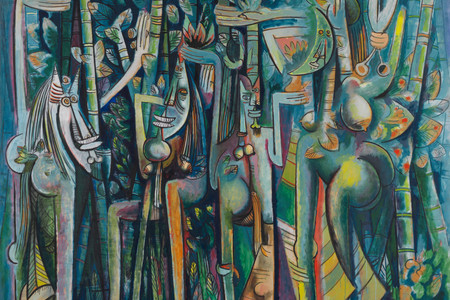
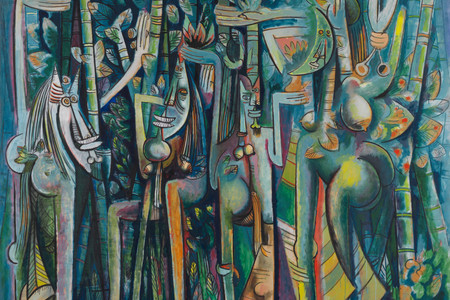
Wifredo Lam charted a pathbreaking trajectory in modern art and served as a reference for subsequent generations of artists working across the Caribbean, Africa, and the West. The early decades of his career were defined by movement and exile: from Cuba to Spain, where he trained as an academic painter, and later to Paris, to escape the Spanish Civil War, in which he had fought alongside the Republicans against the Nationalist military dictatorship. Lam was forced to flee again in the summer of 1940, after the Nazi invasion of Paris. His exile in Marseille, where he awaited safe passage back to the Americas, laid the foundation for his later work. Lam would continue to elaborate on this new world when he returned to Cuba, where he completed the monumental oil painting on kraft paper La Jungla (The Jungle) (1942–43), whose all-over composition features life-size plant-animal-human figures emerging from a dense field of sugarcane, a location that evokes Cuba’s history of slavery and indentured servitude.
Exhibitions
-

Member exclusive
Studio Visit: Rashid Johnson on Wifredo Lam
The artist discusses the influence and legacy of a trailblazing modernist, and new ways to think about the surreal imagination.
Arlette Hernandez, Rashid Johnson
Nov 14, 2025
-

Five Ways of Looking at Wifredo Lam
Contemporary thinkers and artists reflect on the work and legacy of the great Cuban artist.
Ada Ferrer, Martin Tsang, Leo R. Douglas, Damasia Lacroze, Kunbi Oni, María Magdalena Campos-Pons
Nov 18, 2025
-

A World Ahead
Read an excerpt from the Wifredo Lam: When I Don’t Sleep, I Dream exhibition catalogue.
Beverly Adams, Christophe Cherix
Nov 13, 2025
-

How to See
Wifredo Lam: The Power of Art, Exile, and Transformation
Watch to see how Wifredo Lam redefined what it means to create, find kinship, and resist injustice through art.
Sarah Cowan
Nov 6, 2025
-

Poetry Project
The Jungle
Yusef Komunyakaa reads his poem, based on Wifredo Lam’s painting The Jungle (La Jungla).
Yusef Komunyakaa
Oct 29, 2019
-

UNIQLO ArtSpeaks
Jose Camacho on Wifredo Lam’s Mother and Child
How does a painting force us to confront what defines us?
Oct 27, 2023