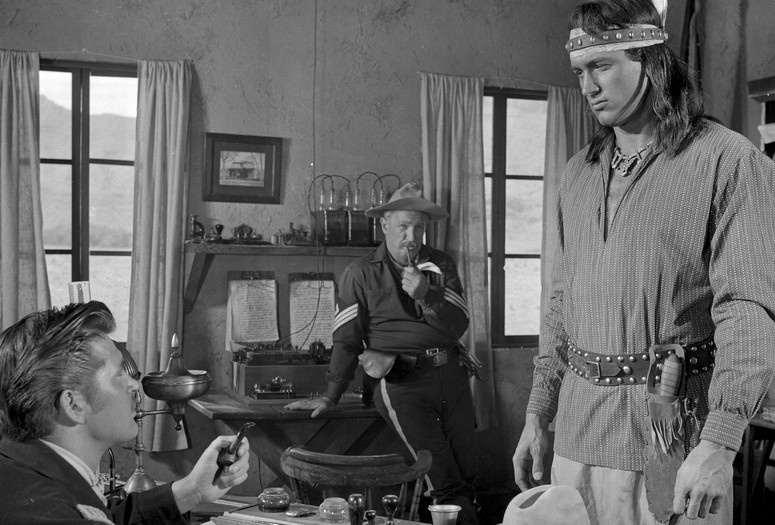
Taza, Son of Cochise. 1954. USA. Directed by Douglas Sirk. Screenplay by George Zuckerman, based on a story by Gerald Drayson Adams. With Rock Hudson, Barbara Rush, Rex Reason, Morris Ankrum, Ian MacDonald, Jeff Chandler. DCP. 3-D. 79 min.
Douglas Sirk’s only serious Western is also his only film in stereoscope, and both distinctions point to the same preoccupation: depth as a compositional problem. Sirk organizes the Arches National Monument locations into layered planes. Lit by Russell Metty in saturated Technicolor, the canyon walls and desert floor become a series of receding surfaces that the 3D format was built to exploit. Jeff Chandler, reprising his Cochise from Broken Arrow and The Battle at Apache Pass, dies in the opening minutes, bequeathing the film’s central conflict: whether the peace he built can outlast him.
Taza belongs to Universal’s cycle of “pro-Indian” Westerns, films that reversed the standard alignment of sympathy while keeping the white star system intact—Rock Hudson, Barbara Rush, and Rex Reason all play Apaches. The casting is an unavoidable product of its moment, but the film’s sympathies are genuine. The cavalry officers are hypocritical and condescending, and Taza’s position—donning a cavalry uniform among his own people as the price of the alliance he’s honoring—carries the kind of social doubleness Sirk understood well. These films, arriving at the start of the decade that would produce the Civil Rights Act, offered American audiences an early rehearsal in seeing the other side.