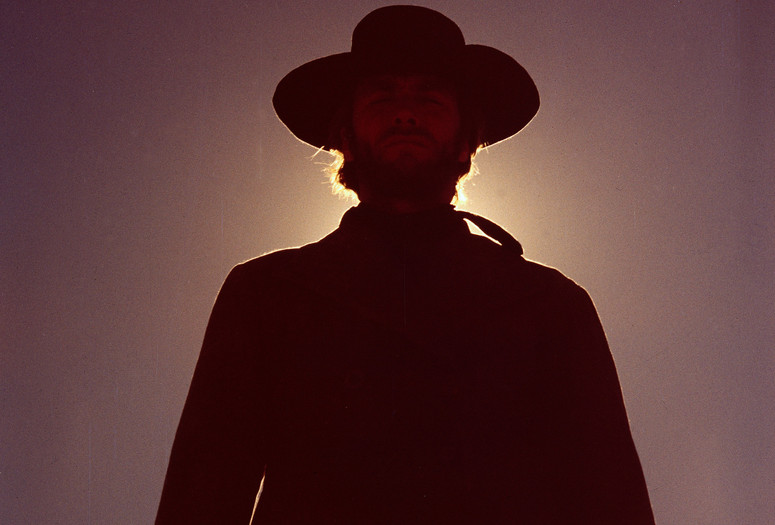
High Plains Drifter. 1973. USA. Directed by Clint Eastwood. Screenplay by Ernest Tidyman. With Eastwood, Verna Bloom, Marianna Hill, Mitchell Ryan, Billy Curtis, Geoffrey Lewis. DCP. 105 min.
Clint Eastwood’s first Western as director is the one that most clearly shows what he absorbed from the Sergio Leone films that made him a star: the Western as parable, the hero as supernatural agency rather than human. The Stranger who rides into the mining town of Lago at the film’s outset comes out of a heat mirage and never quite stops being one—a figure of retribution shaped by a killing the town once stood by and watched. Ernest Tidyman’s screenplay, which he acknowledged drew from the 1964 murder of Kitty Genovese, is frank about the allegory: Lago is a community defined by its complicity, and the man it has summoned is not equipped for mercy. Bruce Surtees’s photography turns the Mono Lake locations into something unsettled and slightly wrong, the light off the alkaline flats bleaching colors toward the ghostly.
The casting of Eastwood’s longtime stunt double, Buddy Van Horn, as the murdered marshal is a small but telling detail, sustaining the film’s ambiguity about who exactly the Stranger is and where he comes from. Verna Bloom and Marianna Hill occupy the poles the Western typically assigns to women, and they subvert both, though the film’s treatment of rape has not aged well. Billy Curtis, as the dwarf Mordecai who is briefly made sheriff and then town painter, enacts the film’s mordant comedy. The tombstones inscribed “Sergio Leone” and “Don Siegel” in the final scene close the loop, with Eastwood acknowledging his influences and aspiring to go beyond them.