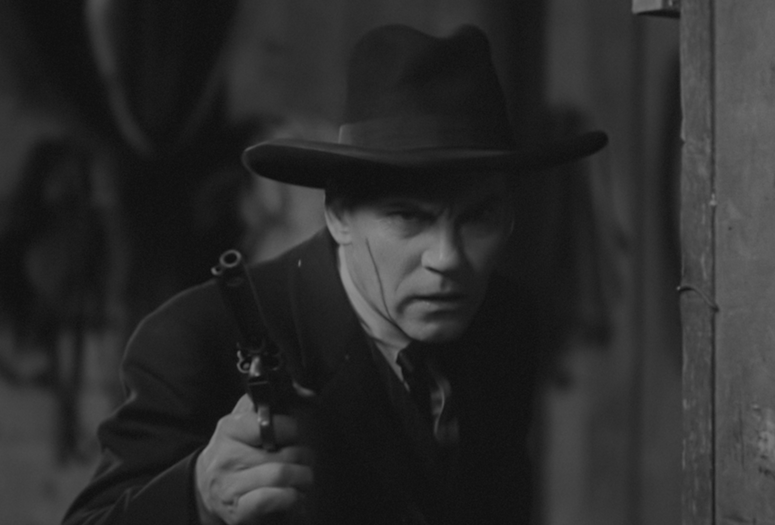
Law and Order. 1932. USA. Directed by Edward L. Cahn. Screenplay by Tom Reed, John Huston, based on the novel Saint Johnson by W. R. Burnett. With Walter Huston, Harry Carey, Russell Hopton, Raymond Hatton, Andy Devine, Ralph Ince. DCP. 72 min.
The first film to dramatize the gunfight at the O.K. Corral—though all the names are changed, the town of Tombstone remains - Law and Order arrived a year after W. R. Burnett’s source novel Saint Johnson and before the myth of Wyatt Earp had fully hardened into Hollywood convention. That timing is part of what makes it still feel sharp. Burnett, fresh from Little Caesar, brought his gangster-novel sensibility to the frontier: The town is a racket, the law an imposition on entrenched interests, and Frame Johnson (Walter Huston) a man with no particular desire to be heroic. The screenplay is credited to Tom Reed, with adaptation and dialogue by John Huston—who was 26 and writing for his father. Jackson Rose’s cinematography employs a moving camera far more freely than the early-sound period usually permitted, using crane shots to position characters across the vertical space of the saloon. The editorial speed of the final gunfight would not look out of place 20 years later.
Walter Huston’s performance is anchored and unhurried—he doesn’t play Frame Johnson as eager for the job of marshal, only as someone who reaches a point where he can no longer ignore what’s in front of him. Harry Carey, whose career at Universal stretched back to the silents, lends the film a particular authenticity as a Doc Holliday stand-in. Andy Devine, thin, young, and cast against type as a convicted man approaching his hanging, has a scene with Walter Huston that lands harder than anything else in the film. This is one of three extraordinary films directed by Edward Cahn at the beginning of his career, before his mysterious exile from Universal drove him into low-budget programmers. Restored by Universal Pictures and the Film Foundation from the original negative, this print adds four minutes to the previously available version.