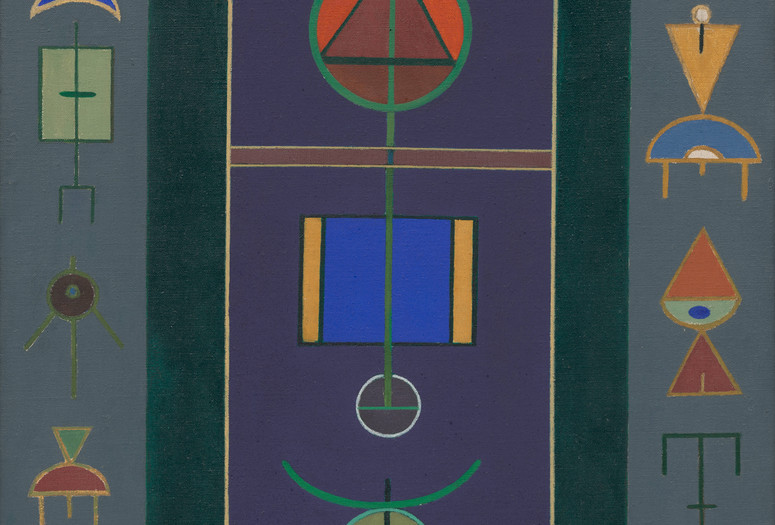
The Sacred and the Modern: Exploring Spiritual Streams in Latin American and Caribbean Art examines the multifaceted, complex relationship between spirituality and modern art in Latin America and the Caribbean, treating different spiritual systems and practices as integral to broader racial and sociopolitical configurations. Considering Afro-Diasporic traditions, the occult, Catholic modernities, and Indigenous spiritual perspectives, this two-day conference reassesses the role of religion in the development of 20th-century art and offers a historical perspective on the current surge in spirituality as a central concern of contemporary art practitioners.
The Sacred and the Modern is the public phase of Bridging the Sacred: Spiritual Streams in 20th-Century Latin American and Caribbean Art, 1920–1970, an ongoing research project initiated by the Cisneros Institute in 2023. This in-depth study questions dominant narratives around modernism that herald secularism as a central tenet, and challenges the idea of the spiritual as a static, traditional, or backward-looking perspective in life and art. The first phase of the project consisted of a series of internal seminars on art and spirituality organized in collaboration with scholars, curators, MoMA colleagues, and a cohort of fellows. These encounters centered on selections of works from MoMA’s Latin American and Caribbean holdings, highlighting artists whose work has had little visibility, while also offering new interpretations of renowned works of modern art from the region.
The guiding questions of the conference include: How can we think about the interaction of art and spiritual systems vis–à–vis the rise of concepts of innovation and autonomy during the 20th century? How can we consider notions of materiality and immateriality through the lens of artists’ beliefs? How can we assess the power relations between various social, racial, and religious groups in relation to the historical visibility/invisibility of certain artistic practices? And finally, what are the tensions that arise in showcasing art that is spiritually infused within the institution of the museum?
The Sacred and the Modern is organized by the Cisneros Institute, with the collaboration of Roberto Conduru, Endowed Distinguished Professor of Art History, Southern Methodist University; Tatiana Flores, Jefferson Scholars Foundation Edgar F. Shannon, Jr. Distinguished Professor of Art History, University of Virginia; and Luis Vargas Santiago, researcher, Instituto de Investigaciones Estéticas, Universidad Nacional Autónoma de México.
The conference will be in English, except for the presentations by Francisco Huichaqueo and Patricia M. Artundo, who will speak in Spanish. Simultaneous translation in English will be provided for these two presentations.
DAY 1
Wednesday, May 21, 2025, 2:00–7:00 p.m.
Register for day one
2:00–2:10 p.m.
Welcome
Introductory address from Inés Katzenstein
2:10–4:10
“Spiritual Networks, Radical Connections”
Presented and moderated by Tatiana Flores
In Our Migrant Souls: A Meditation on Race and the Meanings and Myths of “Latino,” a recent book on Latinidad, author Héctor Tobar states, “‘Latino’ is a synonym for ‘mixed.’ It describes a collision and an accommodation between ethnic groups; Indigenous, European, Black.” While there are plenty of Latin Americans who do not identify as mestizo, connecting with one of those three categories or others, including East Asian or Middle Eastern, it is undeniable that the region is an amalgam of multiple peoples and diverse religious traditions. Under these conditions, syncretism is a fact of life.
The framework of hybridity popular in the 1990s—advanced in postcolonial studies by Homi Bhabha and in Latin America by Néstor García Canclini—was decidedly secular in nature. The discourse on Latin American art has also been framed by secular concerns since Mari Carmen Ramírez published “Beyond ‘the Fantastic’: Framing Identity in US Exhibitions of Latin American Art” in 1992, which critiques the exoticization of Latin America in exhibitions of the period. This session takes up both themes to propose new methodologies for considering the spiritual and the syncretic in dialogue.
Presenters
Genevieve Hyacinthe, “Black Atlantic Embodiment: As Above, So Below”
Omar Rivera, “The Cosmic Knots of Jorge Eielson”
Laura Elisa Pérez, “Animate Earth: The Paintings of Luchita Hurtado, 1940s–1960s”
4:10–4:40
Break
4:40–5:10
Francisco Huichaqueo, “Ngeno Adümtun / The Image Before the Image”
Introduced by Diana Iturralde, Cisneros Institute Research Fellow, MoMA
5:10–7:00
“The Agency of Symbols”
Presented and moderated by Roberto Conduru
In this panel, scholars will explore artists’ dialogues with spirituality through symbols. Figurative and abstract symbols and indices of rituals promote artistic experimentation by expanding its language and creative processes. The inclusion and interconnection of symbols from diverse belief systems broaden the artistic repertoire and foster a greater sense of cultural belonging. The artistic stimulus to interpret symbols or the impossibility of deciphering them enhances communication with or provokes spectators, activating their performativity. The agency of artists’ spiritual symbols and the agency of the symbols themselves blur the boundaries between art and religion; expand the goals, limits, and autonomy of art; and challenge the rationalization process of modernity.
Presenters
Bárbaro Martínez-Ruiz, “Wisdom, Knowledge, and Understanding in Roberto Diago’s Art”
Patricia M. Artundo, “A Reflection on Xul Solar from the San Signos and the Tablets of the I Ching”
Geraldo Souza Dias, “Visible Silence: Transparency as Method in Mira Schendel’s Work”
DAY 2
Thursday, May 22, 2025, 2:00–7:00 p.m.
Register for day two
2:00–4:00 p.m.
“Politics of Religions”
Presented and moderated by Luis Vargas Santiago
This panel explores the role of 20th-century modern art and visual culture as containers and triggers of both religious fervor and its rejection. In both instances, religious practices occupied political sites where worship was either banned and persecuted, or promoted through the establishment of an official state religion. While some anticlerical governments banned Catholicism, such as the post-revolutionary government in Mexico, other countries, like Brazil, presented it as the only option, thus making Afro-Latin religions and Indigenous syncretism invisible. In other instances, such as in Peru, modern states recovered religious structures and iconography for civic worship. By the 1960s, the agendas of a neo-Marxist left merged with processes of religious modernization, leading to iconoclastic movements such as Liberation Theology.
Presenters
Renato González Mello, “Archaeological Styles or Sacred Iconographies: The Dilemmas of Post-Revolutionary Cultures in Mexico”
Amy Buono, “Policing the City: Race and Religion in Rio de Janeiro’s Museum of Methodologies”
Gabriela Germaná, “From Rural Sacredness to Political Rituals: El toro de Pucará and the Regimes of Modernity in Peru”
4:00–4:30
Break
4:30–6:30
“Sacred Threads in the Museum”
Presented and moderated by Inés Katzenstein
Critical questions arise when sacred objects are exposed in the seemingly neutral spaces of the museum and the vitality of belief is disconnected from the either collective or intimate realms of the ritual. In light of current movements of decolonization, these questions have taken center stage, and debates on publicness and cultural context have focused on the politics of care, especially with regard to sacred objects of Black and Indigenous communities held in anthropological museums.
And yet, museums of modern and contemporary art are not exempt from controversies surrounding spectatorship, ownership, misappropriation, and the tensions between accessibility and respect toward practices and traditions. This panel explores different curatorial approaches to and ideas about the exhibition of sacred objects, including their activation via performance, the recontextualization of spiritual practices, and the possibility of working in a collaborative and respectful way.
Presenters
Pablo José Ramírez, “The Spirit Bodies: A Materialist Take on Art and Spirituality”
Magalí Arriola, “The Resting Place of an Artwork”
Kyrah Malika Daniels, “Spirits of the Jewel Case: Africana Sacred Arts and Ethics of the Museum World”
6:30–7:00
Rosana Paulino, “The Sacred as Part of Nature: New Perspectives on Life and Art”
Introduced by Julián Sánchez González, former Cisneros Institute Research Fellow, MoMA
The Patricia Phelps de Cisneros Research Institute for the Study of Art from Latin America is a platform dedicated to stimulating, supporting, and disseminating new understandings of Latin American modern and contemporary art in relationship to broader cultural issues within a global context.
The Institute will present a number of events that examine pressing situations facing Latin America today. We are interested in reflecting on Latin America as part of the larger world, and will create links with debates from further afield.