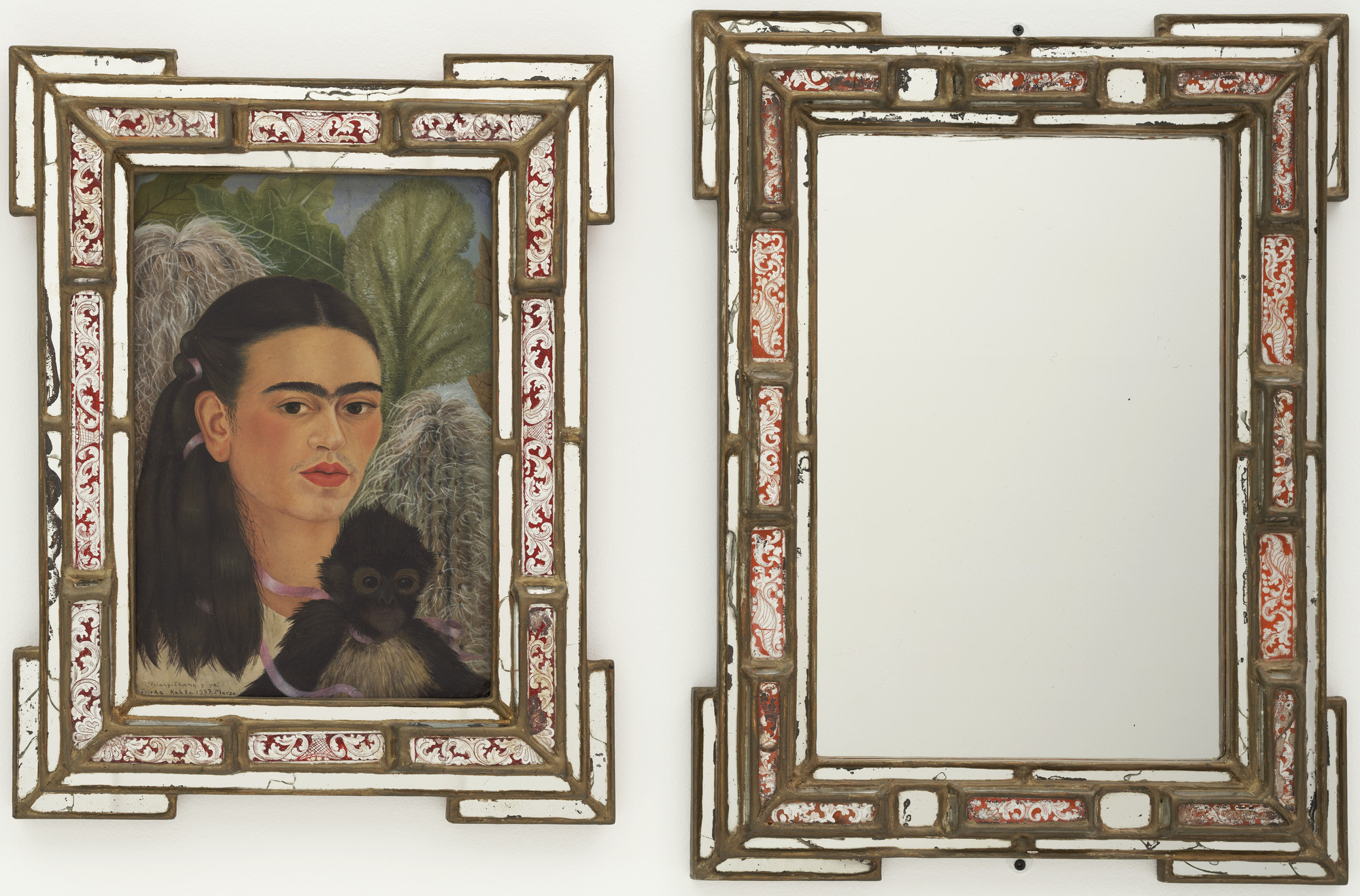
Curator, Caitlin Ryan: When I look at this work, it makes me wonder about relationships. Why is Kahlo painting herself with the monkey? Why are they seemingly connected via this silk pink ribbon? And when I look at the mirror that was added later, it only adds to this layer of relationships.
Within Kahlo's larger painting practice, animals often serve as stand-ins for her biography. The monkey that appears as her companion is Fulang-Chang, the spider monkey that Kahlo kept as a pet. And something which scholars have interpreted as a surrogate for the children that she and her husband, the painter Diego Rivera, were unable to have.
On the right side of this work, you see a mirror. Mirrors were central to Kahlo's process. Early in her life, after a severe bus accident, Kahlo was recovering in bed, and she fastened a mirror to the canopy of the bed so that she could paint.
This mirror was added after Kahlo decided to gift the painting to her close friend, telling her that the mirror was so that they could always be together. The mirror lets the viewer see themselves in relation to Kahlo, turning the painting from something static into something interactive.