Not on view
In 1938, André Breton, the leader of the Surrealist movement, met Kahlo during a visit to Mexico City. He described Kahlo’s work as Surrealist, particularly because of its entanglement with her dreams. But, when asked about it, Kahlo responded: “I never painted dreams. I painted my own reality.” This painting—with an intricately detailed pink ribbon connecting Kahlo and her pet monkey, Fulang-Chang—offers an imaginative view of the real. The artist later paired the self-portrait with a mirror, a tool she also often used to alter and extend her field of vision while painting.
517: A Surreal Lens, 2025
Kids label from 517: Surrealist Objects , 2025
What’s your favorite animal?
Frida Kahlo kept spider monkeys as pets. She named the one in the painting Fulang-Chang. The artist might have painted the pink ribbon connecting them to show how close she felt to her monkey.
What animal would you want to include in a painting? How would you show how you feel about that animal?
517: Surrealist Objects, 2025
Explore more
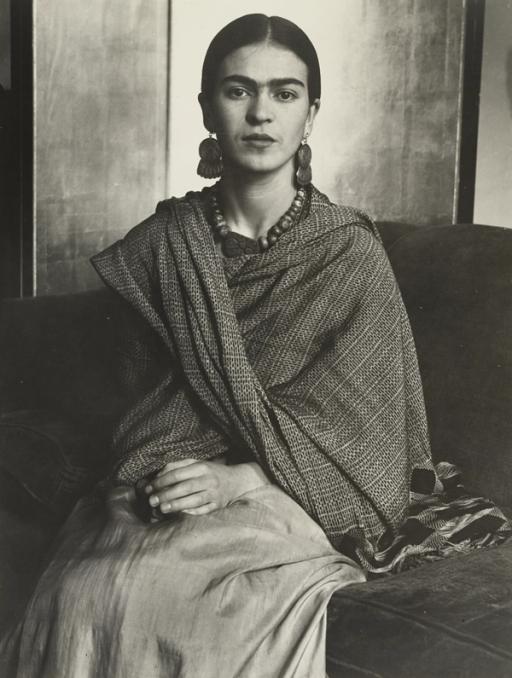
Frida Kahlo
Mexican, 1907–1954 3 works onlineFrida Kahlo began to paint in 1925, while recovering from a near-fatal bus accident that devastated her body and marked the beginning of lifelong physical ordeals.
Learn more →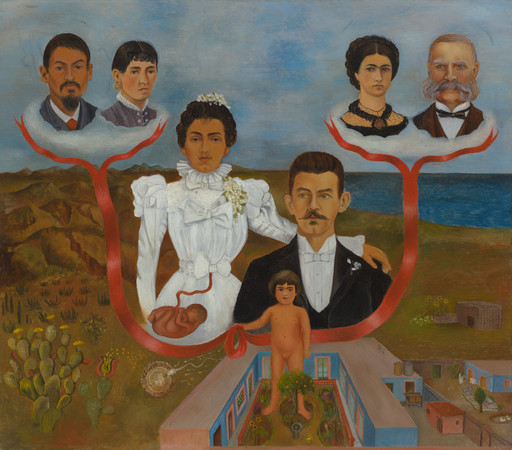
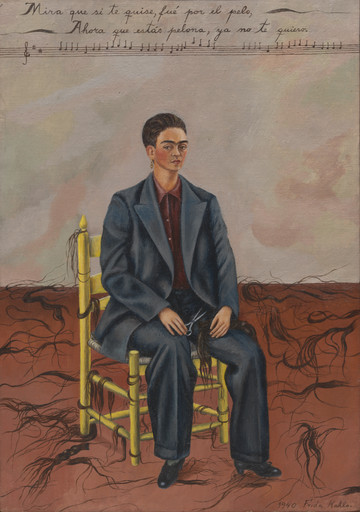

Audio
Audio from the playlist Collection 1880s–1940s
From MoMA Design Store


Installation views
We have identified this work in the following photos from our exhibition history.
Licensing
Artwork or archival images
If you would like to reproduce an image of a work of art in MoMA's collection, or an image of a MoMA publication or archival material (including installation views, checklists, and press releases), please contact Art Resource (publication in North America) or Scala Archives (publication in all other geographic locations).
Audio and film clips
MoMA licenses archival audio and select out of copyright film clips from our film collection. At this time, MoMA produced video cannot be licensed by MoMA/Scala. All requests to license archival audio or out of copyright film clips should be addressed to Scala Archives at [email protected]. Motion picture film stills cannot be licensed by MoMA/Scala. For access to motion picture film stills for research purposes, please contact the Film Study Center at [email protected]. For more information about film loans and our Circulating Film and Video Library, please visit Circulating Film and Video Library.
Text from a publication or the archives
If you would like to reproduce text from a MoMA publication, please email [email protected]. If you would like to publish text from MoMA's archival materials, please fill out this permission form and send to [email protected].
Feedback
This record is a work in progress. If you have additional information or spotted an error, please fill out this feedback form.