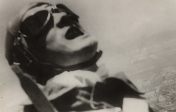
Front / Recto
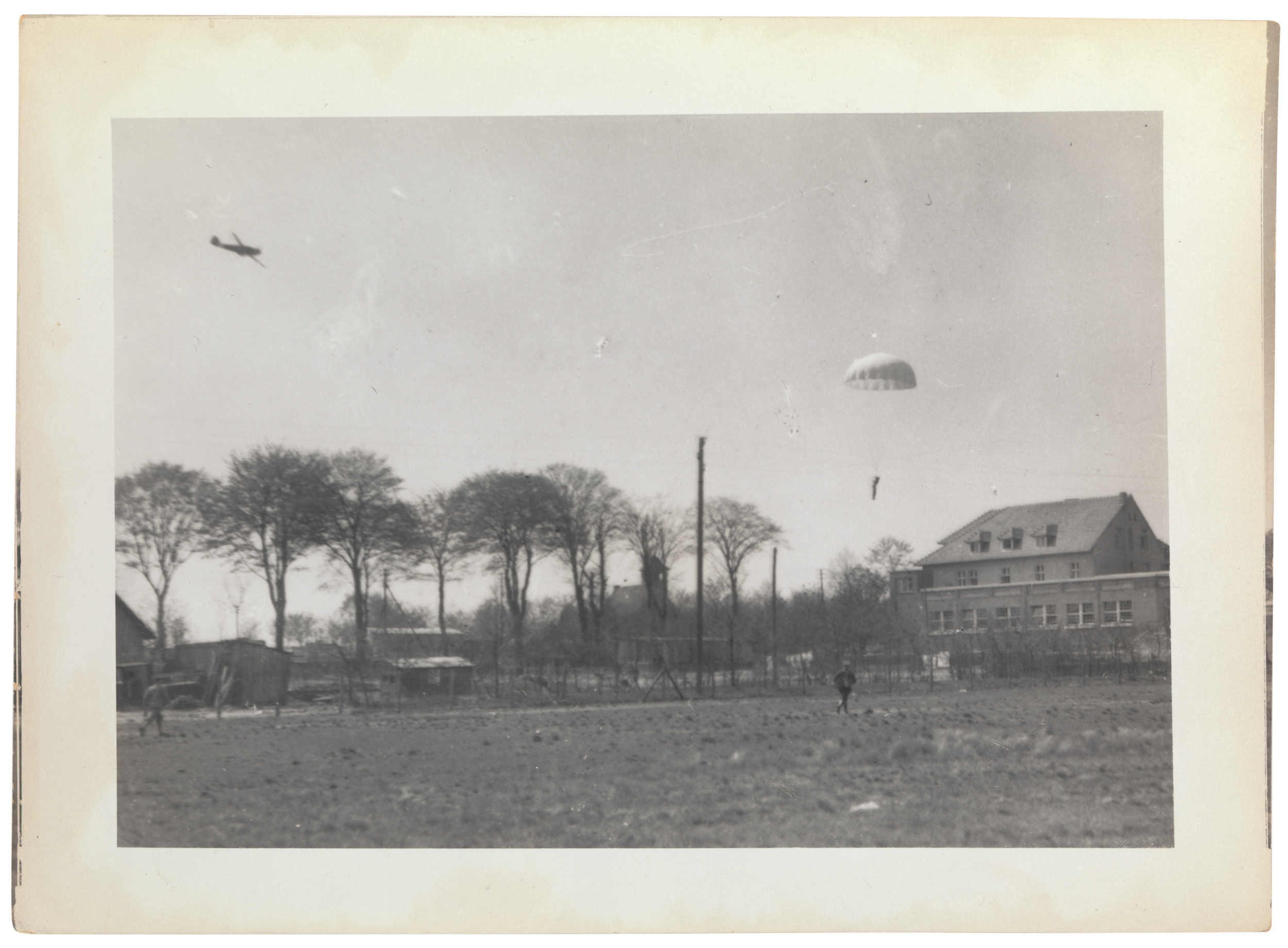
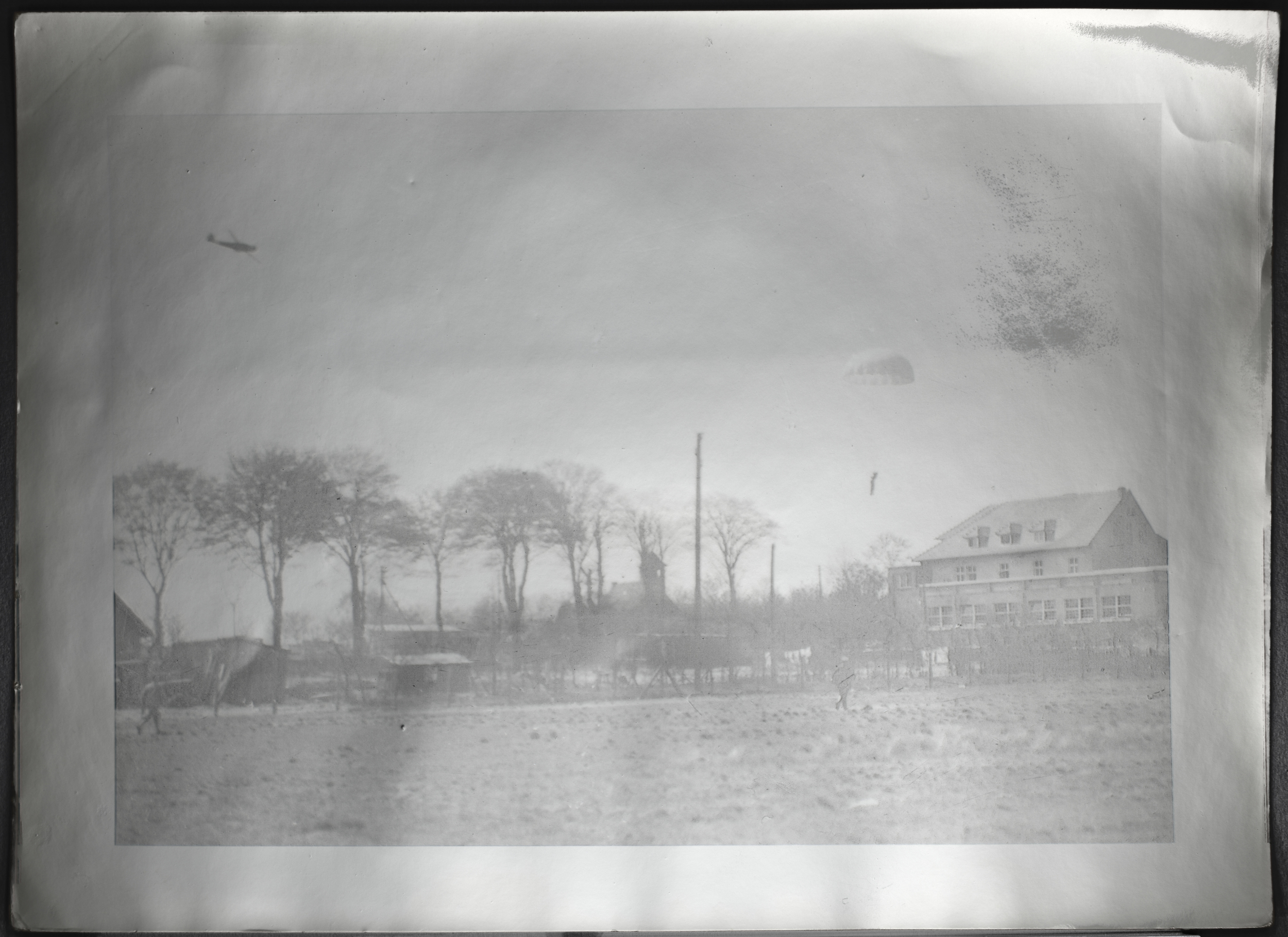
- Title The Dangerous Situation above the High-Voltage Lines . . . from the series I Photograph Myself during a Parachute Jump (Ich fotografiere mich beim Absturz mit dem Fallschirm) (Die gefährliche Situation über der Hochspannungsleitung . . .)
- Negative Date 1931
- Print Date 1931
- Medium Gelatin silver print
- Dimensions Image 5 9/16 × 8 1/16" (14.2 × 20.5 cm)Sheet 6 15/16 × 9 5/8" (17.7 × 24.4 cm)
- Place Taken Berlin
- Credit Line Thomas Walther Collection. Gift of Thomas Walther
- MoMA Accession Number 1849.2001.12
Back / Verso
- Mount Type No mount
-
Marks and Inscriptions
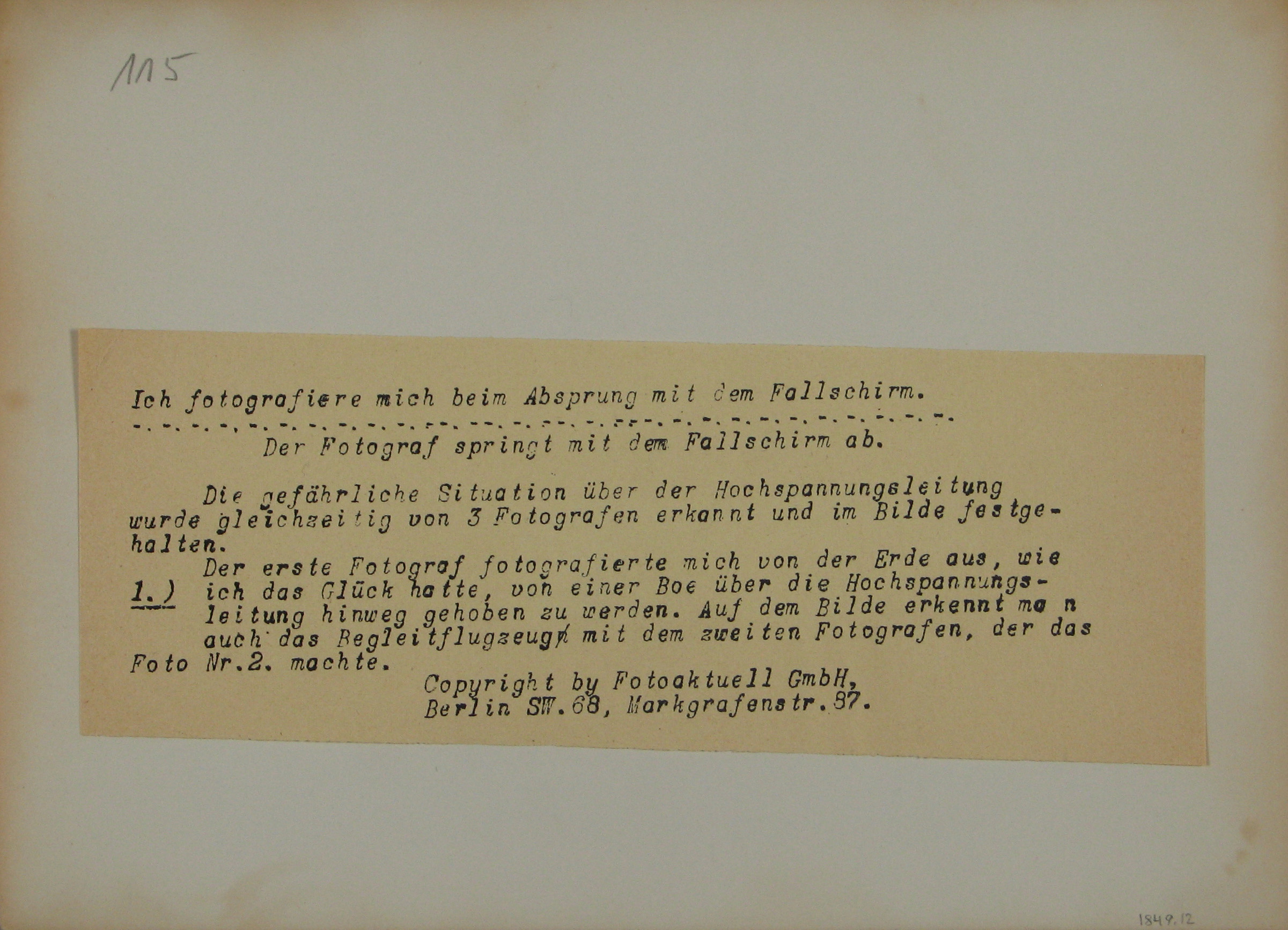
Inscribed in pencil on sheet verso, top left: 115. Label affixed to sheet verso, center, with text printed in black ink: Ich fotografiere mich beim Absturz mit dem Fallschirm./Der Fotograf springt mit dem Fallschirm ab./Die gefährliche Situation über der Hochspannungsleitung/wurde gleichzeitig von 3 Fotografen erkannt und im Bilde festge-/halten./1. Der erste Fotograf fotografierte mich von der Erde aus, wie/ich das Glück hatte, von einer Boe über die Hochspannungs-/leitung hinweg gehoben zu werden. Auf dem Bilde erkennt man/auch das Begleitflugzeug mit dem zweiten Fotografen, der das/Foto Nr. 2. machte [1]./Copyright by Fotoaktuell GmbH./Berlin SW. 68, Markgrafenstr. 87.
[1] "I photograph myself during a parachute jump. The photographer jumps with a parachute. The dangerous situation above the high-voltage lines/was recognized simultaneously by 3 photographers and captured in pictures. 1. The first photographer photographed me from the ground as I was fortunate enough to be lifted away from the power lines by a gust of air. In the picture you can also see the accompanying plane with the second photographer, who took photo no. 2."
-
Provenance
The artist, Berlin; to Vertrieb für Pressephotos (Christoph Netzle), Zurich, probably 1931 [1]; to Freudenberg GmbH (Hans Guggenbühl and Guido A. Pozzi), after 1930 and possibly in summer 1945 [2]; to Internationale Bilderagentur (Dr. Heinz Müller), Oberengstringen, Switzerland, 1945–47 [3]; to Dr. Roland Müller, Brugg, Switzerland, possibly February 1971 [4]; sold through Christie's New York (sale 8982, lot 272) to Michael Shapiro Gallery, San Francisco, October 6, 1998 [5]; purchased by Thomas Walther, 1998 [6]; given to The Museum of Modern Art, New York, 2001.
[1] Roland Müller, e-mail to Simon Bieling, April 16, 2005.
[2] Ibid. This series was acquired in a lot comprising one to two hundred thousand photographs.
[3] Ibid.
[4] Ibid.
[5] MacGill/Walther 2001(4), p. 12; and Shapiro Gallery invoice no. 98-158, October 9, 1998. The series was purchased from Christie's by the gallery on behalf of Thomas Walther.
[6] Shapiro invoice.
Surface
- Surface Sheen Glossy
- Techniques Ferrotyping Copy print
- PTM
-
Micro-raking
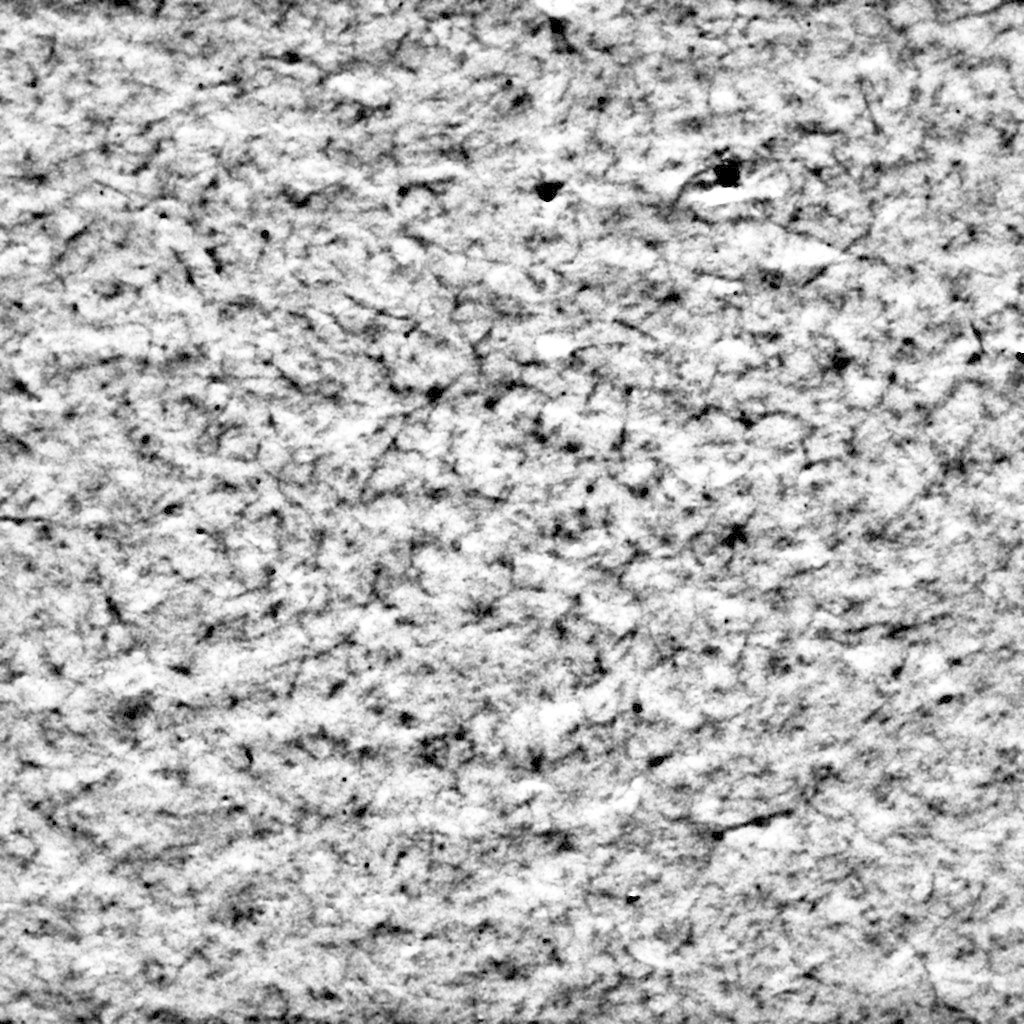
Raking-light close-up image, as shot. Area of detail is 6.7 x 6.7 mm. Department of Conservation, MoMARaking-light close-up image, processed. Processing included removal of color, equalization of the histogram, and sharpening, all designed to enhance visual comparison. Department of Conservation, MoMA
Paper Material
- Format Metric
- Weight Single weight
- Thickness (mm) 0.18
- UV Fluorescence Recto negative Verso negative
- Fiber Analysis Softwood bleached sulfite 12% Rag 79% Bast 9%
- Material Techniques Developing-out paper
-
XRF
This work was determined to be a gelatin silver print via X-ray fluorescence (XRF) spectrometry.
The following elements have been positively identified in the work, through XRF readings taken from its recto and verso (or from the mount, where the verso was not accessible):
- Recto: P, S, Ca, Zn, Sr, Ag, Ba
- Verso: Al, Si, S, K, Ca, Zn, Sr, Ag, Ba
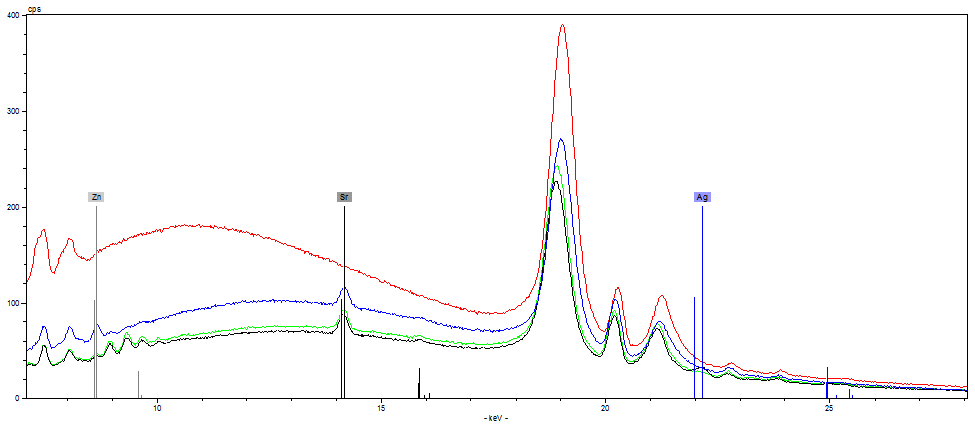
The graphs below show XRF spectra for three areas on the print: two of the recto—from areas of maximum and minimum image density (Dmax and Dmin)—and one of the verso or mount. The background spectrum represents the contribution of the XRF instrument itself. The first graph shows elements identified through the presence of their characteristic peaks in the lower energy range (0 to 8 keV). The second graph shows elements identified through the presence of their characteristic peaks in the higher energy range (8 to 40 keV).
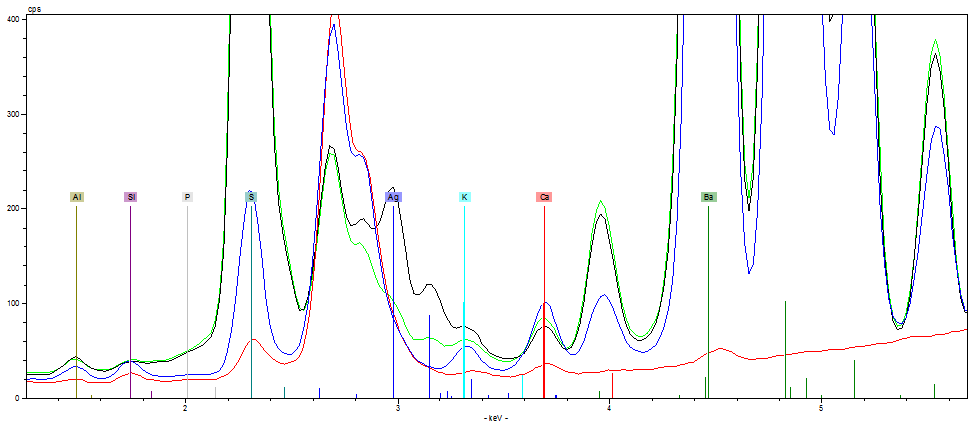
Areas examined: Recto (Dmax: black; Dmin: green), Verso or Mount (blue), Background (red)
Elements identified: Al, Si, P, S, K, Ca, Ag, Ba
In Context
Related People
-
Artist
Related Links
- Cultural Hubs Berlin