PHOTOGRAPHVIEW ALL

Jindřich Štyrský
Untitled, from On the Needles of These Days (Na jehlách těchto dní ) (1945)
1934–35
Gelatin silver print
Print Date 1934–55
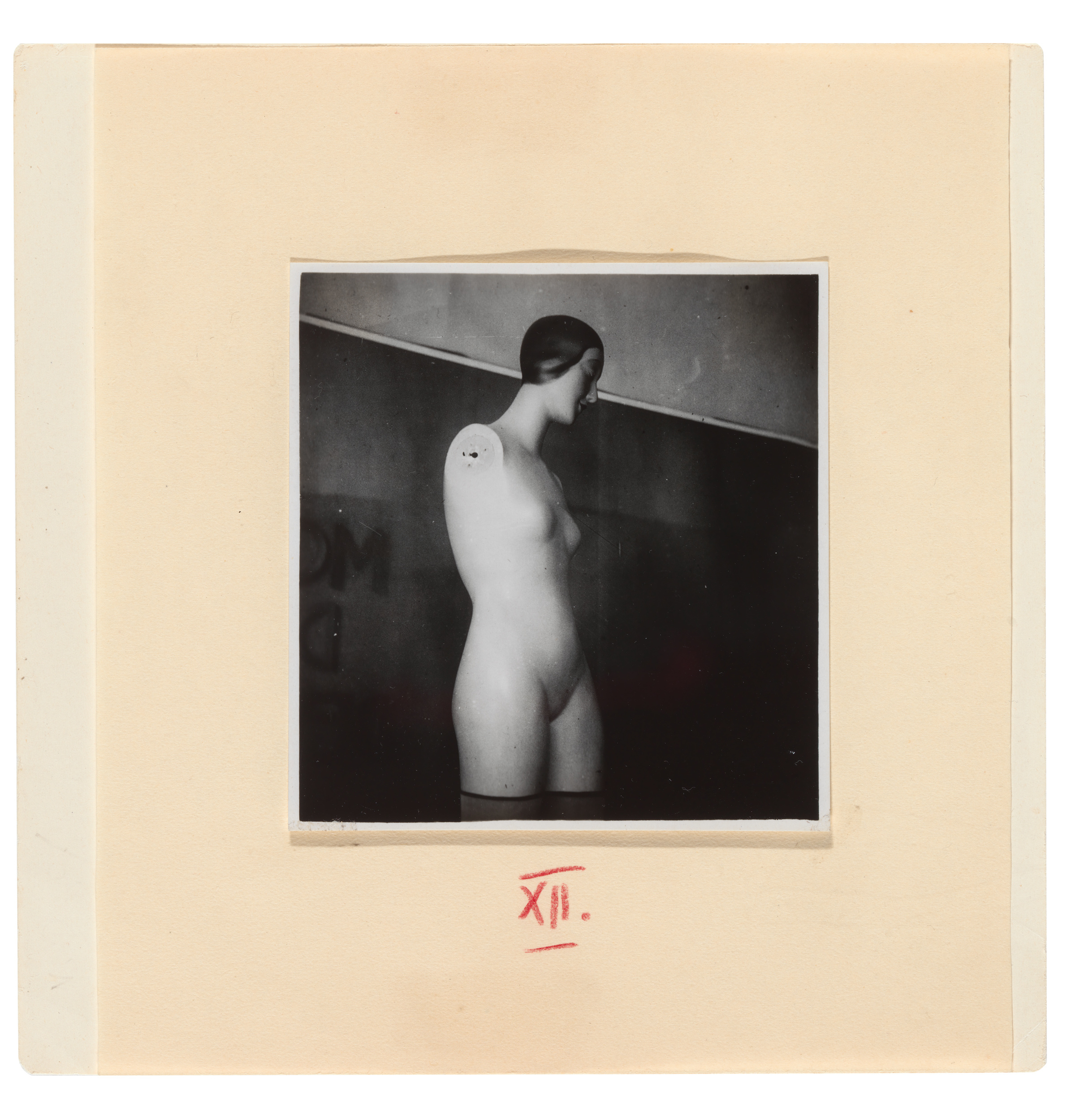
In the early years of the twentieth century, with the step-up in production of factory-made off-the-rack clothing, shops were looking for ways to attract new customers. Mannequins with lifelike faces, anatomically accurate torsos, and interchangeable limbs replaced the headless, featureless wire cages of old dressmaker’s forms. Photographers seized upon the new mannequins, immediately seeing their potential as human analogues: their frozen expressions and gestures mimicked real emotion but were obviously artificial, giving them uncanny life and gratuitous, ready-made irony. One of the first to avail himself of the mannequin’s magic was Eugène Atget, whose photographs were published by the Surrealists. Atget’s mannequin photographs also appeared in the exhibition Film und Foto in Stuttgart in 1929 and in Atget: Photographe de Paris, a widely distributed monograph—the first such study of a modern photographer—simultaneously published in three cities in 1930. Among the artists thus introduced to the mannequin motif was the sensitive Czech avant-garde poet, photographer, editor, painter, and collagist Jindřich Štyrský.
Štyrský became friendly with André Breton, Paul Eluard, and other Surrealist artists and writers in Paris in the years between 1925 and 1928. Like them, he was especially drawn to the bizarre, erotic, and morbid and to the symbolic forms in which they appeared in popular culture. Štyrský trawled the streets of Paris and Prague, looking for such subjects and finding, among others, a fortune-teller’s sign reading “Human Life in Pictures”; a music box; caskets; moldering cupids; artificial limbs; and other treasures of flea markets, sideshows, and window displays. He rarely presented these loaded objects in their entirety, but rather, moving in close, he cropped them into little picture poems. Štyrský contact printed his negatives through a paper mask to straighten and crop them, then arranged his photographs in series: Frog Man, Man with Blinkers, and Paris Afternoon.
In 1941 Štyrský published a clandestine edition of On the Needles of These Days (Na jehlách těchto dní), a book of photographs in which the images were accompanied by Jindřich Heisler’s poems. Because there were many arrests and deportations of Jews in Nazi-occupied Czechoslovakia, for the four years of the war Štyrský and his partner, the artist Toyen, sheltered Heisler, who was Jewish, in their bathroom. Their collaboration was therefore an underground activity. This print of a mannequin in the window of a Prague shop comes from a maquette for the book. It is mounted with adhesive at the top two corners to a folded folio of cream-Toned, textured paper with “XII” written in red pencil directly beneath the image and “12” in green pencil on the verso of the print. The hand-edited, black printed text for the previous spread (“XI”) appears on the verso of the folio. [1] Later published, in 1945, as a book with gravure plates, the original edition with tipped-in photographs was handmade, extremely limited, and, because of the war, of low production quality. However, the very fact of the publication’s dire existence, the apt pairing of two talents, and their brooding, poignant work, at times lyrical but more often oblique, resonates. Although Štyrský had made another photograph of this mannequin, his Venus of Prague, when she was partially clothed and surrounded by the city reflected in the store window (à la Atget), he chose this naked version for the book. By editing context from the image, Štyrský brought to the fore the isolated and mutilated condition of life in Europe or, as Heisler wrote, the starkness of “her eternal misery.”
—Maria Morris Hambourg, Hanako Murata
[1] The maquette is no longer intact. In addition to this print The Museum of Modern Art has one other, and several more are in the collection of the Museum of Fine Arts, Houston.
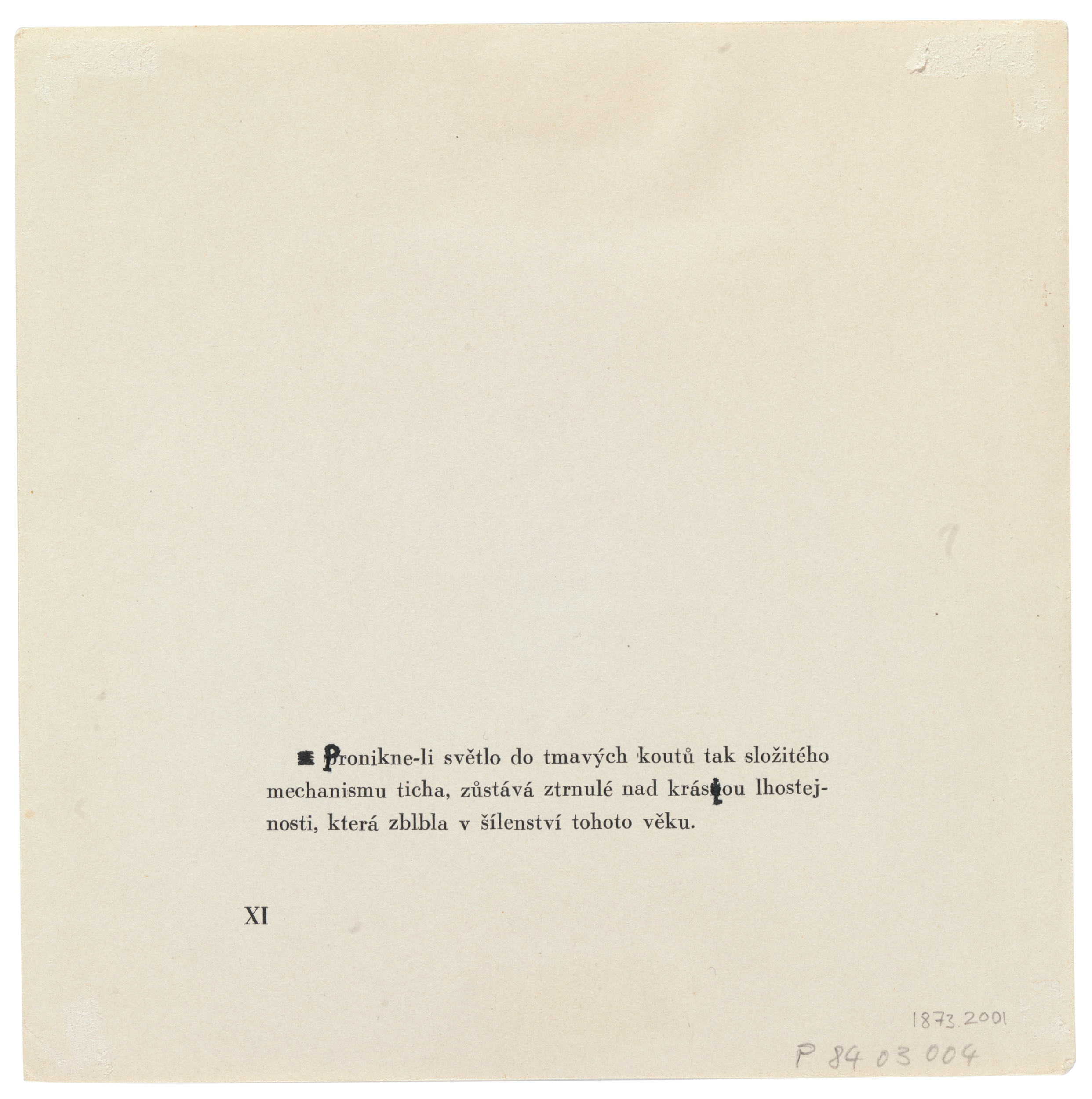
Inscribed in red pencil on small mount recto, bottom center: XII. Inscribed in green pencil on sheet verso, center: 12. Printed in black ink on large mount verso, bottom center: Pronikne-li světlo do tmavých koutů tak složitého/mechanismu ticha, zůstává ztrnulé nad krásou lhostej-/nosti, která zblbla v šílenství tohoto věku. Inscribed in pencil on large mount verso, bottom right: P 84 03 004.
[1] "If light penetrates into the dark corners of such a complicated mechanism of silence, it remains frozen above the beauty of indifference, which went bonkers in the madness of the present age."
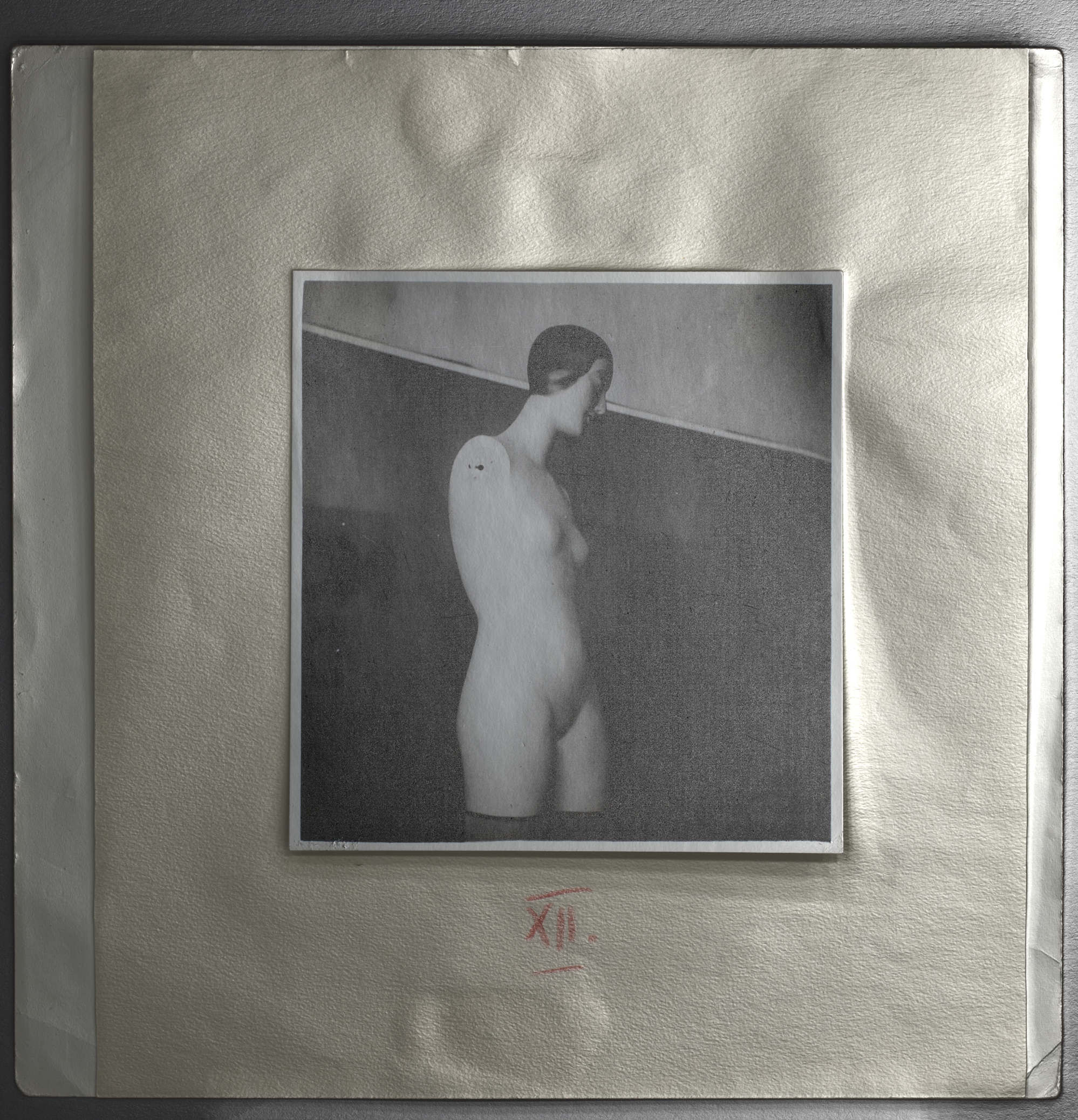

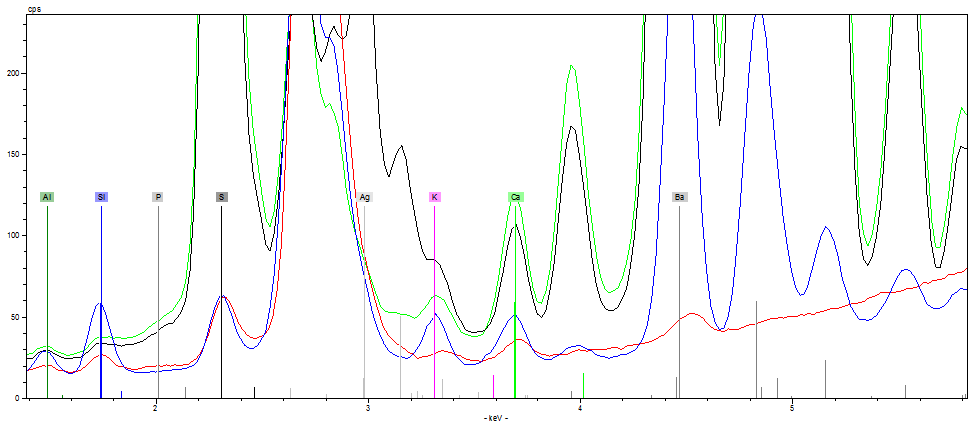
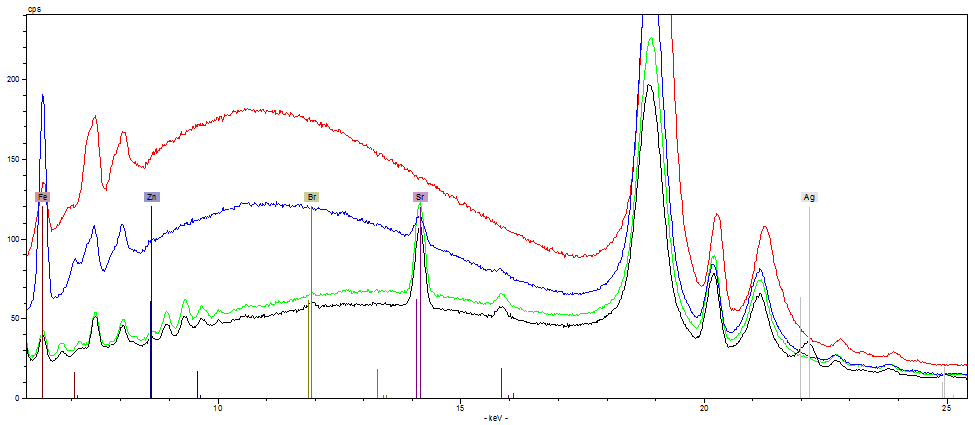
This work was determined to be a gelatin silver print via X-ray fluorescence (XRF) spectrometry.
The following elements have been positively identified in the work, through XRF readings taken from its recto and verso (or from the mount, where the verso was not accessible):
The graphs below show XRF spectra for three areas on the print: two of the recto—from areas of maximum and minimum image density (Dmax and Dmin)—and one of the verso or mount. The background spectrum represents the contribution of the XRF instrument itself. The first graph shows elements identified through the presence of their characteristic peaks in the lower energy range (0 to 8 keV). The second graph shows elements identified through the presence of their characteristic peaks in the higher energy range (8 to 40 keV).
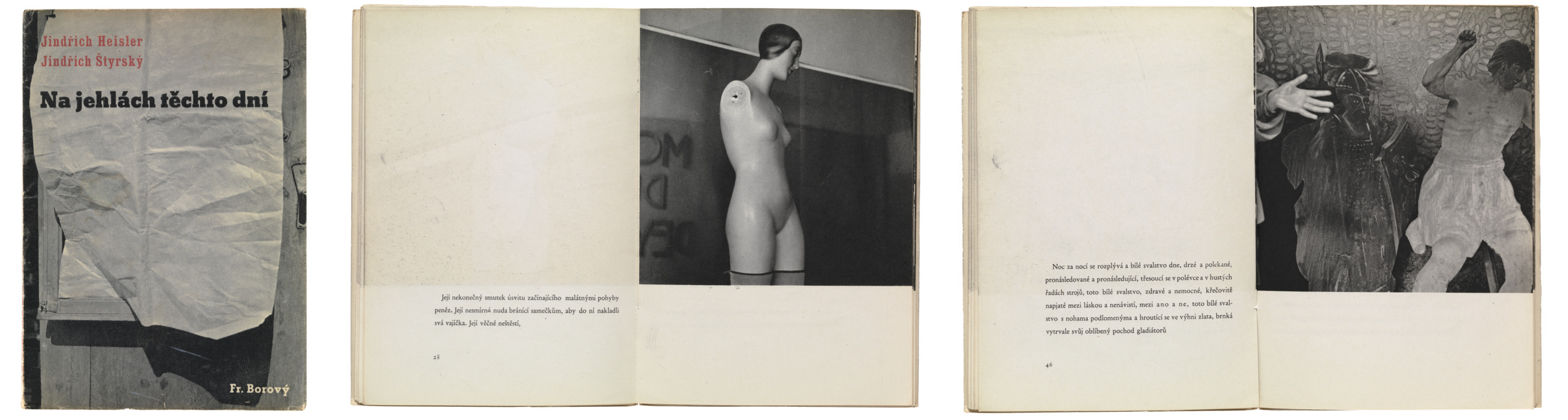
Heisler, Jindřich, and Jindřich Štyrský. Na jehlách těchto dní, p. 29 (as untitled photograph). Prague: Fr. Borový, 1945.
