This week’s roundup highlights live music and summer vibes. Don’t miss out!


Warm Up 2016: Week 3 Highlights
This Saturday we are thrilled to host Theo Parrish, a pillar of Detroit’s house/techno scene for over 20 years. Before Theo plays, we are very excited to hear: Detroit’s mysterious techno master DJ Stingray, the genre-bending sounds of Cologne-based DJ/producer Lena Willikens, and a set from New York-based Japanese writer/artist/DJ Kiki Kudo.
June 28, 2016
|
Intern Chronicles
Expanding Avant-Gardes: Toyen and the Prague Interwar Art Scene
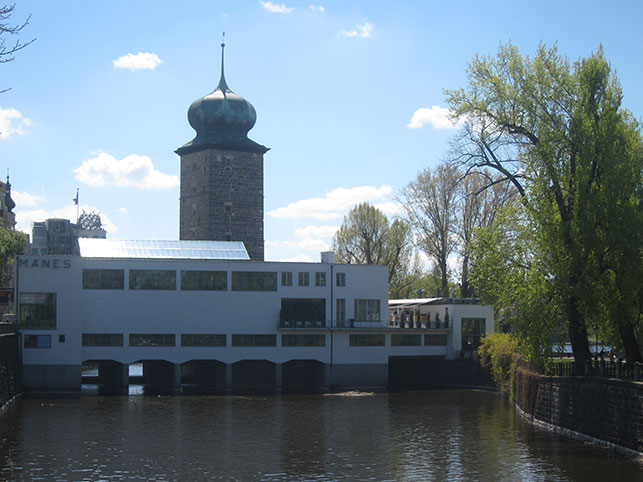
Mánes Exhibition Hall (Výstavní síň Mánes), Prague. Photo: Anna Blaha
Mánes Exhibition Hall rests above Prague’s Vltava River, connecting the city to a small island. While many art collections in the Czech Republic are currently housed in repurposed homes, churches, and even mills, this functionalist building was erected in 1930 specifically to exhibit recent art. One of the first shows in this space, Poesie 1932, presented the people of Prague with their first major exhibition of the Surrealist movement in Europe.
June 27, 2016
|
This Week at MoMA
This Week at MoMA: June 27–July 4
As we head into the week, our sights are set on the fourth of July. If you’re not heading out of the city to the nearest beach, here the lineup of what’s happening at MoMA:
Warm Up 2016: Week 2 Highlights
Last week, we were lucky to host a disco-heavy dance party! After DJ Guiddo and Kento Slash Demon opened the show, we had the pleasure of witnessing the genius of Danny Krivit, Nancy Whang’s lively and ecclectic set, and a riveting live performance by MHD.
June 22, 2016
|
Intern Chronicles
In Search of MoMA’s “Lost” History: Uncovering Efforts to Rescue Artists and Their Patrons
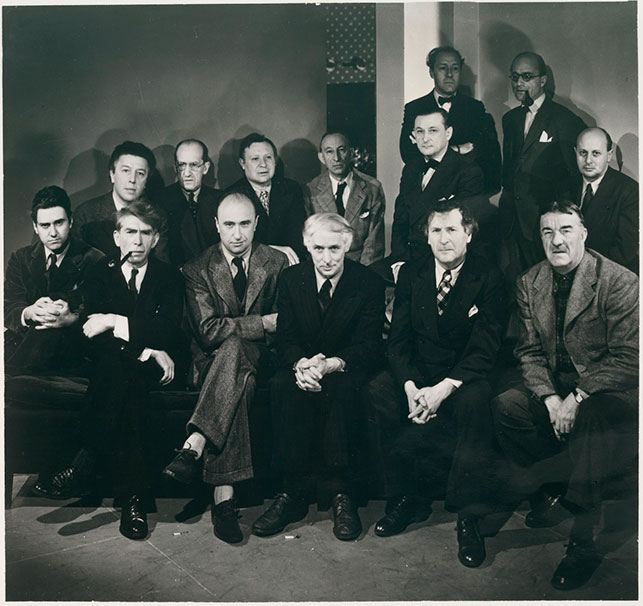
Photograph taken on the occasion of the exhibition Artists in Exile, Pierre Matisse Gallery, New York, March 1942. First row, left to right: Matta Echaurren, Ossip Zadkine, Yves Tanguy, Max Ernst, Marc Chagall, Fernand Léger; second row: André Breton, Piet Mondrian, André Masson, Amédee Ozenfant, Jacques Lipchitz, Pavel Tchelitchew, Kurt Seligmann, Eugene Berman. A number of these artists were aided by the Museum. Photo: George Platt Lynes. Photographic Archive. The Museum of Modern Art Archives, New York
During WWII, The Museum of Modern Art played an integral role in assisting artists, art historians, dealers, and their immediate families in escaping from Europe to America. After the fall of Paris to the Nazis in June 1940 the Museum began to receive numerous requests for help to flee to the U.S.
June 20, 2016
|
This Week at MoMA
This Week at MoMA: June 20–26
Deep explorations and journeys are a theme this week. Check out these highlights:
June 17, 2016
|
Do You Know Your MoMA?
Do You Know Your MoMA? 6/17/16
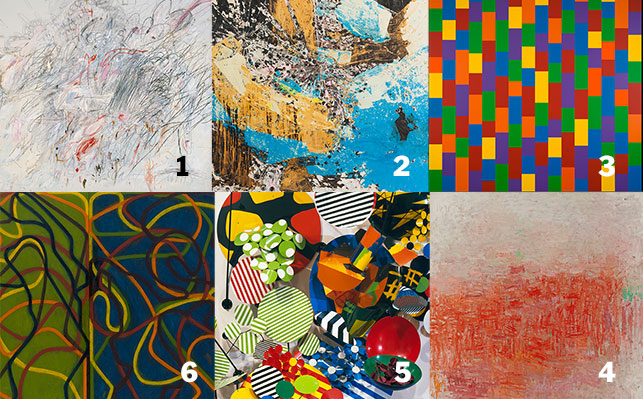
How well do you know your MoMA? If you think you can identify the artist and title of these works from MoMA’s collection—all currently on view in the Museum—please submit your answers by leaving a comment on this post. We’ll provide the answers next month (on Friday, July 15).
Warm Up 2016: Week 1 Highlights
This Saturday we are excited to host Danny Krivit, one of the most admired disco DJs in the world!
June 16, 2016
|
Collection & Exhibitions
MoMA Teens x Dadaglobe Reconstructed
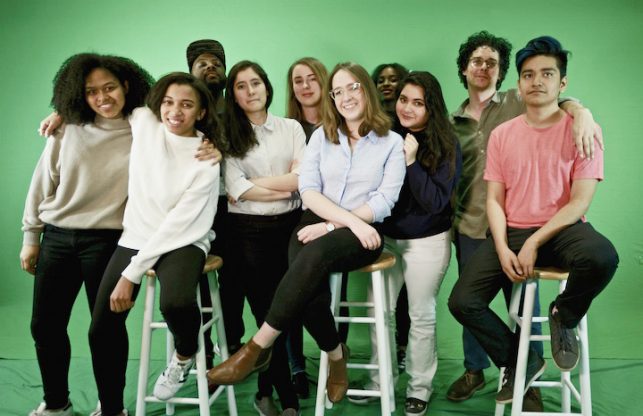
Jo-Anne (far left) and the 2016 Digital Advisory Board
Last fall I was invited back to MoMA for another unique opportunity to work with the Department of Education’s Teen Programs. Initially, I was shocked—after doing an In the Making class in the summer of 2014 and being part of the incredible Cross Museum Collective the following year, I figured I had reached the apex of my involvement here. But of course MoMA, in all its mystifying generosity, had something else to offer: a position on the Digital Advisory Board. I knew little about what I would be doing, but the chance to be part of MoMA Teens again was something I couldn’t resist. I eagerly accepted. Arriving at the first meeting, I was delighted to see the familiar faces of my friends from the past two years, and together we all jumped down the rabbit hole.
We learned we’d be taking over all of MoMA Teens’ social media pages, posting content to Tumblr, Instagram, and Facebook to our heart’s content. It was exciting and new, being able to work on such a large platform and essentially represent the “Artistic Teen of the Modern Age,” and I was ecstatic. Yet, as the weeks carried on, there was something more hinted at by our MoMA leaders Calder and Ali, something that, as far as the history of the Digital Advisory Board went, hadn’t been done before. And then, we met Samantha Friedman, an assistant curator in the Department of Drawings and Prints, who introduced us to Dadaglobe.
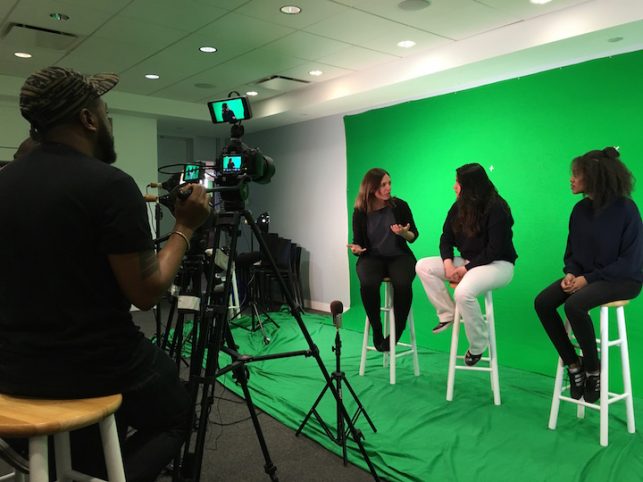
Behind the scenes of the DAB x Samantha Friedman interview
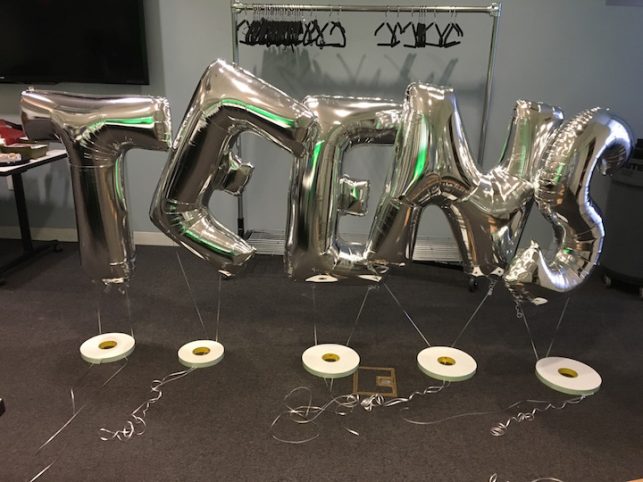
Teens in balloons, waiting to be filmed for the video intro…
Dadaglobe, in the simplest terms, was manqué: something that could have been, but never was. A scattered relic lost essentially forever in time, Dadaglobe was a failed attempt in 1921 to bring together the movement of Dada, an operation that was already global and disjointed, into a published anthology. The aim, however, was not to formalize and sanction Dada into concrete terms, but to coalesce and embody, to provide a glimpse of an explosive campaign at its peak. Its mastermind and architect was Tristan Tzara, a well-known poet and a co-founder of Dada. Through a series of solicitation letters, he garnered the attention of artists from 10 countries, instructing them to carry out four different requests: 1) “send a clear photo of your head (not body), which you can alter freely, although it should retain clarity” 2) send “2 or 3 photos of your works,” 3) send “3 or 4 black-and-white drawings. . . . one drawing can be colorful, but containing no more than 2 to 3 colors,” and 4) if not sending a drawing, then “design a book page with or without text.”
The responses were nothing short of extraordinary. Drawings, collages, and photographs poured in, all ranging from straightforward executions of the instructions to complete defiance (it was Dada, after all). Samantha told us of one self-portrait sent by Dutch artist Theo van Doesburg (in the guise of his alter ego I.K. Bonset), who instead of sending a distinct photograph of his face, sent an image of the back of his head, with an adorning halo of text reading Je suis contre tout et tous—”I am against everything and everyone.” It was utterly and entirely Dada, and I completely fell in love. Learning of Dadaglobe for the first time, discovering this trove of works belonging to a movement I was already thoroughly enamored with, made me feel like a kid in a candy store with an empty stomach and an endless budget. Putting all my childlike glee aside, I knew that we weren’t given a presentation of Dadaglobe simply because it was a neat piece of lost art history; our new roles as Digital Advisory Board members would finally be set in motion.
As MoMA prepared to open its exhibition Dadaglobe Reconstructed on June 12, which reunites over 100 works made for the publication, we discovered that those of us on the Digital Advisory Board would be working together to construct our own homage to Dadaglobe. Following Tzara’s original instructions, we were asked to create works of art in the unbridled spirit of Dada to be published in conjunction with the exhibition. It was exciting news, no doubt, but presented a challenge. How could we adapt and recreate something that was born and functioned to reject the specific principles of a society torn apart by war, under circumstances that no longer existed today? How could we faithfully translate the temperament of Dada to reflect the 21st century? There were no clear answers, but we approached it the only way we could: head on.
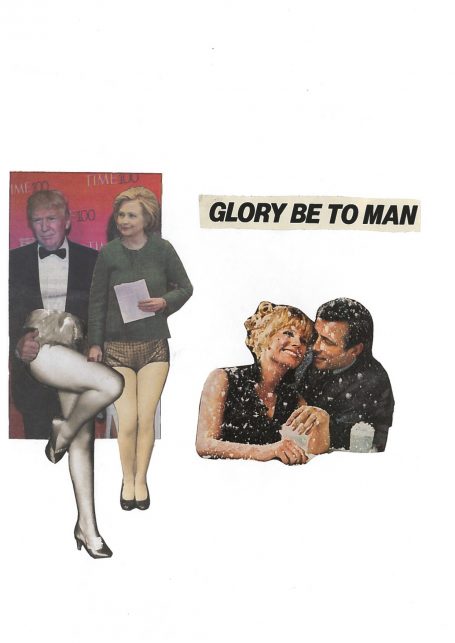
Jo-Anne’s page layout
We began with layouts for book pages. Naturally, there were no rules to what or how we could make, only to create how we saw fit. I have to admit I struggled at first; my mind was saturated with ideas and images, but materializing them with the clever subtleties that seemed to come naturally to the Dadaists was something I thought I wasn’t capable of. Looking back, I can say it never really mattered anyways. I wanted to introduce the tangible social elements of living in 2016, and bring attention to them through mockery and jest. For one collage, I decided to take a picture of Donald Trump with his wife, cover her with a picture of Hillary Clinton to pose them as a rather stylish couple, and replace their lower halves with poised, feminine legs. My motivation was not so much to demean or emasculate either presidential candidate, but really because the idea made me laugh. I tend to think that laughter is the best way to cope with the absurd current events of our time.
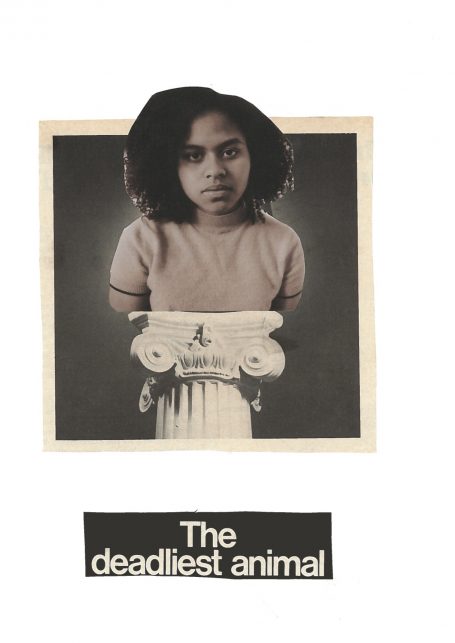
Jo-Anne’s Dadaglobe-inspired self portrait
Self-portraits were next. There was lots of inspiration to draw from concerning the actual submissions for Dadaglobe: van Doesburg and the unapologetically defiant back of his head, artists like Johannes Theodor Baargeld and Max Ernst who pasted their own faces onto and next to other cut-out images, or Francis Picabia, who, for one part of his submission, simply signed his name on a piece of paper. I decided to keep my face unobscured, however. Under normal circumstances, the concept of my face being mass printed would have horrified me, but I saw the call for self-portraits as something more than a vehicle for identification. I wanted to recontextualize myself in a space where I could see myself objectively, as a collection of lines and arrangements of color rather than a person onto which judgements and prejudice could be cast.
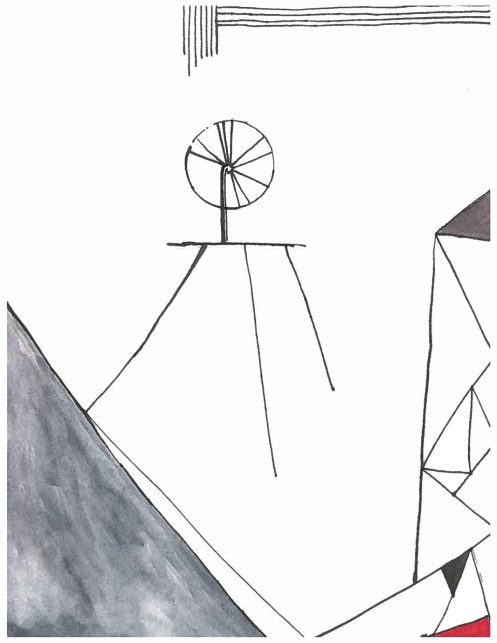
A drawing by Jo-Anne, inspired by both Dadaglobe as well as Duchamp’s Bicycle Wheel
We then moved onto original drawings, for which we limited ourselves to traditional dip pens and black ink. There was something kind of wholly organic about creating the drawings, composing scenes only through stretching black lines and blocks of ink. I think all of us approached the drawings with a sense of assured confidence and lack of restraint; we simply let our hands speak for us. The works we made during that period we all distinctly different, yet distinctly ours.
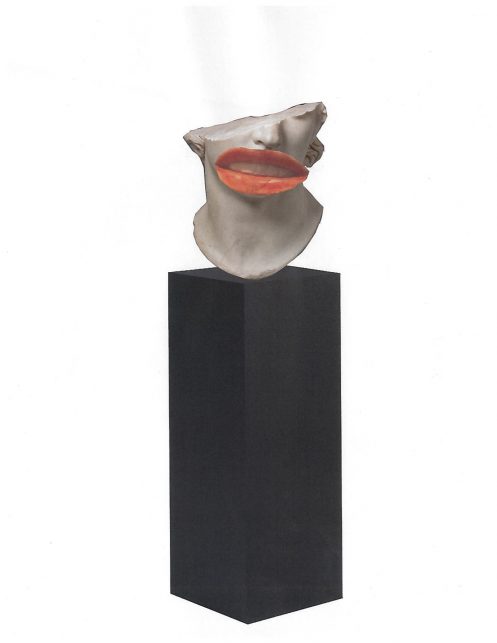
An image of an “artwork” that never existed
The only thing left was to create images of artworks, and here we were truly inspired by how playful the Dadaglobe artists were. The goal, it seemed, was not to capture an artwork accurately with a camera, but to explore how the photographic process and reproduction could manipulate how drawings, collages, or random objects were perceived. For example, one piece I especially enjoyed was a submission by Man Ray, who photographed a random and essentially meaningless concrete and wood structure in an empty lot, and called it La plus belle sculpture d’Amérique—the most beautiful sculpture in America. Using collage for this witty, almost mischievous purpose was a delight. Unlike our layouts for book pages, there wasn’t a particular or single message to convey, therefore we felt a kind of feeling of triumph in creating new works of art out of arbitrary images and fabricating meaning out of “nothing.”
But of course, it had to end. We had made dozens of Dada-esque works, consumed probably several pantry’s worth of snacks, and managed to bring what seemed like an impossible task into an awesome reality. It was hard, but incredibly rewarding work that allowed us to genuinely experience and partake in a small sliver of the art world. Dadaglobe Reconstructed is now open to the public, and for the first time the world will get to see Dada as the Dadaists sought to represent it.
I want to end on a quote expressed by Hugo Ball, a founding member of Dada: “For us, art is not an end in itself, but it is an opportunity for the true perception and criticism of the times we live in.” As the Digital Advisory Board, our objective was not to merely recreate Dadaglobe art for contemporary times, but to utilize the blunt, untainted lens of Dada to perceive those times—and perhaps even criticize them. For it seems as long as the Earth continues to turn, the timeless doctrine of Dada will always endure, illuminating our lives.
Dadaglobe Reconstructed is on view now through September 18, 2016. More info HERE. Special thanks to Jo-Anne Naarendorp and all of the 2016 Digital Advisory Board members: Jocelyn Aldaz, Ashley Aviles, Kevin Cruz, Cara Hernandez, Anatola Pabst, Oksana Pligina, and Yvonne Zagzag. Extra special thanks to Eva Kozanecka, Ali Santana, and Samantha Friedman. Follow @momateens on Instagram for more teen-created content.
If you are interested in reproducing images from The Museum of Modern Art web site, please visit the Image Permissions page (www.moma.org/permissions). For additional information about using content from MoMA.org, please visit About this Site (www.moma.org/site).
© Copyright 2016 The Museum of Modern Art
Welcome to MoMA.org. To take full advantage of all the site’s features, including the option to save works in the collection, please upgrade your browser to Firefox,
Google Chrome, Safari, or Internet Explorer 9.
See our help page for more information.
To take full advantage of all of the features on MoMA.org, please upgrade your browser to Firefox, Google Chrome,
Safari, or Internet Explorer 9.