
MoMA
Posts in ‘Tech’
May 10, 2010  |  Events & Programs, Tech
PopArt Wins a People’s Voice Webby Award!

Congratulations to the teens from the MoMA Teen Voices Project for their hard work on the website PopArt, which recently won a People’s Voice Webby in the Art category. The Teen Voices Project (formerly the Youth Advisory Council), a group of sixteen students from New York City high schools, collaborated with MoMA Staff to design the interactive site.
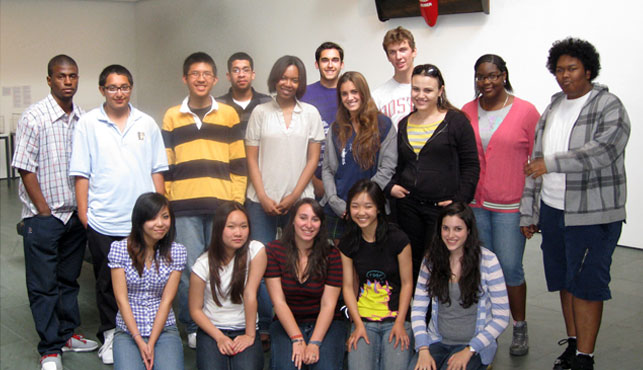
Participants from the 2009-10 Youth Advisory Council

Faced with the challenge of creating an educational resource that other teens could use to engage with MoMA, the team started by learning about and analyzing existing interactive educational activities, websites, and technology-based communication projects. After countless debates on the purpose of education, the coolest parts of MoMA, and strategies to make MoMA more accessible to teens, the team identified a vision for their project: to create an online tool for people of all ages to interact with and respond to modern art, to reveal unexpected connections between works of art, and to trust in their own “gut” feelings about art.
April 30, 2010  |  Artists, Collection & Exhibitions, Tech
Marina Abramović: A Gallery of Portraits

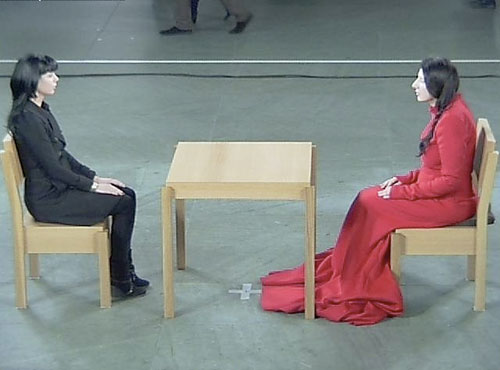
If you happen to witness—or, for the intrepid, participate in—Marina Abramović‘s new work The Artist Is Present, you may notice a well-equipped photographer quietly documenting each daily performance. The artist has asked photographer Marco Anelli to take portraits of every visitor who participates in the piece. The results, as you can see below and on the exhibition website, are captivating.

Check back frequently, as the images are updated regularly. At this point there are over eight hundred portraits!

</embed>

April 16, 2010  |  Tech
Notes from Museums and the Web
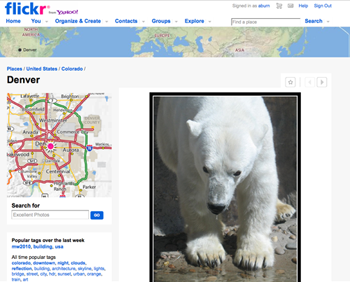
Denver Flickr page

Flickr page for images from Denver, CO

One of the great things about working in museums is the amount of information exchange there is with our fellow colleagues at other cultural institutions. While we all want our museum to be the best it can be (whether its an arts institution, history or social history museum, science museum, or other), there is also a real interest in sharing our experiences and learning from each other. Some of this dialogue takes place informally, one on one; other times it takes place at conferences. There are several museum-focused conferences, including AAM (the American Association of Museums), which is perhaps the largest; MCN (Museum Computer Network); and Museums and the Web. I am currently attending the Museums and the Web conference that is taking place this week in Denver, Colorado, along with Beth Harris and Lisa Mazzola, my colleagues in the Education Department.

April 2, 2010  |  Tech
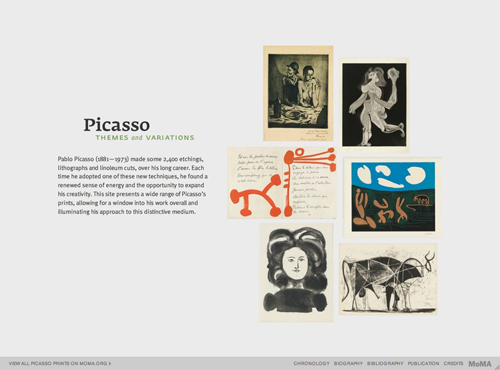
Prints and the Web—Introducing Picasso: Themes and Variations
Picasso Prints

Screenshot of the Picasso: Themes and Variations website

When you think about printmaking, the Web may not be the first thing that comes to mind. You may envision instead old etching presses, or heavy lithographic stones, or stacks of paper waiting to hit the press. But in fact, MoMA’s Prints Department has long been interested in using the Web as a way of sharing information: using animated, interactive multimedia components as a way to make the material come alive. Our online projects are all available on MoMA.org, from our earliest experiments all the way back in 1998 with Miró’s Black and Red Series

March 15, 2010  |  Collection & Exhibitions, Tech
Live-Streaming Marina Abramović: Crazy or Brave?

“We want to live-stream a silent woman, sitting still in a chair all day for three months.”—Paraphrased from a meeting a few weeks ago, followed by the sound of my hand hitting my forehead.

Screenshot from performance by Marina Abramović, MoMA, March 9, 2010

Screenshot from performance by Marina Abramović, MoMA, March 9, 2010

Working in a department that interfaces with the Internet (home of zany fun like Is This Art? and my new favorite site Selleck Waterfall Sandwich), you get used to hearing a lot of unusual ideas getting presented as Things We Need To Be Doing Right Away. I guess I should be used to it by now, since MoMA is a museum that has in its collection an alleged can of poop.

March 5, 2010  |  Tech
MoMA.org turns 1…and 15

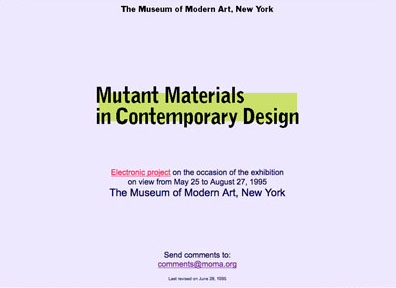
It was one year ago tomorrow that we launched the latest redesign of MoMA.org. (March 6 is a day that will be forever ingrained in the Digital Media team’s memory!) But MoMA has had an online presence for fifteen years now, since 1995, when an exhibition site for the design show Mutant Materials in Contemporary Design was developed. The following year, the Museum’s website, MoMA.org, officially launched, and we’ve been doing exhibition feature sites ever since (including our most recent one for William Kentridge: Five Themes).

Talk about a blast from the past. Here’s a look at MoMA.org through the ages:

Mutant Materials screenshot

Homepage of the Mutant Materials site, MoMA, 1995

February 19, 2010  |  Design, Tech
A Few Words with Legendary Web Designer Yugo Nakamura

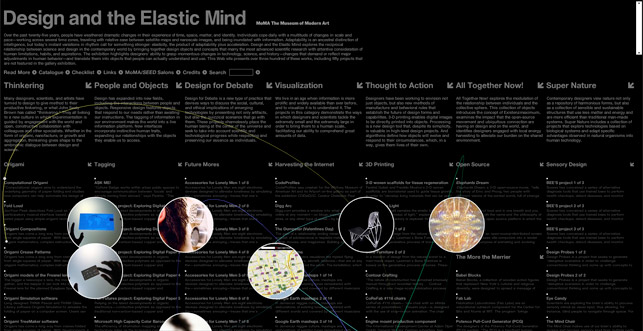
The Design and the Elastic Mind website

We initially suggested five design firms as candidates to design and build the Design and the Elastic Mind website. Paola Antonelli, the exhibition curator, had gone through around twenty links from three firms when we showed her Yugo Nakamura’s personal site, yugop.com. The simple white page that greeted us was immediately invaded by dark, two-dimensional cascading balls. We watched for a few minutes, mesmerized by the simple physics of bouncing. Paola decided to go with Yugo’s firm, tha ltd., on the spot.

Yugo’s work has been inspirational to me since 1998, when I first came across MONO*crafts 2.0 (more on that below). In fact, I can honestly say that seeing that website was one of the reasons I decided to transition from print to web design. His site was among the first to effectively and convincingly instill “life”—flexibility, mutability, playfulness, depth, speed—into what was then a very static experience.

So it was quite an honor for me to ask him a few questions about his experience working on the Design and the Elastic Mind website, and about Web design in general.

February 5, 2010  |  Design, Events & Programs, Tech
Meet Me: From Paper to Pixels

The Graphic Design and Digital Media departments work on the same floor in the MoMA offices, and though we may disagree on how many overhead fluorescent lights should be on (the correct answer is zero), we all enjoy getting the chance to work together. It’s not often that we get the chance to work on a project from its inception, so the Meet Me website was a unique opportunity.

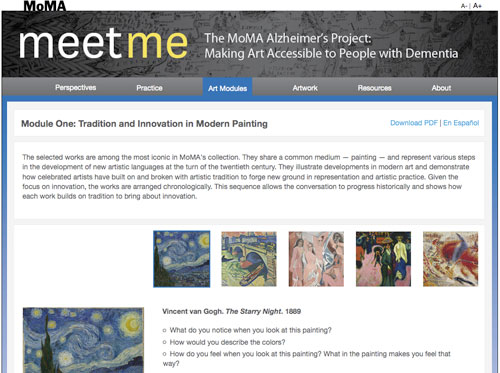
Screenshot from the Meet Me site

Screenshot from the Meet Me site

Last week, Ingrid Chou explained the process of creating the lovely Meet Me publication. For the website, we worked with Ingrid and designer Sam Sherman (as well as the Education Department) to translate elements from the publication into a digital format. We also wanted to take advantage of some of the new features and frameworks we created for the MoMA.org redesign.

January 15, 2010  |  Behind the Scenes, Tech
Time-Lapse Videos: The Joy of Watching Paint Dry and Tons of Steel Moving

The second half of the 2000s (is it too early to say that?) saw the rapid rise of online video (read a good summary here), and we’ve been actively experimenting here at MoMA. What started over three years ago as a small trial with myself, Zoe Jackson from the Marketing Department, a laptop, and a cheap miniDV camera has turned into a larger production—with a team drawn from MoMA’s Education, Marketing, Graphic Design, and Digital Media departments collaborating (in addition to all of our other day-to-day responsibilities). One of the most common types of videos we’ve produced are time-lapse videos of exhibition installations. Our first (shown above) was of Richard Serra’s sculptures being installed in the Sculpture Garden.

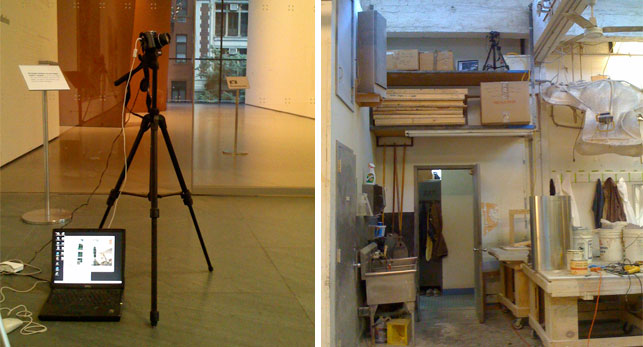
From a technical standpoint, the setup is pretty simple: an old PC laptop, an inexpensive piece of software to control a Canon still camera, a tripod, and a few power cords. It’s very easy to set up, move, or leave running overnight or over multiple days. The individual still images are then run through a QuickTime script or imported into Final Cut and compiled to create a kind of stop-motion film.

Time-lapse setup in the Marron Atrium (left), and on a shelf at the studios of ATTA Inc. (top right) for the fabrication of the topiary for the Tim Burton exhibition

Time-lapse setup in the Marron Atrium (left), and on a shelf at the studios of ATTA Inc. (top right) for the fabrication of the topiary for the Tim Burton exhibition

December 18, 2009  |  Artists, Collection & Exhibitions, Tech
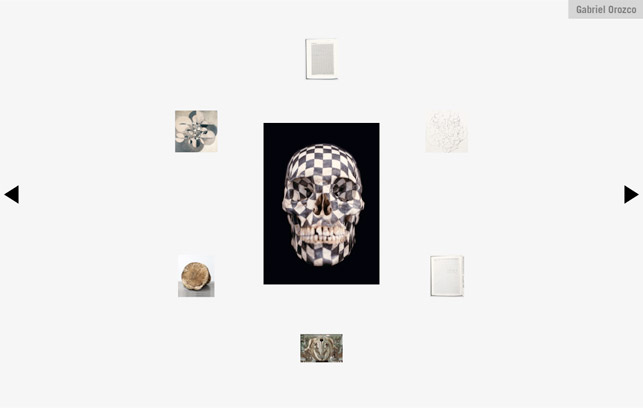
The Gabriel Orozco Website: Stacking the Deck
The <i>Gabriel Orozco</i> website

The Gabriel Orozco website

“There is no way to identify a work by Orozco in terms of physical product. Instead, it must be discerned through leitmotifs and strategies that constantly recur, but in always mutating forms and configurations.”
—Ann Temkin, the Marie-Josée and Henry Kravis Chief Curator of Painting and Sculpture, from the Gabriel Orozco exhibition catalogue

Uh oh.

That was my first reaction to Ann’s description of Gabriel Orozco’s practice. We were researching the artist, looking for persistent visual themes, devices, or elements in his work that could be used to anchor or accent the design of the exhibition website. The works that I was familiar with at the time—Black Kites, Citroen DL, the Atomist series—didn’t share obvious aesthetic connections, so I assumed that a common thread would be found in the pages of the catalogue. But here Ann was saying that Orozco’s mercurial practice provided little in the way of overt physical similarity. And that, given a looming deadline, was daunting.

 More fruitful were meetings Allegra Burnette (Creative Director of Digital Media) and I had with Ann and Paulina Pobocha, a curatorial assistant who worked on the exhibition. Though we didn’t come up with concrete ideas about the look of the site, the curators did provide insight as to its desired spirit: simple and playful. Simple, because the curators wanted something that was easy to use and understand, and playful, because what better way to conceptualize a website dedicated to an artist whose work has included the customization of both billiard and ping pong tables (Carambole with Pendulum, 1996, and Ping-Pond Table, 1998) and chess- and checkerboards (Horses Running Endlessly, 1995, and Lemon Game, 2001)?