Back in the fall of 2012, I wrote a post highlighting the Roving Gallery Guide initiative piloted by the Department of Education staff last summer. Recently, MoMA’s freelance educators completed their own interventions.


Posts in ‘Behind the Scenes’
February 20, 2013
|
Behind the Scenes,
Events & Programs
From Idea to Pilot to Program: Roving Gallery Guides at MoMA
February 18, 2013
|
Artists,
Behind the Scenes,
Collection & Exhibitions
Louise Bourgeois: A Flashback of Something that Never Existed
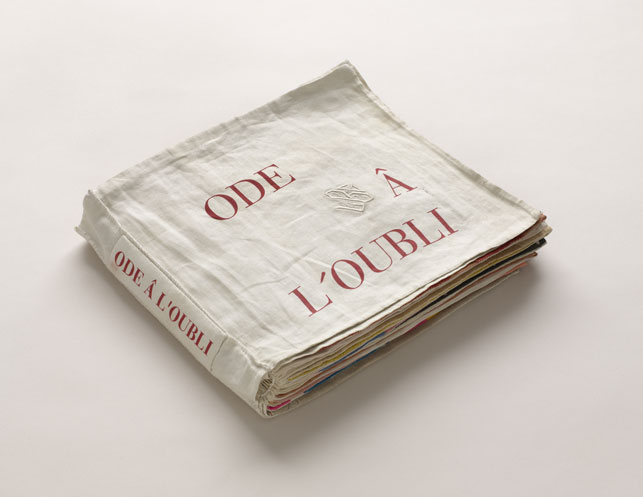
Louise Bourgeois. Ode à l’oubli. 2002. Fabric illustrated book with 35 compositions: 32 fabric collages, 2 with ink additions, and 3 lithographs (including cover), page (each approx.): 11 3/4 x 13” (29.8 x 33 cm); overall: 11 x 12 3/16 x 1 ¾” (28 x 31 x 4.5cm). © 2013 Louise Bourgeois Trust
The first installment of MoMA’s new online project Louise Bourgeois: The Complete Prints & Books includes Bourgeois’s fabric book Ode à l’oubli. In 2002, at the beginning of her 90th decade, Bourgeois constructed the book’s linen binding and pages out of 60-year-old, monogrammed hand towels from her 1938 wedding.
February 15, 2013
|
Behind the Scenes,
International Program
Hello, My Name Is…post!
Launching on February 15, post is an extension of research happening in The Museum of Modern Art’s C-MAP (Contemporary and Modern Art Perspectives in a Global Age) research initiative, which began in 2009.
February 13, 2013
|
Behind the Scenes,
Events & Programs
Invitation to Explore: The Challenges of Getting Visitors to Touch the Art
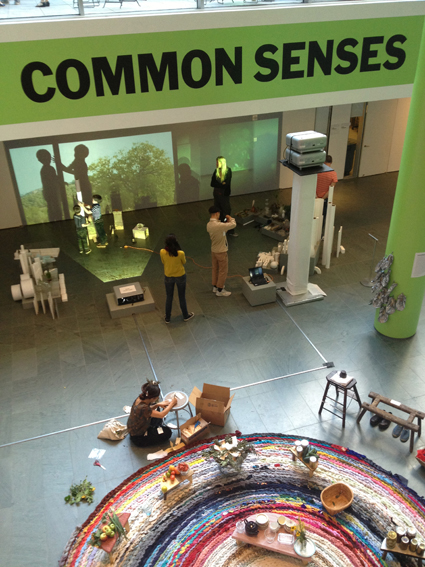
View of MoMA Studio: Common Sense from above
If you came through the Lewis B. and Dorothy Cullman Education and Research Building at MoMA this fall, you probably noticed MoMA Studio: Common Senses. You may have taken a closer look, perhaps intrigued by one of the installations or by one of the activities. The design of this MoMA Studio was particularly engaging and full of opportunities to interact with the installations.
February 7, 2013
|
Behind the Scenes,
Collection & Exhibitions,
Conservation,
Le Corbusier Kitchen Conservation
Le Corbusier Kitchen Conservation: Getting Resourceful
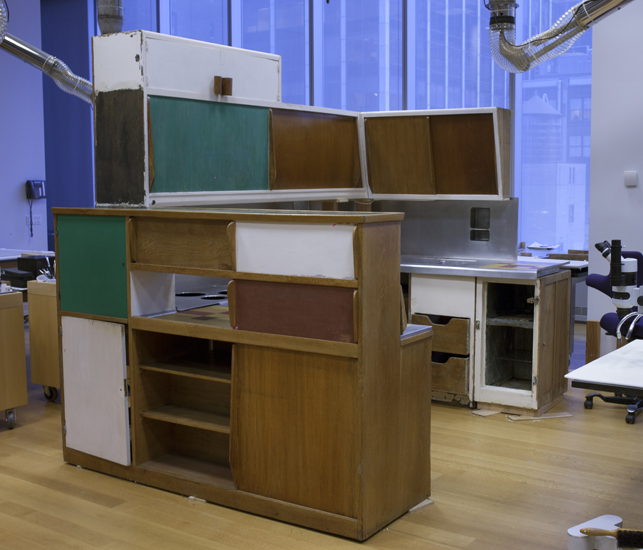
Charlotte Perriand and Le Corbusier. Kitchen from the Unité d’Habitation, Boulevard Michelet, Marseilles, France
One of the initial challenges in conserving a design piece that has been in use for over 60 years is assessing where the work has been modified over the years by the owners, and if it is truly complete. Like in our own homes, parts of this Le Corbusier kitchen have been replaced, painted over, lost, and damaged.
January 18, 2013
|
Behind the Scenes,
Collection & Exhibitions,
Tech
Louise Bourgeois: Spider Bytes
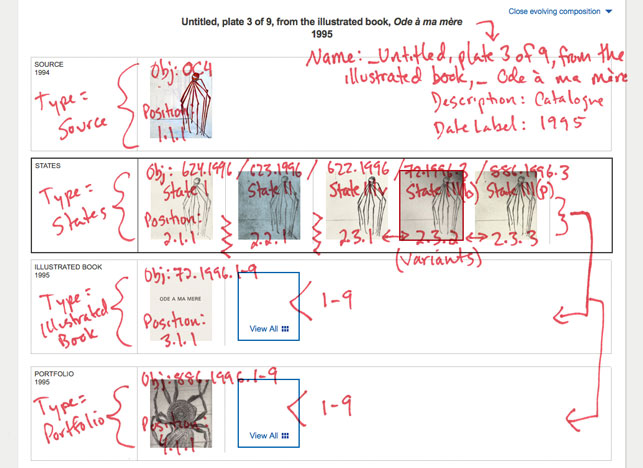
A finished diagram on the site with notes about underlying data
MoMA’s recently launched website, Louise Bourgeois: The Complete Prints & Books, seems to effortlessly reveal Bourgeois’s creative process. You might not suspect that a highly organized sea of intricate data lives behind that elegant design.
January 16, 2013
|
Behind the Scenes,
Collection & Exhibitions,
Performance Series
Being Moved: The Caravan Project
That thing that looks like a hollowed-out vintage caravan in MoMA’s Agnes Gund Garden Lobby, from now until January 21, is just that. And those bulky, muscular curtains—clinging to all sides—are in fact made of leaves, sweet potato stems, and other organic detritus. And yes, those are real people—dressed in gauzy, powdery garb—moving slowing around, or nestling inside of, the vehicle.
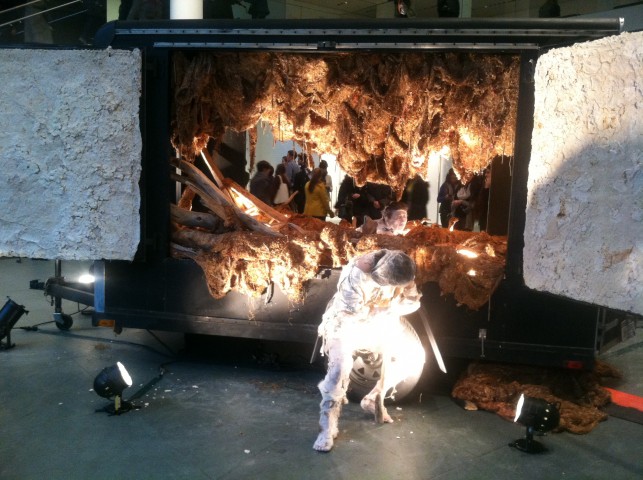
Eiko & Koma. The Caravan Project. 1999/2011/2012/2013. Installation image courtesy of Leora Morinis
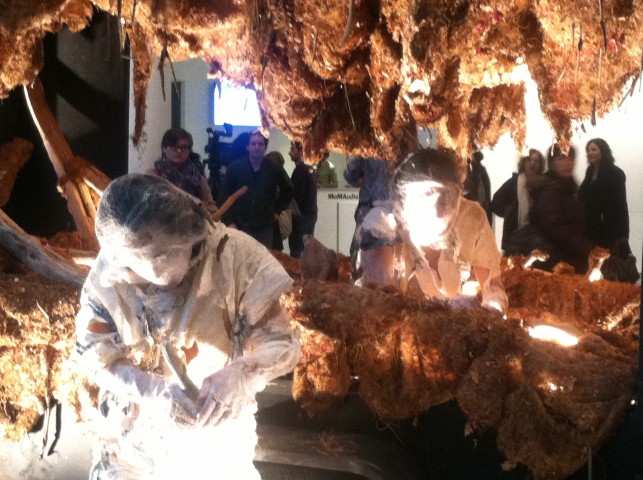
Eiko & Koma. The Caravan Project. 1999/2011/2012/2013. Installation image courtesy of Leora Morinis
What you’re seeing is The Caravan Project (1999/2011/2012/2013) a work by legendary dance duo Eiko & Koma. They have been making work together since 1972, and their history is detailed at length on the Internet and in many books, so I’ll focus here on the lesser-known story of the Caravan’s journey to MoMA and the performance about to unfold inside it.
On Monday afternoon, the Caravan arrived at MoMA from its storage space in Hackensack, New Jersey. We had to stop traffic on 54th Street for a few minutes as Koma expertly reversed it into the loading dock. And from then on, there was very little margin for error as the art handlers guided it through MoMA’s mezzanine. Despite being sealed and unadorned, it had already taken on anthropomorphic airs—seeming to me like some sort of oversized, burrowing animal, ungainly in its slow but determined movement.
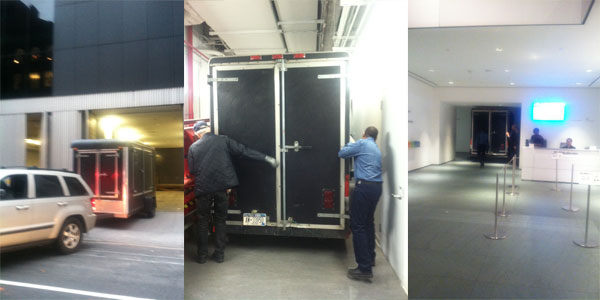
Installation images courtesy of Leora Morinis
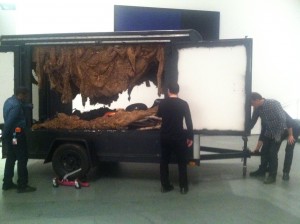
Eiko & Koma. The Caravan Project. 1999/2011/2012/2013. Installation image courtesy of Leora Morinis
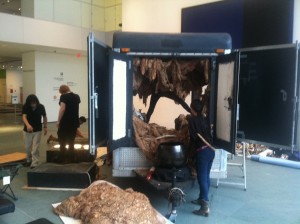
Eiko & Koma. The Caravan Project. 1999/2011/2012/2013. Installation image courtesy of Leora Morinis
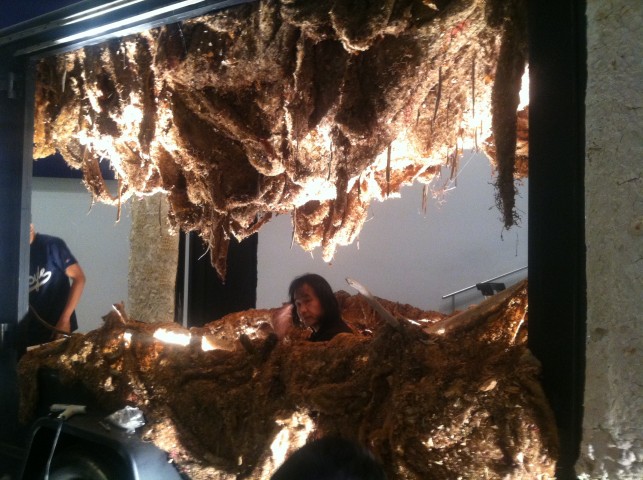
Eiko & Koma. The Caravan Project. 1999/2011/2012/2013. Installation image courtesy of Leora Morinis
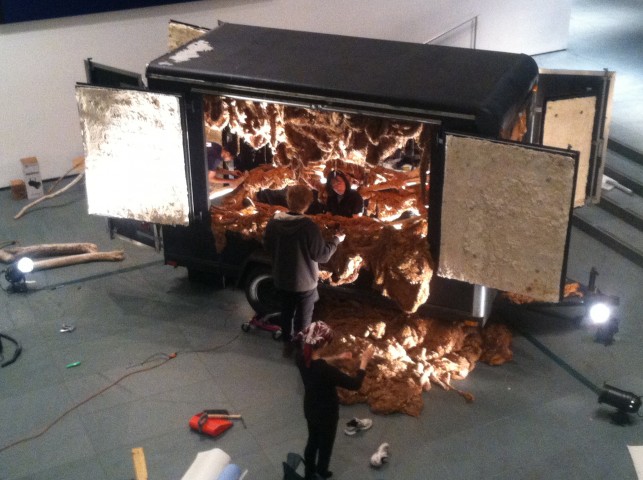
Eiko & Koma. The Caravan Project. 1999/2011/2012/2013. Installation image courtesy of Leora Morinis
The last image above depicts what the Caravan looked like as the installation was wrapping up late Tuesday evening. Illuminated from the inside and parked askew, it sits below Tony Smith’s Untitled (1962), and in front of Rodin’s Monument to Balzac (1898). That unlikely grouping—each a figure in its own right—and the nearly finalized Caravan itself, has left me with a couple of observations:
Even though the performance has yet to begin, the Caravan feels fleeting. As though it had been on-the-move and needed a quick parking space, and MoMA graciously obliged. On the other hand, it appears as though it was abandoned here decades ago, and somehow managed to remain invisible until now. Decaying in plain sight. These impressions of either happenstance or near-permanence each lend the Caravan a serenity I did not anticipate. In the busiest thoroughfare of the Museum, it seems at ease.
I’m reminded here of a story about Eiko & Koma recently told to me by a friend who’d had them as teachers at Wesleyan University. She described how, in class, they asked students to isolate under-loved or under-danced body parts: “Dance from the back of your neck,” “dance from your armpits.” In another exercise, they encouraged students to dance as if each finger had a separate persona, and in a third, students were asked to move as though plants were blooming from their bodies. These requests—dancing from minor parts of the body; reconceiving hands as a quorum of autonomous subjects; trying to adopt an arboreal pace—resonate with the Caravan’s feel and function in the Museum (albeit on a different scale). The Caravan is a slow moving organism, operating in a minor key and with a temporal sensibility that seems to rub MoMA against the grain. It invites close and extended looking, an unanticipated meditation in and on an often frenzied space.
Eiko & Koma: The Caravan Project, held in conjunction with the exhibitions </em>Tokyo 1955–1970: A New Avant-Garde</a> and </em>Performing Histories: Live Artworks Examining the Past</em>, is presented in the Museum’s Agnes Gund Garden Lobby during Museum hours from Wednesday, January 16 through Monday, January 21.</p>
December 20, 2012
|
Behind the Scenes,
Film
The Provenance of the Montgomery Clift Film Collection at MoMA
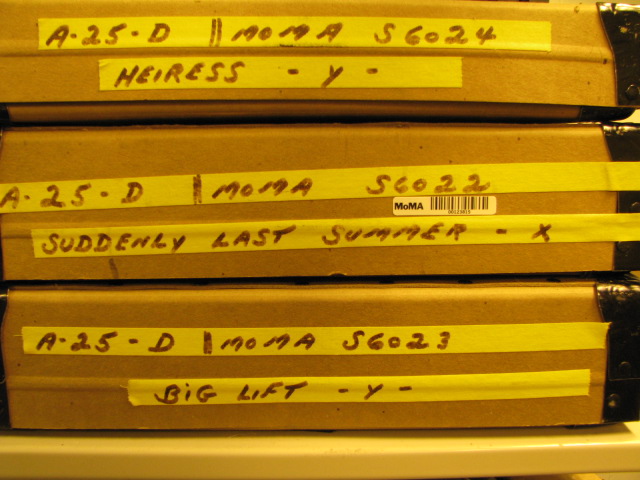
Montgomery Clift collection film cans. Photo by Art Wehrhahn, Celeste Bartos Film Preservation Center manager
The provenance of a work of art is an important part of the acquisition process. What is a provenance? By definition, the noun provenance—with respect to art and archeological specimens—is a place or source of origin.
December 17, 2012
|
Behind the Scenes
Art/Work: MoMA’s Creative Minds: Harvey Tulcensky
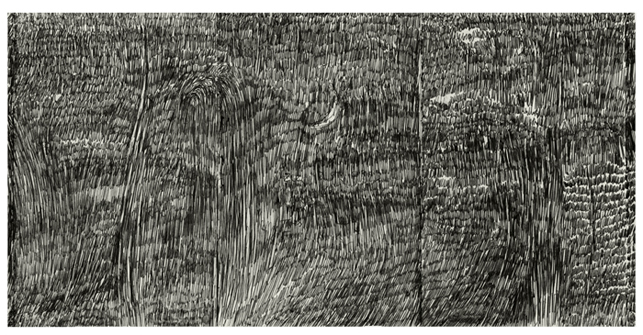
Harvey Tulcensky. Untitled detail from Notebook Drawing. Ballpoint on paper
Sitting in MoMA’s Abby Aldrich Rockefeller Sculpture Garden, Harvey Tulcensky answered my queries, and as he did so, a dragonfly buzzed by and a butterfly landed on his shoulder. These were clearly good signs of the positive conversation to come.
December 10, 2012
|
Artists,
Behind the Scenes,
Collection & Exhibitions,
Conservation,
Jackson Pollock Project
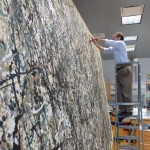
MoMA’s Jackson Pollock Conservation Project—An Ounce of Prevention…
We covered a lot of territory in our last post, documenting Echo’s condition and treating the discolored canvas. Our efforts have produced satisfying results.
If you are interested in reproducing images from The Museum of Modern Art web site, please visit the Image Permissions page (www.moma.org/permissions). For additional information about using content from MoMA.org, please visit About this Site (www.moma.org/site).
© Copyright 2016 The Museum of Modern Art
Welcome to MoMA.org. To take full advantage of all the site’s features, including the option to save works in the collection, please upgrade your browser to Firefox,
Google Chrome, Safari, or Internet Explorer 9.
See our help page for more information.
To take full advantage of all of the features on MoMA.org, please upgrade your browser to Firefox, Google Chrome,
Safari, or Internet Explorer 9.