MoMA
Posts by Anne Morra
May 20, 2010  |  Events & Programs, Film
Getting Attention: A Young Filmmaker’s Beginnings at MoMA

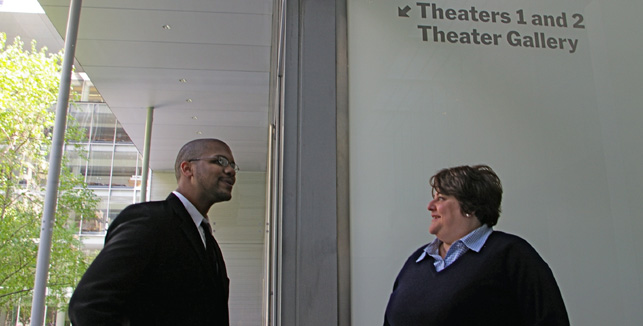
For the past ten years, high school students have been attending free Friday night film screenings at MoMA, spending some time after each film talking with curators, educators, and filmmakers. Recently we’ve experimented with different types of events for teens, such as artists’ talks, gallery activities, and art-making workshops, which means there’s something happening for young artists almost every Friday from October through May. Greeting visitors as they arrive for these events is an impeccably dressed young filmmaker named Michael Brawley, who has been an essential part of the program—first as an attendee, then as a volunteer—for years. We asked Michael his opinion about film, the Oscars, MoMA’s Teen Programs, and more.

Michael Brawley and Anne Morra at MoMA

April 1, 2010  |  Film
Pen Pals: Iris Barry and Joseph Cornell

Though I’m still a believer, I’m a bit too old to send a want list to Santa each year. But if I did, at the top of that list would be a Joseph Cornell box. Any box would do. Even one of the later collages from the 1960s would be just fine by me. But since Santa bestows linens and cooking utensils upon me these days, I keep my nose pressed against the glass on the Cornell boxes on exhibition at MoMA. (No, not really!)
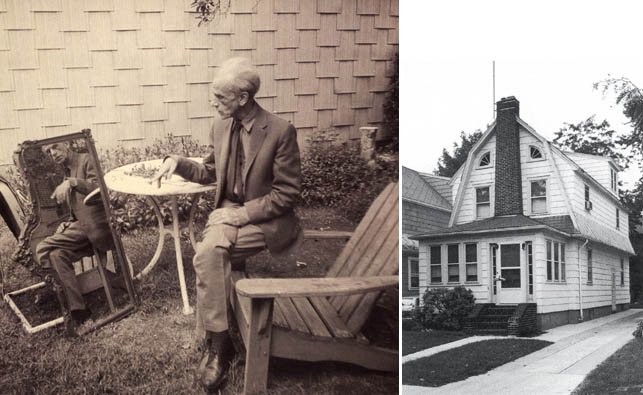
Left: Joseph Cornell in his backyard in Flushing, New York, 1969. Right: Joseph Cornell’s home at 3708 Utopia Parkway, 1976

So imagine my excitement in 1995 when The Joseph and Robert Cornell Memorial Foundation donated a comprehensive gift of film materials made and collected by Joseph Cornell to MoMA’s Department of Film. In this collection are films made by Société Lumière, Georges Méliès, and Pathé Frères. These early film pioneers imbued their inventive cinematic efforts with magic, whimsy, fairies, and other-worldly adventures. Cornell—a sometimes mysterious figure in the New York art world who is best known for his collages, box constructions, and experimental films—was drawn to the escape that these enchanting moments of cinematic exploration afforded him while he remained firmly rooted to the middle-class landscape of Utopia Parkway in Flushing, Queens. If film-going was a treasured diversion for Cornell—who was also a frequent visitor to the Museum’s Library, Archives, and galleries and who engaged in lively, revealing, and surprisingly humorous correspondence with Museum personnel—then just imagine his delight in corresponding with Iris Barry, the first curator of the MoMA Film Library and one of the most influential personalities in the world of film as art.


December 24, 2009  |  Film
The Ingmar Bergman Film Collection at MoMA
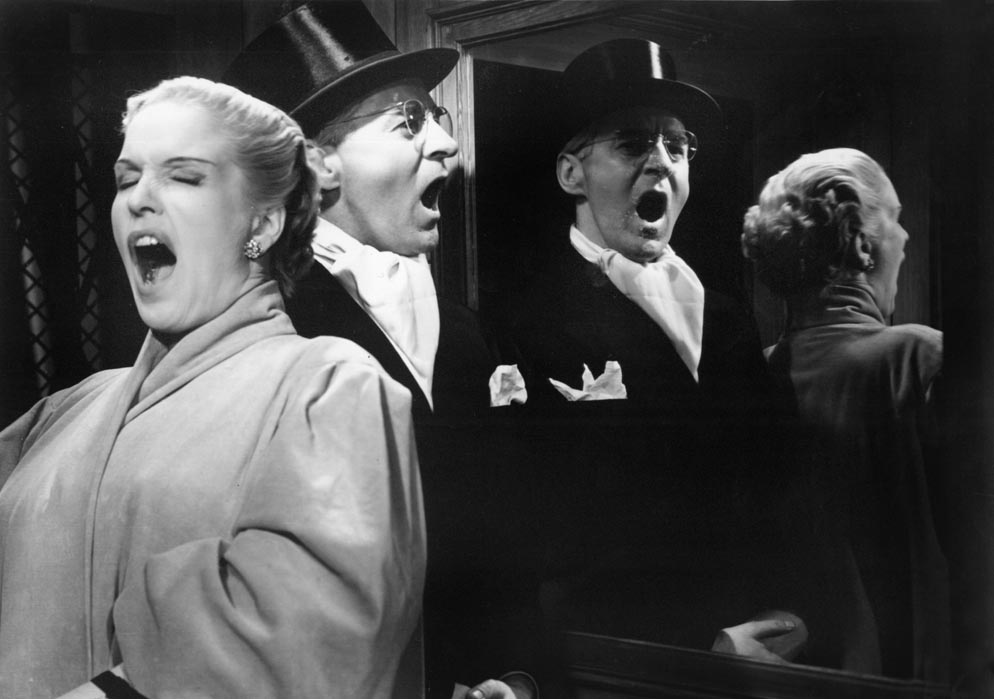
Kvinnors väntan (Secrets of Women). 1952. Sweden. Written and directed by Ingmar Bergman. Shown from left: Eva Dahlbeck, Gunnar Björnstrand . © Janus Films. Photo courtesy Janus Films/Photofest

Kvinnors väntan (Secrets of Women). 1952. Sweden. Written and directed by Ingmar Bergman. Shown from left: Eva Dahlbeck, Gunnar Björnstrand. Gift Janus Films. © Janus Films. Photo courtesy Janus Films/Photofest

The Museum of Modern Art began collecting the films of Swedish filmmaker Ingmar Bergman (1918–2007) in the late 1960s, shortly after the introduction of his ubiquitous art house films in the American theatrical market by the pioneering distributor Janus Films. Through a forty-year collaboration with Janus Films, MoMA has actively acquired Bergman’s films and created preservation materials on such titles as Kvinnors väntan (Secrets of Women) (1952) and Jungfrukällan (The Virgin Spring) (1959). A recent analysis of MoMA’s Bergman holdings totals more than 350 pieces of film materials, representing thirty titles from across the relevant filmography.