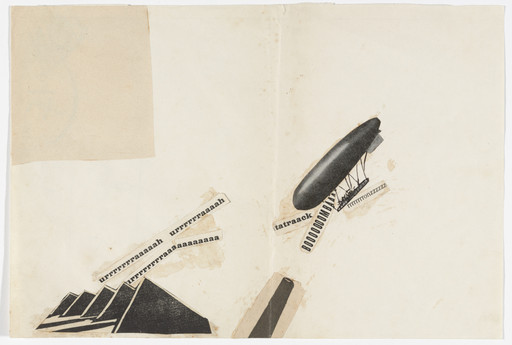
Cut-and-pasted printed paper, charcoal, pencil, and oil pastel on cut-and-pasted paper
Not on view
McCarthy’s work explores fundamental issues of human identity, from the body to social interaction. It confronts and obliterates notions of classical unity and the harmony of human proportion and form, and often questions norms of social interaction in domestic situations.
In Penis Hat the pirate is not the swashbuckling hero from storybooks. Instead McCarthy portrays an intimidating and wretched pirate, emphasizing a lifestyle of danger and debauchery on the margins of society. A captain's life is his ship—or so the saying goes; here McCarthy literally transforms the body of the ship into the body of the pirate. The ribs of the ship are also his ribs, windows and holes are bodily orifices, oars signify limbs, and canons resemble penises and a nose. This penis/weapon motif alludes to both warfare and sexual conquest and exudes a potent masculinity. However, if amputation occurred, as texts at the bottom of the drawing and corresponding red spurts through the work explicitly reference, the pirate would lose his power and manliness. By transforming the iconic figure of the pirate through brutal images of debauchery and castration, in this large drawing McCarthy powerfully critiques stereotypes of masculinity.
The Museum of Modern Art, MoMA Highlights since 1980, New York: The Museum of Modern Art , p. 246.
Gallery label from Compass in Hand: Selections from The Judith Rothschild Foundation Contemporary Drawings Collection , April 22, 2009–January 4, 2010.
No swashbuckling hero, McCarthy's pirate is an intimidating and wretched figure who embodies a lifestyle of danger and licentiousness on the margins of society. McCarthy transforms the body of the ship into the body of the pirate: the ribs of the ship become his ribs, windows and holes become bodily orifices, oars act as limbs, and cannons resemble penises and a nose. The phallic weaponry alludes to warfare and sexual conquest, and the various inscriptions and red spurts make clear that if amputated, the pirate would lose his power. McCarthy critiques Western stereotypes of masculinity by transforming the iconic figure of the pirate through brutal images of debauchery and castration.
Compass in Hand: Selections from The Judith Rothschild Foundation Contemporary Drawings Collection, April 22, 2009–January 4, 2010.
Explore more



From MoMA Design Store


Installation views
We have identified this work in the following photos from our exhibition history.
Licensing
Artwork or archival images
If you would like to reproduce an image of a work of art in MoMA's collection, or an image of a MoMA publication or archival material (including installation views, checklists, and press releases), please contact Art Resource (publication in North America) or Scala Archives (publication in all other geographic locations).
Audio and film clips
MoMA licenses archival audio and select out of copyright film clips from our film collection. At this time, MoMA produced video cannot be licensed by MoMA/Scala. All requests to license archival audio or out of copyright film clips should be addressed to Scala Archives at [email protected]. Motion picture film stills cannot be licensed by MoMA/Scala. For access to motion picture film stills for research purposes, please contact the Film Study Center at [email protected]. For more information about film loans and our Circulating Film and Video Library, please visit Circulating Film and Video Library.
Text from a publication or the archives
If you would like to reproduce text from a MoMA publication, please email [email protected]. If you would like to publish text from MoMA's archival materials, please fill out this permission form and send to [email protected].
Feedback
This record is a work in progress. If you have additional information or spotted an error, please fill out this feedback form.