To make Map of an Englishman, Grayson Perry used the traditional printmaking techniques of etching and photogravure and borrowed the style and lettering of 16th- and 17th-century cartography. But instead of locations, his map depicts behaviors and psychological states, including bodies of water named Psychopath and Delirium and landmarks named Happiness, Cliché, Spit, and Bad Manners. Its central landforms resemble the left and right halves of the brain. Perry explained that he “tended to put the darker, more subconscious things on the bottom right, because that’s where they are in the brain.”
Perry incorporates humor and irony into his work to critique accepted social and cultural norms. Map of an Englishman could be interpreted as both a universal and specific representation of identity: “A lot of people think it’s generally like an Englishman,” the artist has said. “It is an Englishman. It is me.”
Explore more
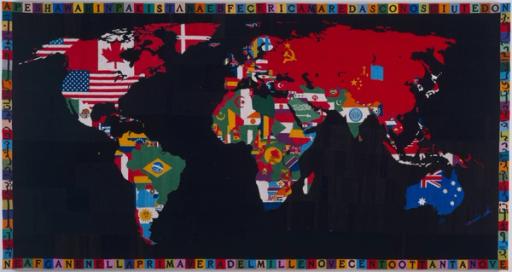
Maps, borders, and networks
People have been creating maps since ancient times. The earliest map, thought to be a schematic representation of the night sky, was found in the caves of Lascaux, France. It dates to 14,500 BCE.
Learn more →

From MoMA Design Store


Installation views
We have identified this work in the following photos from our exhibition history.
Licensing
Artwork or archival images
If you would like to reproduce an image of a work of art in MoMA's collection, or an image of a MoMA publication or archival material (including installation views, checklists, and press releases), please contact Art Resource (publication in North America) or Scala Archives (publication in all other geographic locations).
Audio and film clips
MoMA licenses archival audio and select out of copyright film clips from our film collection. At this time, MoMA produced video cannot be licensed by MoMA/Scala. All requests to license archival audio or out of copyright film clips should be addressed to Scala Archives at [email protected]. Motion picture film stills cannot be licensed by MoMA/Scala. For access to motion picture film stills for research purposes, please contact the Film Study Center at [email protected]. For more information about film loans and our Circulating Film and Video Library, please visit Circulating Film and Video Library.
Text from a publication or the archives
If you would like to reproduce text from a MoMA publication, please email [email protected]. If you would like to publish text from MoMA's archival materials, please fill out this permission form and send to [email protected].
Feedback
This record is a work in progress. If you have additional information or spotted an error, please fill out this feedback form.