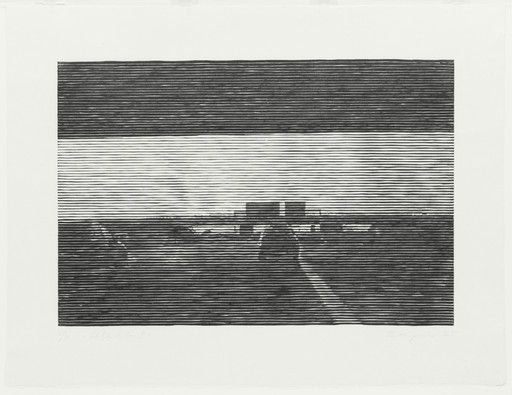
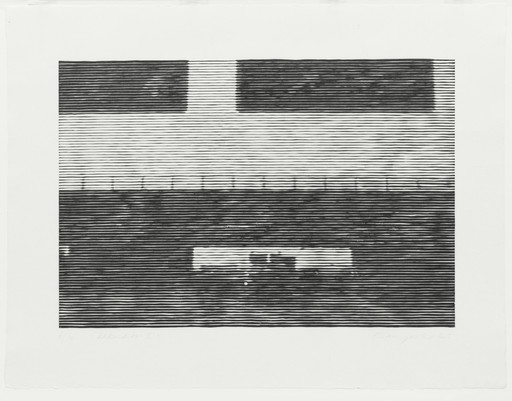
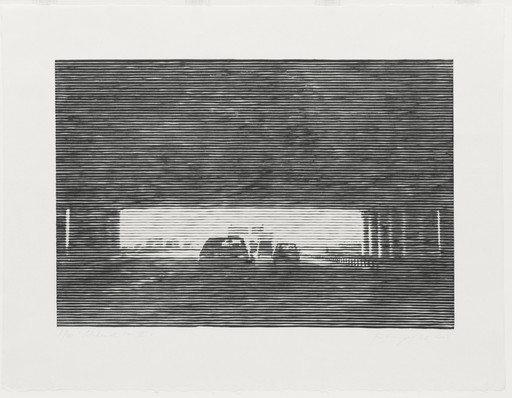
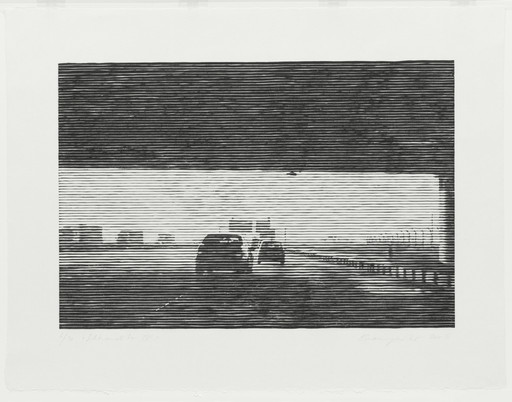
Working with new and old technologies—video and printmaking—Baumgartner addresses the representation of speed and of fleeting imagery through subjects that range from fields of wind turbines to cars on highways to military bombers in flight. In 1987 Baumgartner began experimenting with the medium of woodcut, the oldest printmaking technique and one with a great tradition in her hometown of Leipzig, Germany. Since the 1990s she has worked exclusively with a horizontal line structure in her woodcuts, basing many of her compositions on her own video stills.
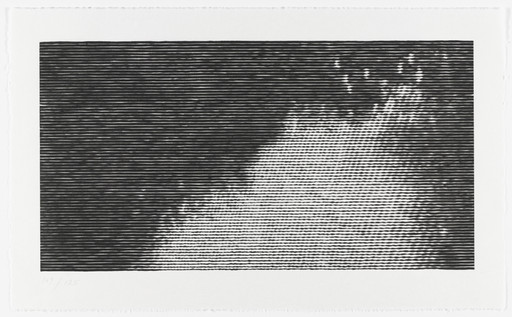
Transall is Baumgartner's largest woodcut to date—over fourteen feet in length—and, remarkably, it is based on a newspaper photograph only inches in size. The print depicts a lineup of aircrafts waiting to be deployed, their power restrained, for the moment, by their stillness. (The title refers to the Transall C-160, a military transport aircraft developed in the 1960s and used over the decades for cargo, refueling, and surveillance.)
To create this print, Baumgartner used a computer to magnify the image and transfer it onto an enormous woodblock for carving. Over a period of ten months, the artist laboriously incised hundreds of horizontal lines, until the complete image was realized and ready for printing. Its horizontal construction is emphasized by the panoramic format of the paper, which in turn underscores the magnitude of the aircrafts’ wingspans. The density of the black-and-white linework produces optical sensations that give the illusion of vibration—an effect that enhances the tension between movement and stasis in the image itself.
The Museum of Modern Art, MoMA Highlights since 1980, New York: The Museum of Modern Art , p. 202.
Explore more

Audio
Audio from the playlist Eye on Europe: Prints, Books & Multiples/1960 to Now
From MoMA Design Store


Installation views
We have identified this work in the following photos from our exhibition history.
Licensing
Artwork or archival images
If you would like to reproduce an image of a work of art in MoMA's collection, or an image of a MoMA publication or archival material (including installation views, checklists, and press releases), please contact Art Resource (publication in North America) or Scala Archives (publication in all other geographic locations).
Audio and film clips
MoMA licenses archival audio and select out of copyright film clips from our film collection. At this time, MoMA produced video cannot be licensed by MoMA/Scala. All requests to license archival audio or out of copyright film clips should be addressed to Scala Archives at [email protected]. Motion picture film stills cannot be licensed by MoMA/Scala. For access to motion picture film stills for research purposes, please contact the Film Study Center at [email protected]. For more information about film loans and our Circulating Film and Video Library, please visit Circulating Film and Video Library.
Text from a publication or the archives
If you would like to reproduce text from a MoMA publication, please email [email protected]. If you would like to publish text from MoMA's archival materials, please fill out this permission form and send to [email protected].
Feedback
This record is a work in progress. If you have additional information or spotted an error, please fill out this feedback form.