Japanese paper
Not on view
In the mid-1960s, Schendel produced a series of three-dimensional works made of knotted rice paper she had intertwined by hand. She thought of them as ephemeral sculpturesnot meant to lastand called them Droguinhas (literally "little drugs"), a Brazilian slang expression that means "nothing"or indicates something worthless. Schendel, one of the major figures of postwar Brazilian art, was also a trained philosopher and poet. She used her art to address existential questions and to subvert the traditional hierarchies between artistic mediums.
Making Space: Women Artists and Postwar Abstraction, April 19 - August 13, 2017.
Publication excerpt from MoMA Highlights: 375 Works from The Museum of Modern Art, New York (New York: The Museum of Modern Art, 2019)
Schendel’s legacy is powerful, but her art was utterly, achingly fragile. In the series of works titled Droguinhas—literally “little drugs,” a slang expression in Brazil for inconsequential things, throwaways—she twisted, knotted, and braided delicate rice paper into elaborate, tangled accumulations that hang from the ceiling or are piled on the floor. These works were not intended to last: sculpture, for Schendel, was not a stable thing but impermanent, fleeting—a catalyst, infusing the experience of the viewer like an intoxicating substance.
The artist was born in Zurich, studied in Milan, and then fled to Yugoslavia during World War II; in 1946 she moved to São Paulo, where she became a major figure in Brazilian art, upending traditional Western orthodoxies about making, composing, and meaning. Throughout her experiments in different mediums, whether drawing or painting or poetry, Schendel surrendered the artist’s control over an artwork, abdicating her own decision-making to other factors: the shape of a support, the passage of time, the inclinations of a material. Perhaps this is why the Droguinhas look almost as if they were grown, rather than made. Like many of her Brazilian and European contemporaries, Schendel believed that meaning lies not in the artist’s intention but in the hands of the viewer, and in the world beyond the work.
MoMA Highlights: 375 Works from The Museum of Modern Art, New York (New York: The Museum of Modern Art, 2019)
Explore more
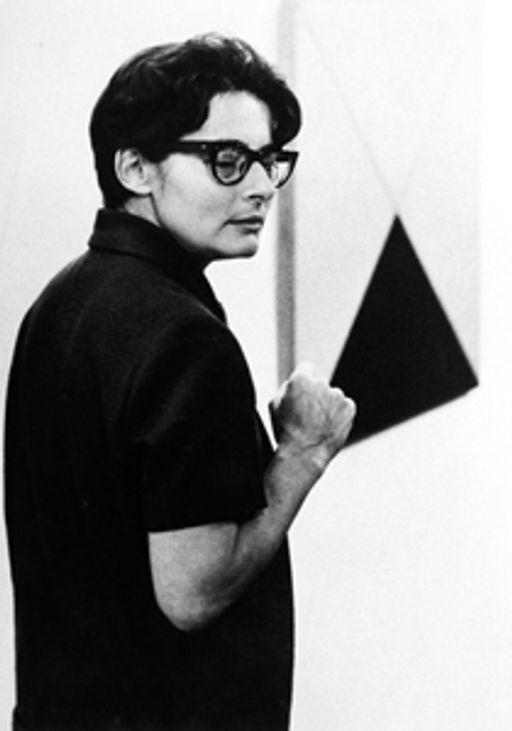
Mira Schendel
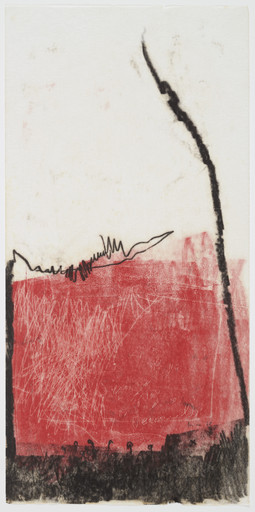
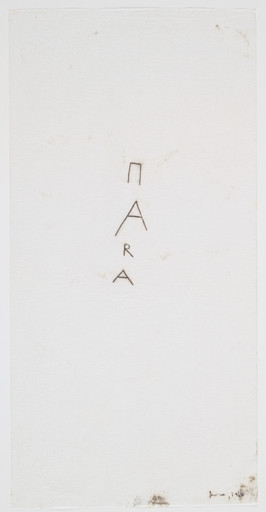
Brazilian, born Switzerland. 1919–1988 60 works onlineIn the early 1960s, the artist Mira Schendel received a large gift of thin Japanese paper. It transformed her practice, giving rise to thousands of Monotipias and culminating in her Objetos gráficos of the 1970s, made while she dedicated a decade to the investigation of the medium of drawing and its potential.
Learn more →
From MoMA Design Store


Installation views
We have identified this work in the following photos from our exhibition history.
Licensing
Artwork or archival images
If you would like to reproduce an image of a work of art in MoMA's collection, or an image of a MoMA publication or archival material (including installation views, checklists, and press releases), please contact Art Resource (publication in North America) or Scala Archives (publication in all other geographic locations).
Audio and film clips
MoMA licenses archival audio and select out of copyright film clips from our film collection. At this time, MoMA produced video cannot be licensed by MoMA/Scala. All requests to license archival audio or out of copyright film clips should be addressed to Scala Archives at [email protected]. Motion picture film stills cannot be licensed by MoMA/Scala. For access to motion picture film stills for research purposes, please contact the Film Study Center at [email protected]. For more information about film loans and our Circulating Film and Video Library, please visit Circulating Film and Video Library.
Text from a publication or the archives
If you would like to reproduce text from a MoMA publication, please email [email protected]. If you would like to publish text from MoMA's archival materials, please fill out this permission form and send to [email protected].
Feedback
This record is a work in progress. If you have additional information or spotted an error, please fill out this feedback form.