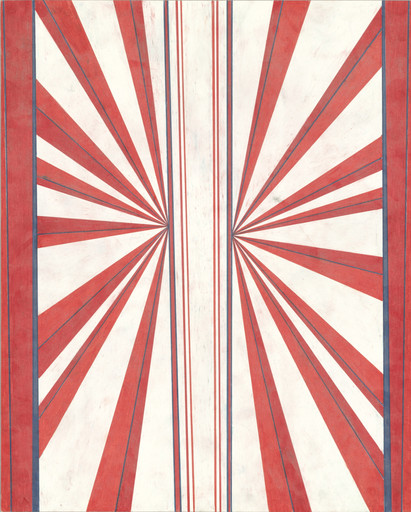
Colored pencil on paper
Not on view
Grotjahn’s belief in the expressive possibilities of abstraction is proven by his constant, almost obsessive, exploration of his signature motif, the butterfly. As its matter-of-fact title emphasizes, this is one of the artist's larger and more complex drawings. The work is more intuitive than its consistent patterning implies—Grotjahn determines the converging points of each "wing" of radiating color by eye, and each is completely unique. The stray marks that appear throughout are remnants of other, smaller drawings worked on top of this larger piece. These slight differences and elements of chance are subtly disorienting—they thwart attempts to place these colorful shapes in any sort of realistic, unified space.
The artist's devotion to his distinctive butterfly form recalls the belief of early modern proponents of abstraction in the universal nature of their artistic language. Grotjahn’s continuing exploration, however, reveals his body of work as distinctly personal and shaped by private goals. These butterflies are not meant to be realistic depictions of insects, but the work’s title does suggest a way to read this drawing—as lively waves of color flitting across the page.
The Museum of Modern Art, MoMA Highlights since 1980, New York: The Museum of Modern Art , p. 232.
Explore more

From MoMA Design Store


Installation views
We have identified this work in the following photos from our exhibition history.
Licensing
Artwork or archival images
If you would like to reproduce an image of a work of art in MoMA's collection, or an image of a MoMA publication or archival material (including installation views, checklists, and press releases), please contact Art Resource (publication in North America) or Scala Archives (publication in all other geographic locations).
Audio and film clips
MoMA licenses archival audio and select out of copyright film clips from our film collection. At this time, MoMA produced video cannot be licensed by MoMA/Scala. All requests to license archival audio or out of copyright film clips should be addressed to Scala Archives at [email protected]. Motion picture film stills cannot be licensed by MoMA/Scala. For access to motion picture film stills for research purposes, please contact the Film Study Center at [email protected]. For more information about film loans and our Circulating Film and Video Library, please visit Circulating Film and Video Library.
Text from a publication or the archives
If you would like to reproduce text from a MoMA publication, please email [email protected]. If you would like to publish text from MoMA's archival materials, please fill out this permission form and send to [email protected].
Feedback
This record is a work in progress. If you have additional information or spotted an error, please fill out this feedback form.