The free-form construction and orange hue of the Corallo Armchair mimic the natural structure and color of coral, the material that inspired it. Short fragments of steel wire are hand-bent and welded each onto the next, much like the budding and branching process by which coral grows underwater. A coat of epoxy paint protects the steel and seduces the eye with dazzling color. The result is a highly expressive sculptural seat perfectly suited for indoor or outdoor use.
Wire is hardly a new material in furniture design. Charles Eames and Harry Bertoia recognized the mass-manufacturing potential of the material in their classic chairs of the early 1950s, and their rational form-follows-function approach to structural applications of steel wire continues to this day in the designs of Enzo Mari and Alfredo Haeberli. The Corallo Armchair distinguishes itself from this tradition and allies itself with a very contemporary design concern: emotional and psychological appeal. The Campana brothers avoid rectilinear, geometric construction suited for mass production in favor of a liberated, vital tangle of sensuous lines that make a virtue of the charming imperfections created by the maker's hand. The evocation of coral lends the chair an appearance of having blossomed organically through its own DNA-encoded growth patterns, completely free of the strictures of mass production. Indeed, no two Corallo chairs are alike.
The Museum of Modern Art, MoMA Highlights since 1980, New York: The Museum of Modern Art, 2007 , p. 268.
Explore more
Fernando Campana
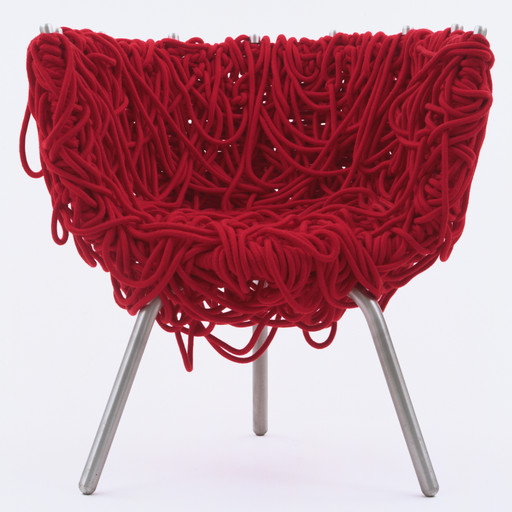
Brazilian, 1961–2022 5 works onlineMusing over the origins of his Vermelha (Red) Chair (1993), Humberto Campana reflected, “The idea emerged when we bought a large bundle of rope from a street stall and brought it back to the studio.
Learn more →
Humberto Campana
Brazilian, born 1953 5 works onlineMusing over the origins of his Vermelha (Red) Chair (1993), Humberto Campana reflected, “The idea emerged when we bought a large bundle of rope from a street stall and brought it back to the studio.
Learn more →



From MoMA Design Store


Installation views
We have identified this work in the following photos from our exhibition history.
Licensing
Artwork or archival images
If you would like to reproduce an image of a work of art in MoMA's collection, or an image of a MoMA publication or archival material (including installation views, checklists, and press releases), please contact Art Resource (publication in North America) or Scala Archives (publication in all other geographic locations).
Audio and film clips
MoMA licenses archival audio and select out of copyright film clips from our film collection. At this time, MoMA produced video cannot be licensed by MoMA/Scala. All requests to license archival audio or out of copyright film clips should be addressed to Scala Archives at [email protected]. Motion picture film stills cannot be licensed by MoMA/Scala. For access to motion picture film stills for research purposes, please contact the Film Study Center at [email protected]. For more information about film loans and our Circulating Film and Video Library, please visit Circulating Film and Video Library.
Text from a publication or the archives
If you would like to reproduce text from a MoMA publication, please email [email protected]. If you would like to publish text from MoMA's archival materials, please fill out this permission form and send to [email protected].
Feedback
This record is a work in progress. If you have additional information or spotted an error, please fill out this feedback form.