Not on view
In this collage a fantastical quasi-reptilian figure is posed aggressively, as if she is about kick a potential predator with her stiletto-clad left foot. However, upon closer inspection it becomes clear that blood is hemorrhaging from her head and mangled right foot. Mutilated and unstable, she is supported at her ankle by a lilliputian creature. The artist has described women as "sensitivity charts"—their bodies function as "barometers, tracking the health, or more often the sickness, of any given society’s own body politic." In One Hundred Lavish Months of Bushwhack, conflict and strife have literally scarred the female figure's body.
Mutu executes her work on Mylar, a plastic film that causes the paint to pool, further emphasizing the glittering and leprous sheen of the skin. She incorporates imagery from ethnographic catalogues, pornography, and fashion magazines, reconstructing the female body into something elegantly disordered. Her women are adaptors, mutations of culturally imposed ideals of femininity, beauty, and sexuality. Often compared to Hannah Höch and Romare Bearden, pioneers of photomontage, Mutu explores the inherent disjunctions of the medium, combining images of the female body with contemporary narratives of African culture and tradition, articulating a historical, cultural, and personal narrative of postimperialism, feminism, and globalization.
The Museum of Modern Art, MoMA Highlights since 1980, New York: The Museum of Modern Art, 2007, p. 235.
Explore more
Wangechi Mutu
Kenyan American, born 1972 14 works onlineBorn in Nairobi, Kenya, in 1972, the artist relocated to the US in the mid-1990s to study fine art. Her experience of migration and her diasporic identity have infused the artist’s creations with an expansive philosophy of belonging: “If a plant has just one root that doesn’t necessarily mean it’s going to stand straight and strong.
Learn more →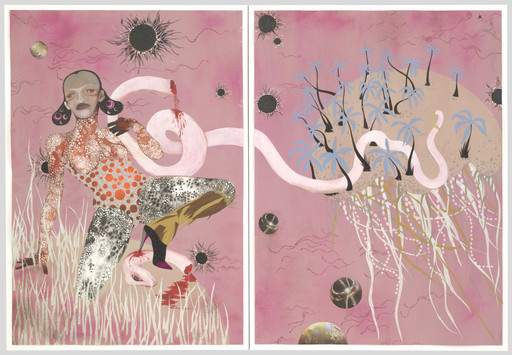

From MoMA Design Store


Installation views
We have identified this work in the following photos from our exhibition history.
Licensing
Artwork or archival images
If you would like to reproduce an image of a work of art in MoMA's collection, or an image of a MoMA publication or archival material (including installation views, checklists, and press releases), please contact Art Resource (publication in North America) or Scala Archives (publication in all other geographic locations).
Audio and film clips
MoMA licenses archival audio and select out of copyright film clips from our film collection. At this time, MoMA produced video cannot be licensed by MoMA/Scala. All requests to license archival audio or out of copyright film clips should be addressed to Scala Archives at [email protected]. Motion picture film stills cannot be licensed by MoMA/Scala. For access to motion picture film stills for research purposes, please contact the Film Study Center at [email protected]. For more information about film loans and our Circulating Film and Video Library, please visit Circulating Film and Video Library.
Text from a publication or the archives
If you would like to reproduce text from a MoMA publication, please email [email protected]. If you would like to publish text from MoMA's archival materials, please fill out this permission form and send to [email protected].
Feedback
This record is a work in progress. If you have additional information or spotted an error, please fill out this feedback form.