Bent plywood, bent laminated birch, and solid birch
Not on view
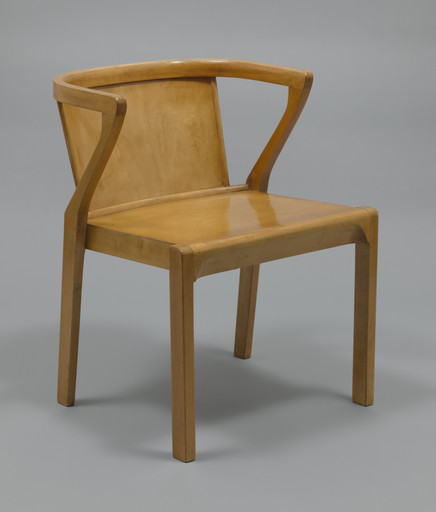
Admired as much for its sculptural presence as for its comfort, the Paimio Chair is a tour de force in bentwood that tested the limits of plywood manufacturing in the early 1930s. The chair’s framework consists of two closed loops of laminated wood, forming arms, legs, and floor runners, between which rides the seat—a thin sheet of plywood tightly bent at both top and bottom into sinuous scrolls, giving it added resiliency. Inspired by the architect and designer Marcel Breuer’s Club Chair of 1927–28, which was made of tubular steel, Aalto chose native birch for its natural feel and insulating properties, and developed a more organic form.
The Paimio Chair, the best-known piece of furniture by Aalto, is named for the town in southwestern Finland for which he designed a tuberculosis sanatorium and all its furnishings. The chair was used in the patients’ lounge; the angle of the back of the armchair was intended to help sitters breathe more easily.
Aalto’s bentwood furniture had a great influence on the American designers Charles and Ray Eames and the Finnish-born Eero Saarinen. In 1935 the company Artek was established in Finland to mass-produce and distribute wood furniture designed by Aalto and his wife, Aino. Most of their designs remain in production.
MoMA Highlights: 375 Works from The Museum of Modern Art, New York (New York: The Museum of Modern Art, 2019)
Explore more

Alvar Aalto
Finnish, 1898–1976 37 works onlineAlvar Aalto, the renowned Finnish architect, designer, and town planner, forged a remarkable synthesis of romantic and pragmatic ideas. His work reflects a deep desire to humanize architecture through an unorthodox handling of form and materials that was both rational and intuitive.
Learn more →




From MoMA Design Store


Installation views
We have identified this work in the following photos from our exhibition history.
Licensing
Artwork or archival images
If you would like to reproduce an image of a work of art in MoMA's collection, or an image of a MoMA publication or archival material (including installation views, checklists, and press releases), please contact Art Resource (publication in North America) or Scala Archives (publication in all other geographic locations).
Audio and film clips
MoMA licenses archival audio and select out of copyright film clips from our film collection. At this time, MoMA produced video cannot be licensed by MoMA/Scala. All requests to license archival audio or out of copyright film clips should be addressed to Scala Archives at [email protected]. Motion picture film stills cannot be licensed by MoMA/Scala. For access to motion picture film stills for research purposes, please contact the Film Study Center at [email protected]. For more information about film loans and our Circulating Film and Video Library, please visit Circulating Film and Video Library.
Text from a publication or the archives
If you would like to reproduce text from a MoMA publication, please email [email protected]. If you would like to publish text from MoMA's archival materials, please fill out this permission form and send to [email protected].
Feedback
This record is a work in progress. If you have additional information or spotted an error, please fill out this feedback form.