Not on view
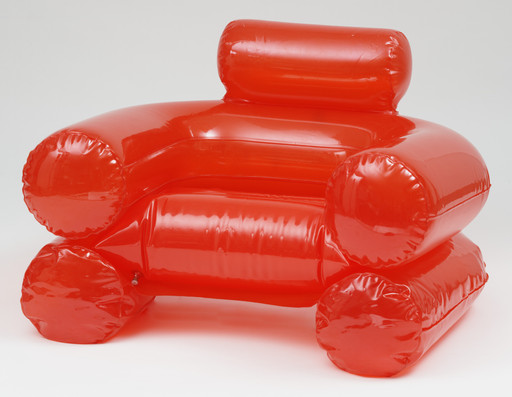
The lightweight and cheap Blow was manufactured through a new technique—electronic welding—by the young Italian firm Zanotta. This icon of 1960s Pop furniture embodies the revolutionary spirit of its time in its rejection of the bourgeois idea of furniture as solid, heavy, and long-lasting. It is a youthful, playful expression of the free, casual lifestyle and culture of ephemerality associated with this period. And, executed in candy-colored PVC plastic, it was far more affordable than other contemporary works of "high-style" Italian design. Despite its cult status, however, consumers disliked the fact that PVC quickly became hot and tended to stick to your legs.
From the Collection: 1960-69, March 26, 2016 - March 12, 2017.
Gallery label from Shaping Modernity: Design 1880-1980 , December 23, 2009–July 25, 2010 .
"Her neon mouth with the blinkers-off smile / Nothing but an electric sign / You could say she has an individual style /She's part of a colorful time." Psychedelic rock pioneers Jefferson Airplane released the song "Plastic Fantastic Lover" the same year the world received Blow, the first mass-produced inflatable chair. It was designed by the Milan-based studio of De Pas, D'Urbino, and Lomazzi and manufactured through a new technique, electronic welding, by the young Italian firm Zanotta. This icon of 1960s Pop furniture embodies the revolutionary spirit of its time. It is a youthful, playful expression of the free, casual life-style and culture of ephemerality associated with this period. And, executed in candy-colored PVC plastic, it was far more affordable than other contemporary works of "high-style" Italian design.
Shaping Modernity: Design 1880-1980, December 23, 2009–July 25, 2010 .
Explore more


Audio
Audio from the playlist From the Collection: 1960–1969
From MoMA Design Store


Installation views
We have identified this work in the following photos from our exhibition history.
Licensing
Artwork or archival images
If you would like to reproduce an image of a work of art in MoMA's collection, or an image of a MoMA publication or archival material (including installation views, checklists, and press releases), please contact Art Resource (publication in North America) or Scala Archives (publication in all other geographic locations).
Audio and film clips
MoMA licenses archival audio and select out of copyright film clips from our film collection. At this time, MoMA produced video cannot be licensed by MoMA/Scala. All requests to license archival audio or out of copyright film clips should be addressed to Scala Archives at [email protected]. Motion picture film stills cannot be licensed by MoMA/Scala. For access to motion picture film stills for research purposes, please contact the Film Study Center at [email protected]. For more information about film loans and our Circulating Film and Video Library, please visit Circulating Film and Video Library.
Text from a publication or the archives
If you would like to reproduce text from a MoMA publication, please email [email protected]. If you would like to publish text from MoMA's archival materials, please fill out this permission form and send to [email protected].
Feedback
This record is a work in progress. If you have additional information or spotted an error, please fill out this feedback form.