Colored ink and watercolor on board
Not on view
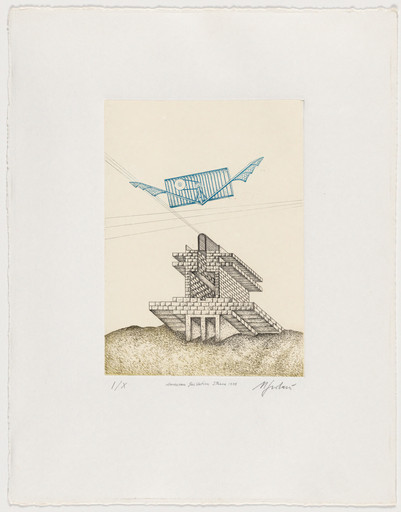
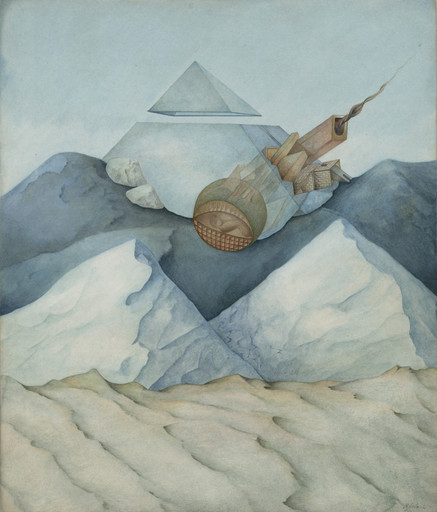
Massimo Scolari used images to manipulate form without using Renaissance or neoclassical styles. His drawings are pure fantasy and often defy explanation. In Urban Passage, geometric forms resembling a house seem to be projected onto a mythical landscape by the sky. In Addio Melampo, these forms emanate from the earth itself. Its title refers both to the name of a dog in an Italian novel and to a mythical Greek man who can see the future and understand the voices of animals, although for Scolari there is not necessarily a connection between the title and the image of a drawing. Addio Melampo is clearly a drawing born from imagination.
an essay by Bevin Cline and Tina di Carlo, in Terence Riley, ed., The Changing of the Avant-Garde: Visionary Architectural Drawings from the Howard Gilman Collection, New York: The Museum of Modern Art, 2002, p. 124.
Publication excerpt from Matilda McQuaid, ed., Envisioning Architecture: Drawings from The Museum of Modern Art , New York: The Museum of Modern Art, 2002, p. 182.
The scholar, painter, and architect Massimo Scolari chose early in life not to build. His small-format drawings, often accompanied by theoretical writings, are not views of an architectural utopia or of a proposed reality; rather, each is intended as a redesign of an architectural form (a fortress, a bridge, a dwelling, a small city, a landscape), "extracting it from its obvious context, redescribing it as though it were being seen for the first time."
In the Passaggio Urbano Project, a remote landscape and an uninhabitable building seem caught in a moment of transformation and construction. An unoccupied cube contains a variety of the familiar architectural elements that would normally constitute a traditional house—masonry cladding, windows, gable roof, cantilevered slabs—yet their scrambled arrangement requires a different interpretation, although a nonspecific one. In his writing, in fact, Scolari has chosen to describe a house through negatives, a practice he finds revealing and liberating: "The house must not have ribbon windows, must not rest on piloti, must not have a flat roof, must not refer to the tradition of the Modern Movement, must not be solely a living space, must not extend more than two stories above ground, must not rest directly on the ground (must not, therefore, have a base), and must not be symmetrical with respect to its main axis." His one affirmation, meanwhile, reflects an aesthetic requirement in his work, borne out by the delicacy of his watercolor rendering: "Beautiful things are the only friends who never deceive you."
Matilda McQuaid, ed., Envisioning Architecture: Drawings from The Museum of Modern Art, New York: The Museum of Modern Art, 2002, p. 182.
Explore more

From MoMA Design Store


Installation views
We have identified this work in the following photos from our exhibition history.
Licensing
Artwork or archival images
If you would like to reproduce an image of a work of art in MoMA's collection, or an image of a MoMA publication or archival material (including installation views, checklists, and press releases), please contact Art Resource (publication in North America) or Scala Archives (publication in all other geographic locations).
Audio and film clips
MoMA licenses archival audio and select out of copyright film clips from our film collection. At this time, MoMA produced video cannot be licensed by MoMA/Scala. All requests to license archival audio or out of copyright film clips should be addressed to Scala Archives at [email protected]. Motion picture film stills cannot be licensed by MoMA/Scala. For access to motion picture film stills for research purposes, please contact the Film Study Center at [email protected]. For more information about film loans and our Circulating Film and Video Library, please visit Circulating Film and Video Library.
Text from a publication or the archives
If you would like to reproduce text from a MoMA publication, please email [email protected]. If you would like to publish text from MoMA's archival materials, please fill out this permission form and send to [email protected].
Feedback
This record is a work in progress. If you have additional information or spotted an error, please fill out this feedback form.