Glue tempera on cardboard mounted on wood
Construction in White and Black is characteristic of Torres-García’s use of the golden section to create harmonious grids within his paintings. It also shows his interest in the structure of indigenous art and architecture of the Americas. The shaded, rhythmic rectangular sections of this simple grid evoke Inca masonry. Torres-García strove to create a visual language that he termed “universal constructivism.” It combined visual traditions from across history and geography, in order to create a symbolic language which could be understood by all people.
2020
Publication excerpt from MoMA Highlights: 375 Works from The Museum of Modern Art, New York (New York: The Museum of Modern Art, 2019)
Torres-García rejected the opposition of figuration and abstraction, preferring to think of his painting as “constructive” and emphasizing facture rather than the final image. In this example, the contrast between black and white is the sole means used to construct a syncopated grid which seems to protrude outward as much as it recedes into the picture plane. The effect of volume and irregular geometry evokes ancient architectonic structures, like those of the Incan stonework in which Torres-García was particularly interested.
In the late 1930s, Torres-García developed a personal philosophy of art that he called Constructive Universalism. Through it he advanced his views of art as a means to organize the natural world and human experience according to universal laws of unity. His ideas were influenced greatly by the geometric abstraction practiced by the artists in the group Cercle et Carré (Circle and Square), which he helped found in Paris in 1930. When Torres-García returned to his native Uruguay in 1934, he worked to synthesize European modernism and indigenous traditions. The inscription “AAC” in the lower-right corner of this painting refers to the Asociación de Arte Constructivo, a group the artist established to disseminate modern art in South America and to adapt it to local traditions.
MoMA Highlights: 375 Works from The Museum of Modern Art, New York (New York: The Museum of Modern Art, 2019)
Explore more
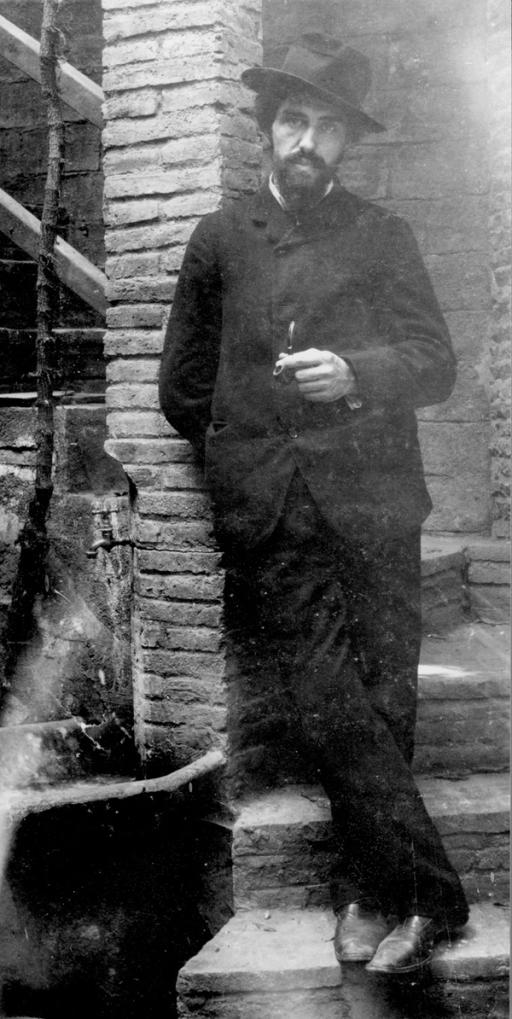
Joaquín Torres-García
Uruguayan, 1874–1949 13 works onlineThe Uruguayan-born artist Joaquín Torres García was 60 years old when he returned to his native country in 1934, after living abroad in Spain, France, Italy, and the United States for more than four decades.
Learn more →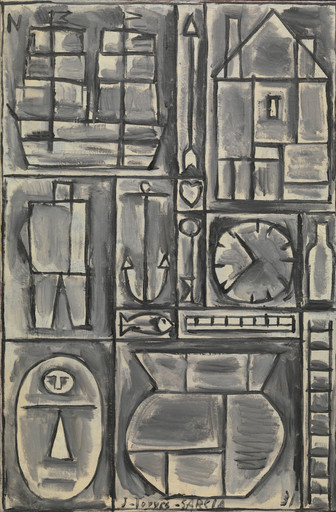
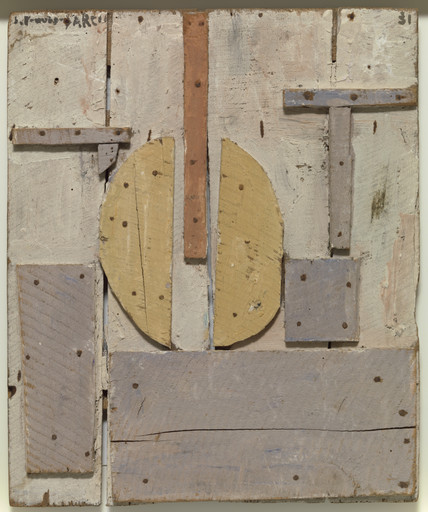
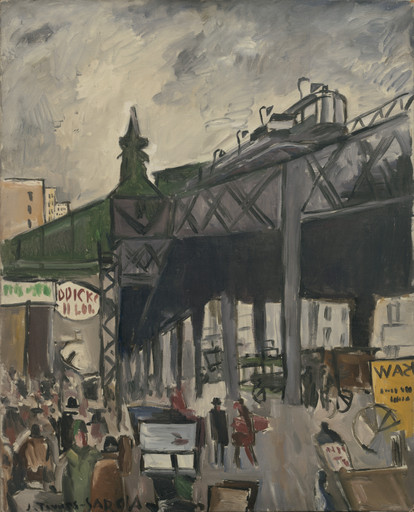
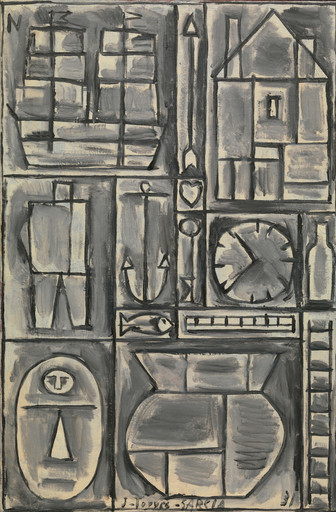
Circle and Square, Joaquin Torres-Garcia and Piet Mondrian
Gallery 512Joaquín Torres-García and Piet Mondrian met in Paris in 1929 and, together with the Belgian artist and writer Michel Seuphor, founded the group Cercle et Carré (Circle and Square).
Learn more →


Audio
Audio from the playlist Collection 1880s–1940s
From MoMA Design Store


Installation views
We have identified this work in the following photos from our exhibition history.
Provenance
The artist.
1949, Estate of the Artist, Montevideo.
? - 1989, Galeria Gmurzynska, Cologne.
1998 - 2004, Colección Patricia Phelps de Cisneros, New York, and Caracas, purchased through Christie’s, New York, "Important Latin American Paintings, Drawings and Sculpture", Sale 8888, lot 25, May 29, 1998.
2004, The Museum of Modern Art, New York, acquired as gift from Patricia Phelps de Cisneros.
Exhibition history
MoMA Exh. #1931: "Painting and Sculpture: Inaugural Installation", 5th Floor, gallery 9, November 20, 2004 - August 7, 2005
Mexico City, Museo del Palacio de Bellas Artes, "Cruce de Miradas Tradiciones Plásticas de América Latina en la colección CPPC", August 2 through October 22, 2006
Austin, Blanton Museum of Art, "The Geometry of Hope: Latin American Geometrical Abstraction from the Patricia Phelps de Cisneros Collection", February 17, 2007 - April 5, 2007
MoMA Exh. #2022: "New Perspectives in Latin American Art, 1930-2006: Selections from a Decade of Acquisitions", 3rd Floor, November 21, 2007 - February 25, 2008
Albany, New York State Museum, "Latin American and Caribbean Art: Selected Highlights from the Collection of The Museum of Modern Art", May 17 - October 13, 2008
Madrid, Fundación Juan March, "Geometric Abstraction in Latin America (1934-1973)", February 11 - May 15, 2011
MoMA Exh. #2178: "Painting and Sculpture Changes 2012", 5th Floor, gallery 10, added July 16 - November 27, 2012
Madrid, Museo Nacional Centro de Arte Reina Sofía, "La invención concreta. Collección Patricia Phelps de Cisneros", January 22 - September 16, 2013
London, Royal Academy of Arts, "Radical Geometry: Modern Art of South America from the Patricia Phelps de Cisneros Collection", July 5 - September 28, 2014
MoMA Exh. #2339: "Joaquín Torres-García: The Arcadian Modern", 6th Floor, The International Council of The Museum of Modern Art Gallery, October 25, 2015 - February 15, 2016 and tour:
Madrid, Fundación Telefónica, May 19 - September 18, 2016
Malaga, Museo Picasso Malaga, October 3, 2016 - January 29, 2017
MoMA Exh. #2424: "Sur moderno: Journeys of Abstraction—The Patricia Phelps de Cisneros Gift", 3rd Floor, 3 East, October 21, 2019 - September 12, 2020
MoMA Exh. #2462: “Collection: 1880s-1940s”, 5th Floor, gallery 512, “Circle and Square, Joaquin Torres-Garcia and Piet Mondrian”, November 14, 2020 -
Licensing
Artwork or archival images
If you would like to reproduce an image of a work of art in MoMA's collection, or an image of a MoMA publication or archival material (including installation views, checklists, and press releases), please contact Art Resource (publication in North America) or Scala Archives (publication in all other geographic locations).
Audio and film clips
MoMA licenses archival audio and select out of copyright film clips from our film collection. At this time, MoMA produced video cannot be licensed by MoMA/Scala. All requests to license archival audio or out of copyright film clips should be addressed to Scala Archives at [email protected]. Motion picture film stills cannot be licensed by MoMA/Scala. For access to motion picture film stills for research purposes, please contact the Film Study Center at [email protected]. For more information about film loans and our Circulating Film and Video Library, please visit Circulating Film and Video Library.
Text from a publication or the archives
If you would like to reproduce text from a MoMA publication, please email [email protected]. If you would like to publish text from MoMA's archival materials, please fill out this permission form and send to [email protected].
Feedback
This record is a work in progress. If you have additional information or spotted an error, please fill out this feedback form.