Not on view
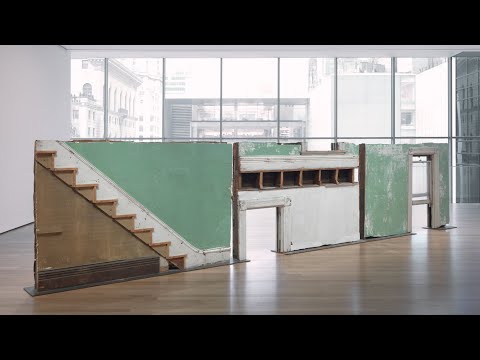
Matta-Clark cut these fragments from the facade of a house in Niagara Falls, New York, that was about to be demolished by the local housing commission. Working with a small team over the course of ten days, he cut the facade into nine equivalent rectangles then removed each one until only the central rectangle remained, like the central section of a Bingo card. Minutes after they finished the extraction, the house was razed. The artist retained these three sections and deposited the remaining five in a nearby sculpture park, where he hoped they would be "gradually reclaimed by the Niagara River Gorge."
Matta-Clark was raised in New York City, and he had witnessed firsthand the constant demolition of older buildings for the construction of new ones, the result of shifting real estate values. "Work with abandoned structures," he wrote around 1974, "began with my concern for the life of the city, of which a major side effect is the metabolization of old buildings." The presence of empty and neglected buildings in urban centers is "a reminder of the ongoing fallacy of renewal through modernization."
Contemporary Art from the Collection, June 30, 2010 - September 12, 2011.
Publication excerpt from MoMA Highlights: 375 Works from The Museum of Modern Art, New York (New York: The Museum of Modern Art, 2019)
The city planning commission of Niagara Falls, New York, allotted Matta-Clark ten days to carve up a condemned house at 349 Erie Avenue before it was demolished. He divided the facade into a grid and then removed each rectangle individually. The result was eight separate building fragments (Bingo comprises three of them) and a Super 8 film documenting the deconstruction. In Matta-Clark’s process of subtraction and destruction, attributes that are conventionally associated with a house—domesticity, comfort, privacy—were displaced by a disorienting physical experience: the house became strange, a simple container for space now opened and incomplete.
Matta-Clark trained as an architect before developing the practice of “anarchitecture,” his term for the attacks he staged on the structural foundations of the built environment. As the tract houses of postwar suburban America began to decay in the 1970s, he sought to unearth the ideological assumptions attached to structures like the single-family home he demolished for Bingo. “Social mobility is the greatest spatial factor. . . . How one maneuvers in the system determines what kind of space [one] works and lives in,” Matta-Clark said, emphasizing the sociological critique that underpinned his work.
MoMA Highlights: 375 Works from The Museum of Modern Art, New York (New York: The Museum of Modern Art, 2019)
Explore more
Audio
Audio from the playlist Kids
Audio from the playlist 1950–1980: Works from the Collection
Articles and videos
From MoMA Design Store


Installation views
We have identified this work in the following photos from our exhibition history.
Licensing
Artwork or archival images
If you would like to reproduce an image of a work of art in MoMA's collection, or an image of a MoMA publication or archival material (including installation views, checklists, and press releases), please contact Art Resource (publication in North America) or Scala Archives (publication in all other geographic locations).
Audio and film clips
MoMA licenses archival audio and select out of copyright film clips from our film collection. At this time, MoMA produced video cannot be licensed by MoMA/Scala. All requests to license archival audio or out of copyright film clips should be addressed to Scala Archives at [email protected]. Motion picture film stills cannot be licensed by MoMA/Scala. For access to motion picture film stills for research purposes, please contact the Film Study Center at [email protected]. For more information about film loans and our Circulating Film and Video Library, please visit Circulating Film and Video Library.
Text from a publication or the archives
If you would like to reproduce text from a MoMA publication, please email [email protected]. If you would like to publish text from MoMA's archival materials, please fill out this permission form and send to [email protected].
Feedback
This record is a work in progress. If you have additional information or spotted an error, please fill out this feedback form.