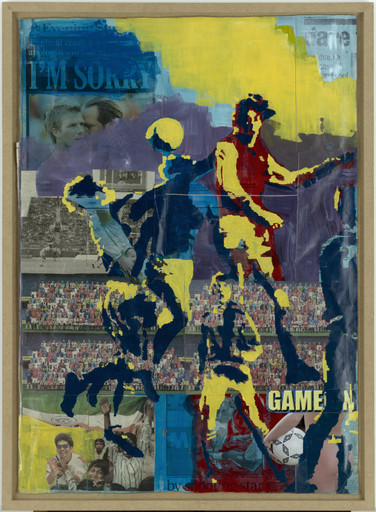
Geezer is part of a large body of work by Lucas dedicated to Charlie George, a star player of one of the top London soccer clubs during the 1970s. Lucas grew up in the same gritty working-class neighborhood as George, who in the artist's youth represented dreams of stardom and escape. Here, in a portrait comprised primarily of collaged pizza-parlor advertisements, Lucas uses her relationship with the soccer star as a touchstone for a complicated investigation of identity, success, and marketing.
While George is the ostensible subject of the portrait, the figure bears an uncanny resemblance to Lucas, whose work typically explores androgyny, the hybridity of personal identity, and double meanings. Indeed, Geezer can be understood as a kind of self-portrait connecting the artist's personal history with that of the soccer star's. However, Geezer is infused with a biting political critique as well. By rendering the face of the portrait from advertisements—the only legible identifying characteristic in the drawing is the logo of George's team, Arsenal—Lucas seems to speak to the commodification of bodies in sports, and in society generally. Not only are the fans' identities molded by their identification with sports stars, but those models to which they aspire are themselves just blank screens for the projection of logos. In this light, the letters "nanza," which emblazon the absolute center of the subject's forehead, stand as a poignant symbol for the fragmentary nature of the "bonanza" of success. For as much as Geezer celebrates Charlie George and represents dreams and their realization, it also depicts the underbelly of certain aspects of late-stage capitalism—a stance perfectly attuned to the tradition of political commentary in much collage, to which Lucas knowingly nods with this work.
The Museum of Modern Art, MoMA Highlights, New York: The Museum of Modern Art, revised 2004, originally published 1999, p. 371.
Explore more
Young British Artists
A label applied to a loose group of British artists who began to exhibit together in 1988, and who became known for their openness to materials and processes, shock tactics, and entrepreneurial attitude.
Learn more →


From MoMA Design Store


Installation views
We have identified this work in the following photos from our exhibition history.
Licensing
Artwork or archival images
If you would like to reproduce an image of a work of art in MoMA's collection, or an image of a MoMA publication or archival material (including installation views, checklists, and press releases), please contact Art Resource (publication in North America) or Scala Archives (publication in all other geographic locations).
Audio and film clips
MoMA licenses archival audio and select out of copyright film clips from our film collection. At this time, MoMA produced video cannot be licensed by MoMA/Scala. All requests to license archival audio or out of copyright film clips should be addressed to Scala Archives at [email protected]. Motion picture film stills cannot be licensed by MoMA/Scala. For access to motion picture film stills for research purposes, please contact the Film Study Center at [email protected]. For more information about film loans and our Circulating Film and Video Library, please visit Circulating Film and Video Library.
Text from a publication or the archives
If you would like to reproduce text from a MoMA publication, please email [email protected]. If you would like to publish text from MoMA's archival materials, please fill out this permission form and send to [email protected].
Feedback
This record is a work in progress. If you have additional information or spotted an error, please fill out this feedback form.