Trained in the visual arts while also experimenting with music, Christian Marclay emerged in the 1980s as a crossover artist, fusing the worlds of music, fine art, and performance. His work comprises sculpture, collage, and installation, and invariably includes records, album covers, and musical instruments, all rendered unusable and surreal through restructuring and distortion. He also continues to compose and perform music and produces videos that ingeniously integrate clips about the meaning and production of sound.
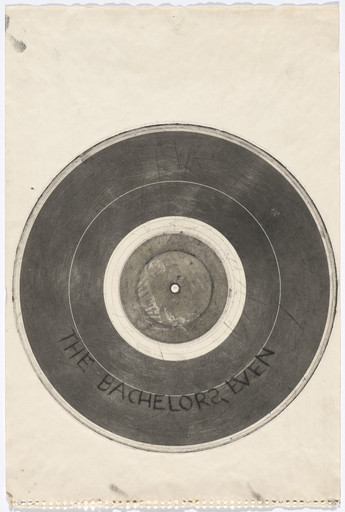
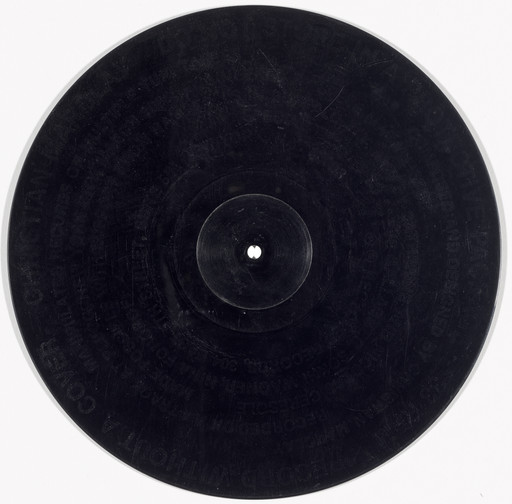
Marclay's innovative approach to printmaking reflects his fascination with the vinyl record, which itself is an object that has been engraved. In 1990, at the invitation of Judith Solodkin of Solo Press, Marclay completed this print using records as readymade printing plates, just as a traditional printmaker uses a copperplate or woodblock. First he experimented with several monotypes, fine-tuning the printing process so that the records would not crack. To make this Untitled edition, he selected a variety of 10- and 12-inch records (all old 78 RPMs with wide grooves), placed them in a specially designed support to prevent breakage, then inked them using a roller and ran them through the press. The overlapping ghostlike representations on the paper capture the variety of moirT patterns and concentric designs that the printed records produced. Mimicking the commercial four-color printing process, Marclay mixed black ink with yellow, magenta, and cyan, producing further optical vibrations.
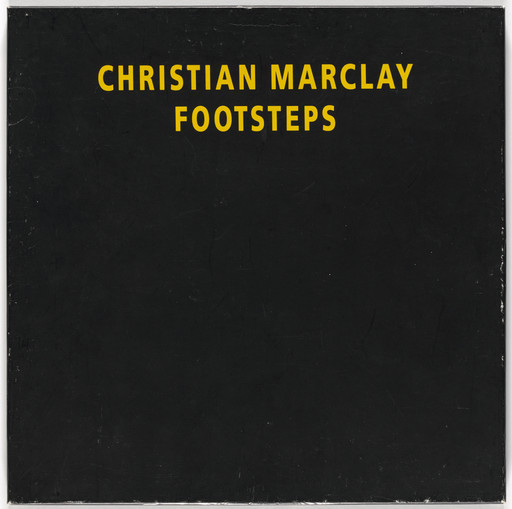
While at Solo Press, Marclay also experimented with printing records on old Beatles' album covers. In the late 1990s, with Goya-Girl Press in Baltimore, he began a series of photolithographs based on snapshots of instruments. More recently he printed a boxed set of digital prints at Muse [X] Editions in Los Angeles that documents a project involving musical scores posted on the streets of Berlin. Marclay has also created printed works to "publicize" fictional performances and recordings, as well as several editioned multiples that reflect his fascination with objects that create sound.
an essay by Judy Hecker, in Deborah Wye, Artists and Prints: Masterworks from The Museum of Modern Art, New York: The Museum of Modern Art, 2004, p. 248.
Gallery label from Out of Time: A Contemporary View , August 30, 2006–April 9, 2007.
Marclay, an artist who has been exploring visual and audio crosscurrents for twenty years, plastered more than five thousand blank musical notation sheets in public spaces throughout Berlin during a month-long sound festival in 1996. Members of the public filled them in with standard musical notations as well as scribbles, drawings, and random marks. Marclay then photographed the graffitied sheets, selected 150 from the group, and compiled them into a book, creating a musical score. This selection of prints makes visible the usually intangible elements of music, like beat and rhythm.
Out of Time: A Contemporary View, August 30, 2006–April 9, 2007.
Explore more
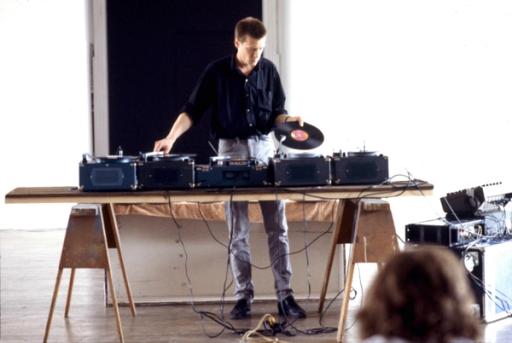
Christian Marclay
American and Swiss, born 1955 25 works onlineTime—that most intangible and mysterious of things—is the very stuff of modern culture. What else is a film but time captured and condensed onto celluloid ?
Learn more →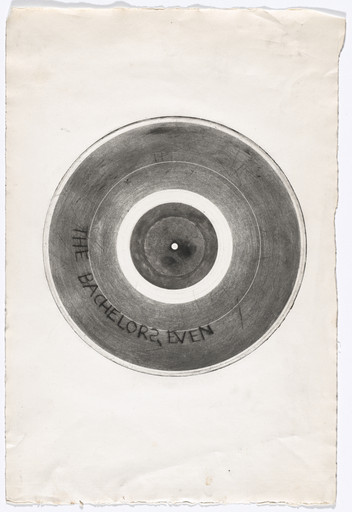
From MoMA Design Store


Installation views
We have identified this work in the following photos from our exhibition history.
Licensing
Artwork or archival images
If you would like to reproduce an image of a work of art in MoMA's collection, or an image of a MoMA publication or archival material (including installation views, checklists, and press releases), please contact Art Resource (publication in North America) or Scala Archives (publication in all other geographic locations).
Audio and film clips
MoMA licenses archival audio and select out of copyright film clips from our film collection. At this time, MoMA produced video cannot be licensed by MoMA/Scala. All requests to license archival audio or out of copyright film clips should be addressed to Scala Archives at [email protected]. Motion picture film stills cannot be licensed by MoMA/Scala. For access to motion picture film stills for research purposes, please contact the Film Study Center at [email protected]. For more information about film loans and our Circulating Film and Video Library, please visit Circulating Film and Video Library.
Text from a publication or the archives
If you would like to reproduce text from a MoMA publication, please email [email protected]. If you would like to publish text from MoMA's archival materials, please fill out this permission form and send to [email protected].
Feedback
This record is a work in progress. If you have additional information or spotted an error, please fill out this feedback form.