Kupka seems to have arrived at this and similar composition gradually, beginning in 1907–8 with a drawing of a girl holding a ball in her hand, as if she were about to play or dance with it. He then developed progressively more diagrammatic images of her circular motion, ultimately arriving at a series of fully abstract drawings. In a limited palette of red, blue, black, and white, ribbons of color morph across the page. The radically fluid relationship they establish between foreground and background, line and plane, signals Kupka’s prescient renunciation of the aesthetic conventions of perspective. He made these studies for his manifesto painting Amorpha, fugue a deux couleurs (Amorpha, fugue in two colors), which when it was shown at the 1912 Salon d’Automne, a watershed event in the history of modernist abstraction, was one of the very first abstract paintings to be publicly exhibited in Paris.
Inventing Abstraction, 1910–1925, December 23, 2012–April 15, 2013.
Gallery label from Geo/Metric: Prints and Drawings from the Collection , June 11– August 18, 2008.
Kupka was born in the Czech Republic and settled in Paris in 1896. In 1910 he became one of the first artists to work in a completely abstract mode, developing colorful, visionary paintings and watercolors such as these. They are a product of his mystical belief that rhythmic forms in pure colors can reflect the forces of the cosmos.
Geo/Metric: Prints and Drawings from the Collection, June 11– August 18, 2008.
Publication excerpt from The Museum of Modern Art, MoMA Highlights , New York: The Museum of Modern Art, revised 2004, originally published 1999, p. 80.
This small study for a large painting, Amorpha, Fugue in Two Colors (1912), is one of twenty-seven such studies in the collection of The Museum of Modern Art. It shows a late interpretation of this theme, the fugue, in which the irregularly shaped and patterned panes recall the complexity and translucency of stained–glass windows. In the final painting, Kupka simplified the composition into broader planes of color that constitute a single monumental arabesque.
The painting was exhibited at the Salon d'Automne in Paris in 1912, where it provoked general consternation. Whereas Kupka's original motifs had been inspired by nature, his final gouache studies and the painting itself were totally abstract and distilled to two colors, red and blue. These were intended to represent the interlacing voices of a fugue, in which, as he himself wrote, "the sounds evolve like veritable physical entities, intertwine, come and go."
Born in a small city in eastern Bohemia, Kupka studied in Prague and Vienna and then settled permanently in Paris in 1896. By 1912 his painting had evolved to a radically abstract style, establishing him as one of the earliest pioneers of abstraction in European painting.
The Museum of Modern Art, MoMA Highlights, New York: The Museum of Modern Art, revised 2004, originally published 1999, p. 80.
Explore more
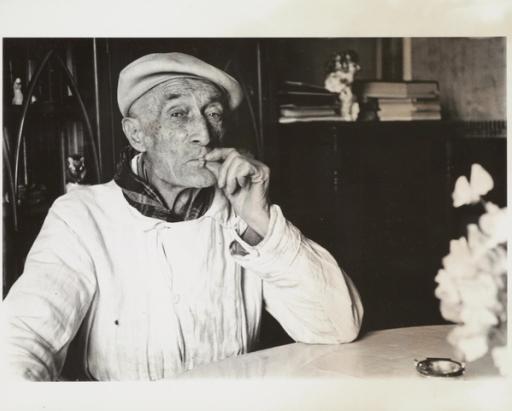
František Kupka
Czech, 1871–1957 51 works onlineShortly before he died in 1957, František Kupka sold Mme Kupka among Verticals , a work he had stored in his studio for nearly 45 years after its completion in 1910–11, to The Museum of Modern Art.
Learn more →



From MoMA Design Store


Installation views
We have identified this work in the following photos from our exhibition history.
Licensing
Artwork or archival images
If you would like to reproduce an image of a work of art in MoMA's collection, or an image of a MoMA publication or archival material (including installation views, checklists, and press releases), please contact Art Resource (publication in North America) or Scala Archives (publication in all other geographic locations).
Audio and film clips
MoMA licenses archival audio and select out of copyright film clips from our film collection. At this time, MoMA produced video cannot be licensed by MoMA/Scala. All requests to license archival audio or out of copyright film clips should be addressed to Scala Archives at [email protected]. Motion picture film stills cannot be licensed by MoMA/Scala. For access to motion picture film stills for research purposes, please contact the Film Study Center at [email protected]. For more information about film loans and our Circulating Film and Video Library, please visit Circulating Film and Video Library.
Text from a publication or the archives
If you would like to reproduce text from a MoMA publication, please email [email protected]. If you would like to publish text from MoMA's archival materials, please fill out this permission form and send to [email protected].
Feedback
This record is a work in progress. If you have additional information or spotted an error, please fill out this feedback form.