Gelatin silver print
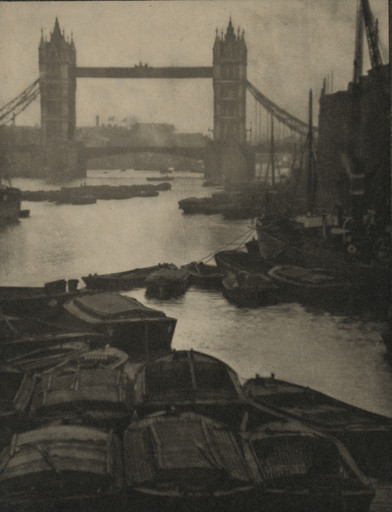
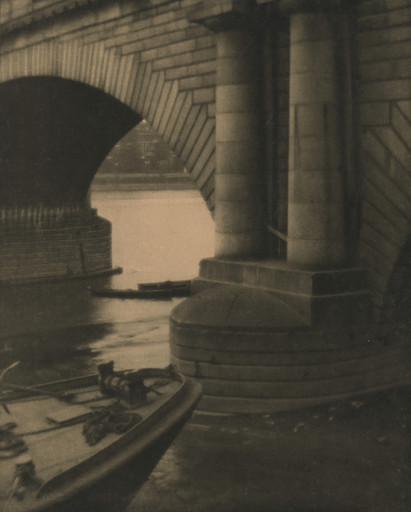
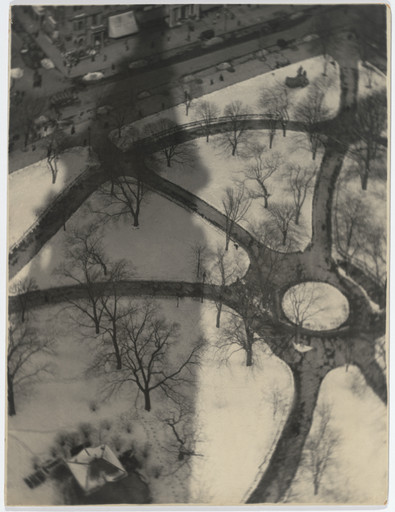
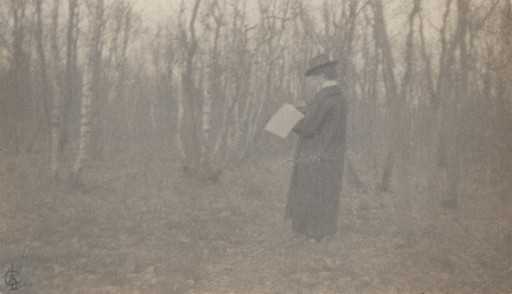
Photo-Secessionists embraced labor-intensive processes that emphasized the role of photographers as craftsmen and challenged the notion of photography as an entirely mechanical medium. While deeply rooted in this approach, these image-makers also explored alternative ways of embracing form, through angular abstraction and straight photography. Alvin Langdon Coburn’s The Octopus and Vortograph offer a unique glimpse into this oscillation between formal approaches. While markedly different in scale and style, Vortograph exaggerates the fluid lines of The Octopus, taking this graphic composition to a more abstract dimension. Coburn believed photography to be “the most modern of the arts,” offering artists “infinite possibilities” of conveying the world around them.
504: A Little Gallery of the Photo-Secession, 2025
Gallery label from Inventing Abstraction, 1910–1925 , December 23, 2012–April 15, 2013.
The intricate patterns of light and line in this photograph, and the cascading tiers of crystalline shapes, were generated through the use of a kaleidoscopic contraption invented by the American/British photographer Alvin Langdon Coburn, a member of London's Vorticist group. To refute the idea that photography, in its helplessly accurate capture of scenes in the real world, was antithetical to abstraction, Coburn devised for his camera lens an attachment made up of three mirrors, clamped together in a triangle, through which he photographed a variety of surfaces to produce the results in these images. The poet and Vorticist Ezra Pound coined the term "vortographs" to describe Coburn’s experiments. Although Pound went on to criticize these images as lesser expressions than Vorticist paintings, Coburn's work would remain influential.
Inventing Abstraction, 1910–1925, December 23, 2012–April 15, 2013.
Explore more
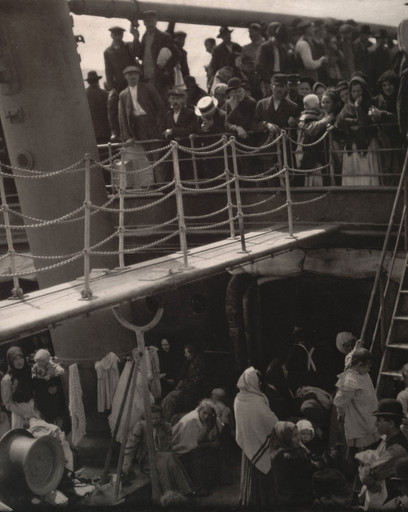
A Little Gallery of the Photo-Secession
Gallery 504In 1902, a group of photographers banded together in protest against the conventional view of the medium as a mechanical tool.
Learn more →

From MoMA Design Store


Installation views
We have identified this work in the following photos from our exhibition history.
Licensing
Artwork or archival images
If you would like to reproduce an image of a work of art in MoMA's collection, or an image of a MoMA publication or archival material (including installation views, checklists, and press releases), please contact Art Resource (publication in North America) or Scala Archives (publication in all other geographic locations).
Audio and film clips
MoMA licenses archival audio and select out of copyright film clips from our film collection. At this time, MoMA produced video cannot be licensed by MoMA/Scala. All requests to license archival audio or out of copyright film clips should be addressed to Scala Archives at [email protected]. Motion picture film stills cannot be licensed by MoMA/Scala. For access to motion picture film stills for research purposes, please contact the Film Study Center at [email protected]. For more information about film loans and our Circulating Film and Video Library, please visit Circulating Film and Video Library.
Text from a publication or the archives
If you would like to reproduce text from a MoMA publication, please email [email protected]. If you would like to publish text from MoMA's archival materials, please fill out this permission form and send to [email protected].
Feedback
This record is a work in progress. If you have additional information or spotted an error, please fill out this feedback form.