Oil on canvas
Although Bridge over the Riou describes a place in the south of France, its complexly patterned composition suggests a gradual reworking and reshaping rather than a quick and fluid response to what Derain saw there. From the foreground bank, over the riverbed, to the higher ground beyond, the space is compressed and flattened, but the scene can still be identified—the bridge at the lower right, a cabin down in the ravine, the beehive form of a covered well. Houses appear beyond the river, behind the trees.
In 1905 Derain and his peers in the Fauvist group had created a succés de scandale through their radical use of color, but they still accepted from Impressionism the idea that a painting should follow nature, and should try to capture the passing moment of contemporary life. By 1906, however, Derain wanted to create images that would "belong to all time" as well as to his own period, and the separate strokes of color seen in his paintings of 1905 are here subsumed into larger colored shapes, some of them outlined in exotic blues or lavenders, or an indian red or pink, say, for a tree trunk. This emotionally high-keyed color relates to the intensity of the light in the south of France, yet belongs less to nature than to art.
The Museum of Modern Art, MoMA Highlights, New York: The Museum of Modern Art, revised 2004, originally published 1999.
Explore more
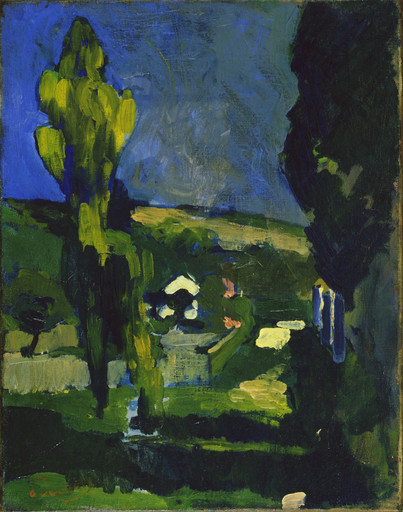
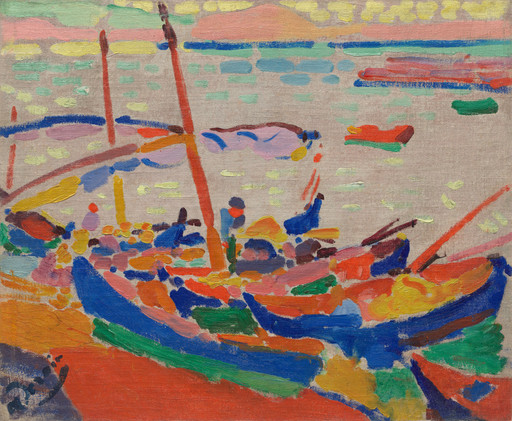
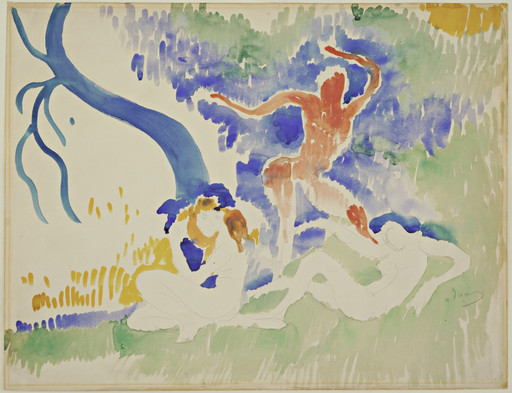

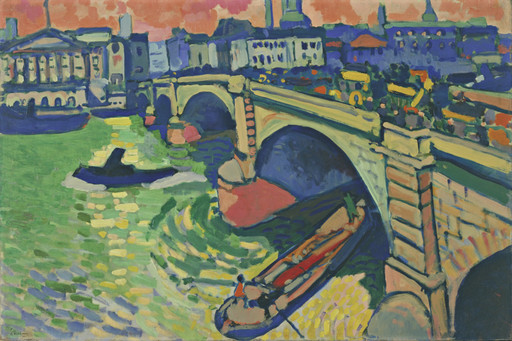
Fauvism
A style of painting in the first decade of the 20th century that emphasized strong, vibrant color and bold brushstrokes over realistic or representational qualities.
Learn more →
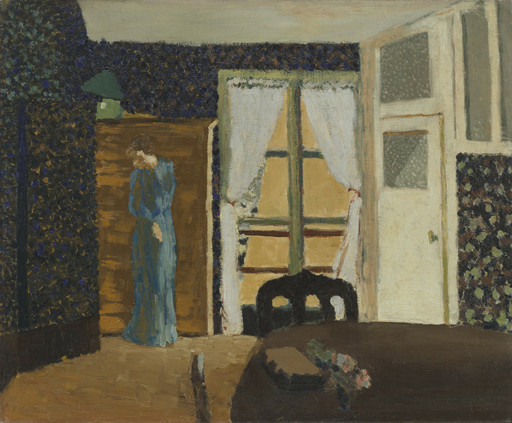
Intimate Visions
Gallery 518Much modern painting is made on a grand scale, but the works in this gallery are intimate in size and character.
Learn more →
From MoMA Design Store


Installation views
We have identified this work in the following photos from our exhibition history.
Provenance Research Project
This work is included in the Provenance Research Project, which investigates the ownership history of works in MoMA's collection.
The William S. Paley Collection at The Museum of Modern Art, New York, 1990
Provenance research is a work in progress, and is frequently updated with new information. If you have any questions or information to provide about the listed works, please email [email protected] or write to:
Provenance Research Project
The Museum of Modern Art
11 West 53 Street
New York, NY 10019
Licensing
Artwork or archival images
If you would like to reproduce an image of a work of art in MoMA's collection, or an image of a MoMA publication or archival material (including installation views, checklists, and press releases), please contact Art Resource (publication in North America) or Scala Archives (publication in all other geographic locations).
Audio and film clips
MoMA licenses archival audio and select out of copyright film clips from our film collection. At this time, MoMA produced video cannot be licensed by MoMA/Scala. All requests to license archival audio or out of copyright film clips should be addressed to Scala Archives at [email protected]. Motion picture film stills cannot be licensed by MoMA/Scala. For access to motion picture film stills for research purposes, please contact the Film Study Center at [email protected]. For more information about film loans and our Circulating Film and Video Library, please visit Circulating Film and Video Library.
Text from a publication or the archives
If you would like to reproduce text from a MoMA publication, please email [email protected]. If you would like to publish text from MoMA's archival materials, please fill out this permission form and send to [email protected].
Feedback
This record is a work in progress. If you have additional information or spotted an error, please fill out this feedback form.