Aluminum and plastic
Not on view
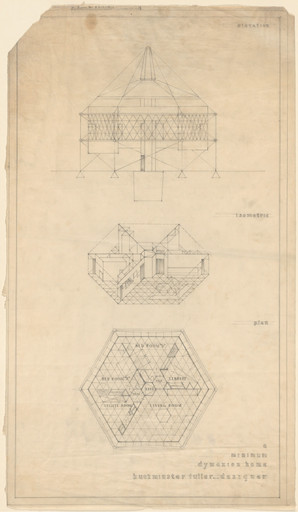
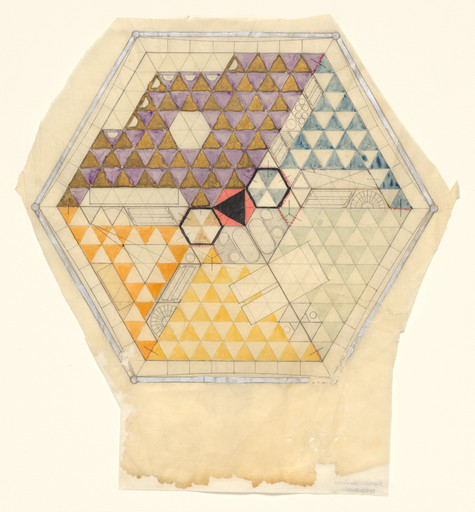
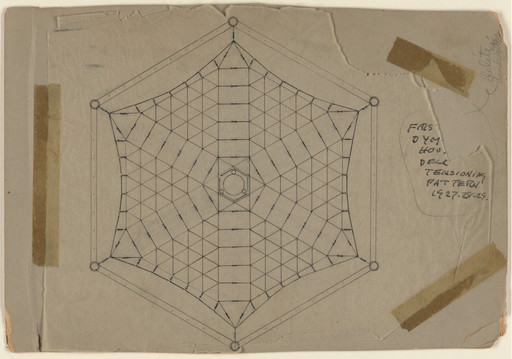
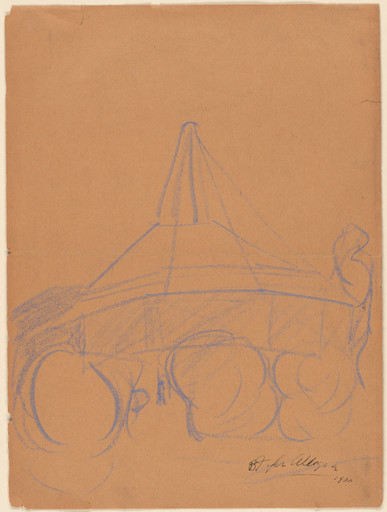
Developed from a project initially conceived by Fuller in 1920, this 1940s model depicts an autonomous, self-sustaining single-family dwelling that, composed of prefabricated elements, could be mass-produced and shipped throughout the world. Fuller described the Dymaxion Dwelling Machine as “an attitude and an interpretive principle” that would mobilize and integrate society. He was an ardent champion of doing “more with less,” and his ambition was to maintain equitable, sustainable relationships in every context and discipline. A portmanteau of three words—“dynamic,” “maximum,” and “tension”—the term Dymaxion connoted a systemic approach to household living; it was also applied to a patented bathroom and an automobile that Fuller developed in the 1930s.
In Fuller’s design, the Dymaxion Dwelling Machine—a freestanding structure of lightweight aluminum—is held aloft by a massive column containing all of its utilities. The hundred-square-meter (1,076-square-foot) building is self-sustaining: wind turbines circulate warm or cool air, while cisterns collect and recycle water. Modular furnishings are included, and an open plan allows the interior to be transformed at will by its inhabitants. Fuller built two full-size prototypes, including the house in Wichita, Kansas, represented in this model. As mass housing became a critical aspect of rebuilding after World War II, one writer, in a 1946 article, commented, “The ‘Dwelling Machine’ is likely to produce greater social consequences than the introduction of the automobile.”
MoMA Highlights: 375 Works from The Museum of Modern Art, New York (New York: The Museum of Modern Art, 2019)
Explore more

Architectural model
A presentation of an architectural concept in three-dimensional form. Can also refer to digital files representing the same.
Learn more →

From MoMA Design Store


Installation views
We have identified this work in the following photos from our exhibition history.
Licensing
Artwork or archival images
If you would like to reproduce an image of a work of art in MoMA's collection, or an image of a MoMA publication or archival material (including installation views, checklists, and press releases), please contact Art Resource (publication in North America) or Scala Archives (publication in all other geographic locations).
Audio and film clips
MoMA licenses archival audio and select out of copyright film clips from our film collection. At this time, MoMA produced video cannot be licensed by MoMA/Scala. All requests to license archival audio or out of copyright film clips should be addressed to Scala Archives at [email protected]. Motion picture film stills cannot be licensed by MoMA/Scala. For access to motion picture film stills for research purposes, please contact the Film Study Center at [email protected]. For more information about film loans and our Circulating Film and Video Library, please visit Circulating Film and Video Library.
Text from a publication or the archives
If you would like to reproduce text from a MoMA publication, please email [email protected]. If you would like to publish text from MoMA's archival materials, please fill out this permission form and send to [email protected].
Feedback
This record is a work in progress. If you have additional information or spotted an error, please fill out this feedback form.