Rem Koolhaas, Zoe Zenghelis
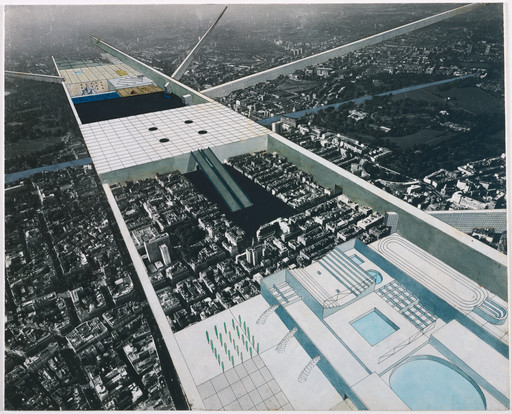
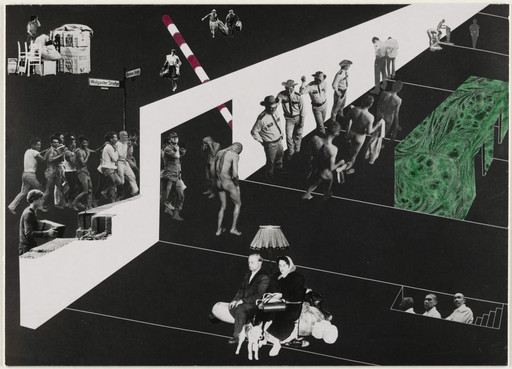
New Welfare Island Project, Roosevelt Island, New York, NY (Aerial perspective)
c. 1975-76
Gouache on paper
Not on view
Rem Koolhaas, German Martinez, and Richard Perlmutter designed New Welfare Island for the south end of Roosevelt Island (once known as Welfare Island). This theoretical project extended Manhattan's grid, in this case between Fiftieth and Fifty-ninth streets, onto the island, in a manner similar to that used for Koolhaas's and Zenghelis's Roosevelt Island Redevelopment competition entry. Each newly created lot was intended to support competing structures—formally, ideologically, and programmatically—corresponding to what they viewed as Manhattan's dominant characteristic. Just north of the "travelator," a moving pavement extending to the rivers, is a convention center. To its south, amid vacant lots reserved for future use, are Kazimir Malevich's "Architecton," an interior harbor housing a 1932Norman Bel Geddes yacht, and a "Chinese" swimming pool. The New Welfare Hotel, a city within a city, which looks toward Manhattan, is situated at the bottom of the island.
an essay by Bevin Cline and Tina di Carlo, in Terence Riley, ed., The Changing of the Avant-Garde: Visionary Architectural Drawings from the Howard Gilman Collection, New York: The Museum of Modern Art, 2002, p. 145.
Publication excerpt from an essay by Terence Riley, in Matilda McQuaid, ed., Envisioning Architecture: Drawings from The Museum of Modern Art , New York: The Museum of Modern Art, 2002, p. 172.
Koolhaas, German Martinez, and Richard Perlmutter designed the theoretical New Welfare Island Project for just the southern half of Roosevelt Island (once called Welfare Island). At the top of the aerial view, the Queensboro Bridge passes through a convention center, a monumental gateway to Manhattan. Farther south, a tecton—a Suprematist device from the work of Kasimir Malevich—hovers over a streamlined Art Deco yacht designed in 1932 by Norman Bel Geddes. At the island's tip the six towers of the New Welfare Hotel rise up opposite a wandering fragment of Manhattan that includes Rockefeller Center and Times Square (including the proposed Sphinx Hotel, designed by Elia and Zoe Zenghelis). The New Welfare Hotel, designed by Koolhaas, Perlmutter, and Derrick Snare, is separately rendered in the third drawing; it is a center for dancing, dining, and general urban pleasure. Overall, Koolhaas writes, the Roosevelt Island project is intended as a visual interpretation and resuscitation of some of the themes that made Manhattan's architecture unique; its ability to fuse the popular with the metaphysical, the commercial with the sublime, the refined with the primitive.
an essay by Terence Riley, in Matilda McQuaid, ed., Envisioning Architecture: Drawings from The Museum of Modern Art, New York: The Museum of Modern Art, 2002, p. 172.
Explore more
Zoe Zenghelis
British, born Greece 1937 29 works onlinean interviewer once asked painter Zoe Zenghelis. She responded that her choice would be “walking and looking at streets, buildings, trees and plants, or looking at design in general.
Learn more →

From MoMA Design Store


Installation views
We have identified this work in the following photos from our exhibition history.
Licensing
Artwork or archival images
If you would like to reproduce an image of a work of art in MoMA's collection, or an image of a MoMA publication or archival material (including installation views, checklists, and press releases), please contact Art Resource (publication in North America) or Scala Archives (publication in all other geographic locations).
Audio and film clips
MoMA licenses archival audio and select out of copyright film clips from our film collection. At this time, MoMA produced video cannot be licensed by MoMA/Scala. All requests to license archival audio or out of copyright film clips should be addressed to Scala Archives at [email protected]. Motion picture film stills cannot be licensed by MoMA/Scala. For access to motion picture film stills for research purposes, please contact the Film Study Center at [email protected]. For more information about film loans and our Circulating Film and Video Library, please visit Circulating Film and Video Library.
Text from a publication or the archives
If you would like to reproduce text from a MoMA publication, please email [email protected]. If you would like to publish text from MoMA's archival materials, please fill out this permission form and send to [email protected].
Feedback
This record is a work in progress. If you have additional information or spotted an error, please fill out this feedback form.