Plexiglass maze, closed-circuit video camera, scanner and mount, switcher, two videotape players, 13-inch color monitor, 9-inch back-and-white monitor, video projector, and two videotapes (color, sound)
Not on view
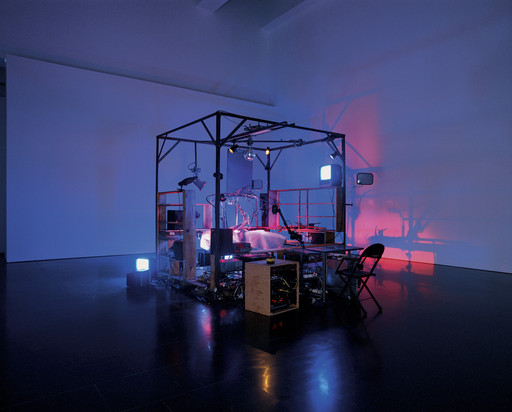
In this video installation, a low, transparent yellow Plexiglas maze, divided into many chambers, rests on the floor in the center of a darkened gallery. Monitors of different sizes occupy the two ends of the maze. They face the structure, while a video projector placed on a crate beams images onto an adjacent wall. All three video streams alternately display recorded images of a rat trapped within the maze and a teenage boy frantically playing the drums, interspersed with live images fed by a scanning video camera that surveys the now-empty maze. (Depending on the placement of the camera, it may also transmit images of the legs of passing viewers.)
The drums are loud, the equipment is devoid of visual pleasure, the maze is sharp-cornered and sickly yellow, and the signs of frustrated habit in the movements of both the boy and the rat are painfully similar. Nauman culled the title phrase from an article published in Scientific American in 1987 titled "Stressed Out: Learned Helplessness in Rats Sheds Light on Human Depression." Here the artist parodies a laboratory experiment and questions the social and scientific belief that human nature can be improved through controlled environments and behavioral retraining.
The Museum of Modern Art, MoMA Highlights since 1980, New York: The Museum of Modern Art, 2007, p. 93.
Explore more
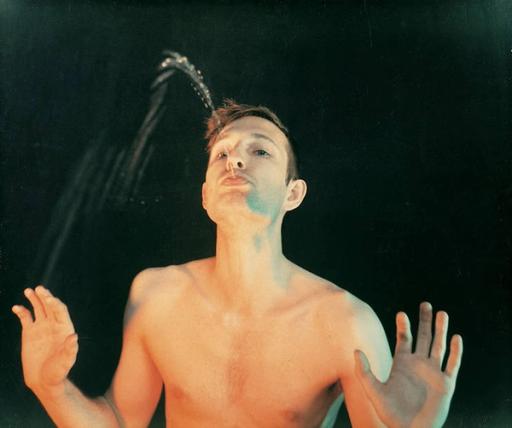
Bruce Nauman
American, born 1941 92 works onlineFor more than 50 years, he has worked in every conceivable artistic medium, dissolving established genres and inventing new ones in the process.
Learn more →
Installation
An art form that comprises visual elements in any medium and the space they inhabit.
Learn more →


From MoMA Design Store


Installation views
We have identified this work in the following photos from our exhibition history.
Licensing
Artwork or archival images
If you would like to reproduce an image of a work of art in MoMA's collection, or an image of a MoMA publication or archival material (including installation views, checklists, and press releases), please contact Art Resource (publication in North America) or Scala Archives (publication in all other geographic locations).
Audio and film clips
MoMA licenses archival audio and select out of copyright film clips from our film collection. At this time, MoMA produced video cannot be licensed by MoMA/Scala. All requests to license archival audio or out of copyright film clips should be addressed to Scala Archives at [email protected]. Motion picture film stills cannot be licensed by MoMA/Scala. For access to motion picture film stills for research purposes, please contact the Film Study Center at [email protected]. For more information about film loans and our Circulating Film and Video Library, please visit Circulating Film and Video Library.
Text from a publication or the archives
If you would like to reproduce text from a MoMA publication, please email [email protected]. If you would like to publish text from MoMA's archival materials, please fill out this permission form and send to [email protected].
Feedback
This record is a work in progress. If you have additional information or spotted an error, please fill out this feedback form.