Having worked as an impoverished poet for many years, Broodthaers began to make visual art in 1964, announcing rather provocatively, "I, too, wondered if I couldn't sell something and succeed in life. . . . The idea of inventing something insincere finally crossed my mind and I set to work at once." Broodthaers often used found or discarded materials, favoring eggshells, which are "without content other than the air." Using antique-looking furniture and organic materials, Broodthaers critiqued museum display and avoided modern products. In 1968, he created his own museum—called Museum of Modern Art—in his apartment, complete with labels and a catalogue.
2007.
Publication excerpt from The Museum of Modern Art, MoMA Highlights , New York: The Museum of Modern Art, revised 2004, originally published 1999, p. 263.
Explaining his beginnings in art, Broodthaers once wrote, "The idea of inventing something insincere . . . crossed my mind and I set to work at once." Anyone upset to find a cabinet of eggshells presented as art might take this to mean that the work is a joke. But there is another possibility: Broodthaers is warning us not to take him at face value, but to look for hidden meanings.
White Cabinet and White Table actually does have aesthetic ancestors, in Marcel Duchamp's Readymade objects and in the surprises of Surrealism. It also reflects the concern with everyday reality in the Pop and neo-realism of Broodthaers's own time. But Broodthaers wanted to avoid glamorizing modern products, and eggshells have nothing uniquely contemporary about them. They interested Broodthaers, rather, as empty containers—containers "without content other than the air."
There are other containers in White Cabinet and White Table: the cabinet and table themselves, both stuffed with content, but an apparently empty or meaningless one. If the table stands on the floor like a sculpture's pedestal while the closet hangs on the wall like a painting's frame (Broodthaers described himself as "painting with eggs"), then the work subtly analyzes art itself: how does art contain meaning for its viewers? Or has it been drained of meaning, like an eggshell minus its egg?
The Museum of Modern Art, MoMA Highlights, New York: The Museum of Modern Art, revised 2004, originally published 1999, p. 263.
Explore more
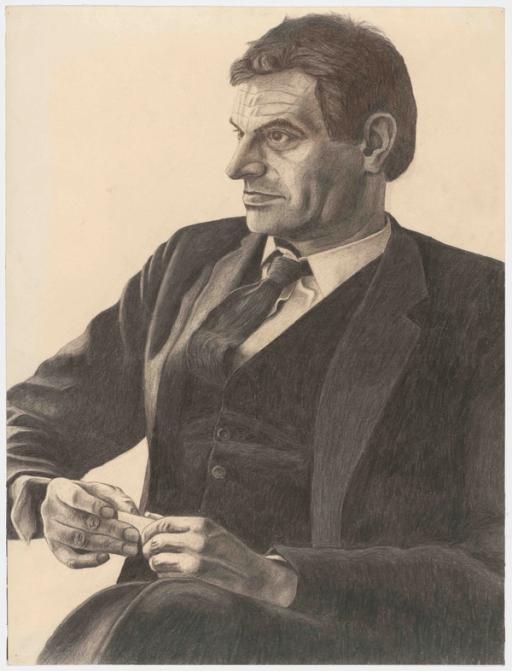
Marcel Broodthaers
Belgian, 1924–1976 94 works onlineOver the course of 12 extraordinary years, Marcel Broodthaers developed a distinctive body of work characterized by irreverence, wit, introspection, and skepticism.
Learn more →


From MoMA Design Store


Installation views
We have identified this work in the following photos from our exhibition history.
Licensing
Artwork or archival images
If you would like to reproduce an image of a work of art in MoMA's collection, or an image of a MoMA publication or archival material (including installation views, checklists, and press releases), please contact Art Resource (publication in North America) or Scala Archives (publication in all other geographic locations).
Audio and film clips
MoMA licenses archival audio and select out of copyright film clips from our film collection. At this time, MoMA produced video cannot be licensed by MoMA/Scala. All requests to license archival audio or out of copyright film clips should be addressed to Scala Archives at [email protected]. Motion picture film stills cannot be licensed by MoMA/Scala. For access to motion picture film stills for research purposes, please contact the Film Study Center at [email protected]. For more information about film loans and our Circulating Film and Video Library, please visit Circulating Film and Video Library.
Text from a publication or the archives
If you would like to reproduce text from a MoMA publication, please email [email protected]. If you would like to publish text from MoMA's archival materials, please fill out this permission form and send to [email protected].
Feedback
This record is a work in progress. If you have additional information or spotted an error, please fill out this feedback form.