Wax, stainless steel, and plexiglass
This work appears to be a slab of rotten meat, realistically rendered in wax and sealed in a display case made from colored plexiglass. It was partly inspired by a summer in Sicily, where the artist observed firsthand the Roman Catholic tradition of venerating saintly bodies through reliquaries, and reflects his reaction to the state of the art world of his time. “The world was falling apart, anyone could see it,” Thek explained. “I was a wreck, the block was a wreck, the city was a wreck; and I’d go to a gallery and there would be a lot of fancy people looking at a lot of stuff that didn’t say anything about anything to anyone.” The fictional text inscribed on the case, with its pseudo-legal terminology and warnings of massacre, highlight the heightened distrust of established institutions of the time.
420: Picturing History, 2026
Gallery label from From the Collection: 1960-69 , March 26, 2016 - March 12, 2017.
Hippopotamus Poison belongs to the series Technological Reliquaries, which Thek began in New York after a summer spent in Sicily. The work engages the Roman Catholic tradition of venerating saintly bodies that Thek had observed firsthand in the catacombs near Palermo and simultaneously offers a critique of the art of the time, Pop and Minimalism in particular. Within a visually seductive display case made from colored plexiglass sits what appears to be a slab of rotten meat, realistically rendered in wax. Inscribed on the vitrine is a paranoid quote that nods to a generation's underlying fears. "The world was falling apart, anyone could see it," Thek has explained. "I was a wreck, the block was a wreck, the city was a wreck; and I’d go to a gallery and there would be a lot of fancy people looking at a lot of stuff that didn’t say anything about anything to anyone."
From the Collection: 1960-69, March 26, 2016 - March 12, 2017.
Explore more
Picturing History
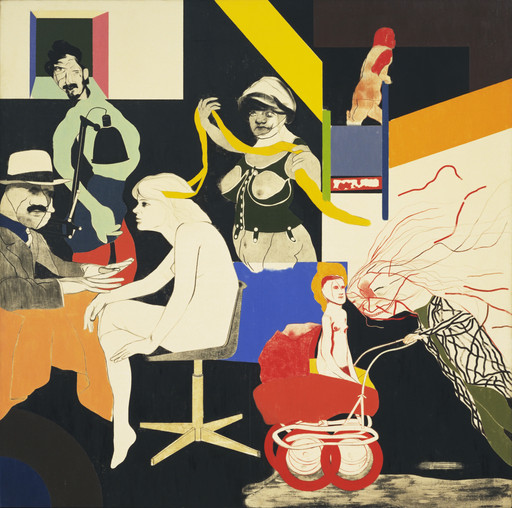
Gallery 420Her response to this omission was to create American People Series #20: Die. For the mural-sized painting, Ringgold depicted contemporary events using a figurative visual language—at a time when the art world celebrated abstraction.
Learn more →

From MoMA Design Store


Installation views
We have identified this work in the following photos from our exhibition history.
Licensing
Artwork or archival images
If you would like to reproduce an image of a work of art in MoMA's collection, or an image of a MoMA publication or archival material (including installation views, checklists, and press releases), please contact Art Resource (publication in North America) or Scala Archives (publication in all other geographic locations).
Audio and film clips
MoMA licenses archival audio and select out of copyright film clips from our film collection. At this time, MoMA produced video cannot be licensed by MoMA/Scala. All requests to license archival audio or out of copyright film clips should be addressed to Scala Archives at [email protected]. Motion picture film stills cannot be licensed by MoMA/Scala. For access to motion picture film stills for research purposes, please contact the Film Study Center at [email protected]. For more information about film loans and our Circulating Film and Video Library, please visit Circulating Film and Video Library.
Text from a publication or the archives
If you would like to reproduce text from a MoMA publication, please email [email protected]. If you would like to publish text from MoMA's archival materials, please fill out this permission form and send to [email protected].
Feedback
This record is a work in progress. If you have additional information or spotted an error, please fill out this feedback form.