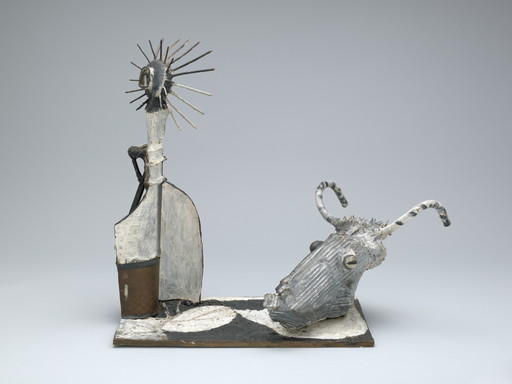
Goat Skull and Bottle is painted in shades of gray that match the somber palette of some of Picasso's paintings in the years during and just after World War II and perhaps allude to the black-and-white photography that brought images of the war home. The candle depicted here serves as a memento mori, a reminder of mortality. The sculpture was created from a host of found materials unified by their castingin bronze. Picasso used the handlebars of a bicycle to represent the goat's horns, and the heads of large bolts form its eyes. The goat's head is covered in a layer of corrugated cardboard that implies the directionof its hair. Nails are used for the tufts between itsears and for the rays of light emanating from the candle nestled in the bottle. In this and other of Picasso's sculptures, found elements never fully give up their original identities even as they serve as parts of a sculptural whole.
2015.
Gallery label from Focus: Picasso Sculpture , July 3–November 3, 2008.
Goat Skull and Bottle is painted in shades of gray that match the somber palette of some of Picasso’s paintings in the years during and just after World War II and perhaps allude to the black-and-white photography that brought images of the war home. The candle depicted here serves as a memento mori, a reminder of mortality. The sculpture was created from a host of found materials unified by their casting in bronze. Picasso used the handlebars of a bicycle to represent the goat’s horns, and the heads of large bolts form its eyes. The goat's head is covered in a layer of corrugated cardboard that implies the direction of its hair. Nails are used for the tufts between its ears and for the rays of light emanating from the candle nestled in the bottle. In this and other of Picasso’s sculptures, found elements never fully give up their original identities even as they serve as parts of a sculptural whole.
Focus: Picasso Sculpture, July 3–November 3, 2008.
Explore more
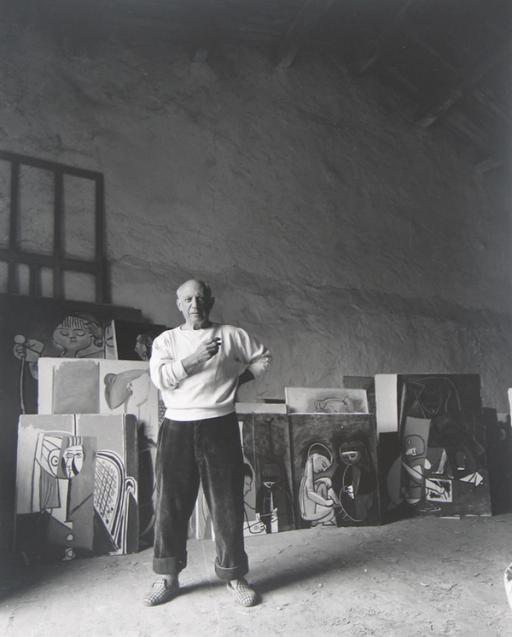
Pablo Picasso
Spanish, 1881–1973 1257 works onlineWith these words, Picasso shed light on two central principles of his artistic production over nearly 80 years: his openness to a diverse range of styles, subject matters, and mediums, and his resistance to the notion that change in art necessarily corresponds to improvement or progress.
Learn more →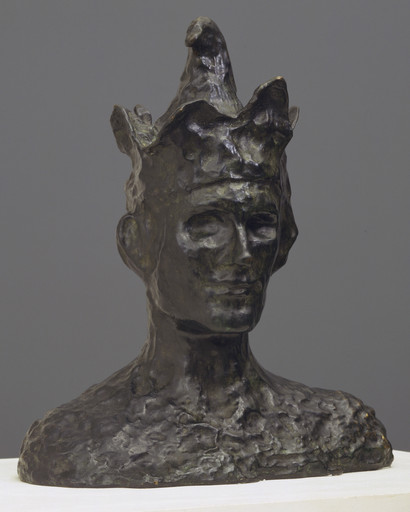
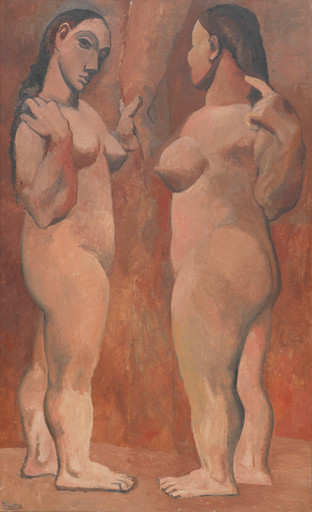
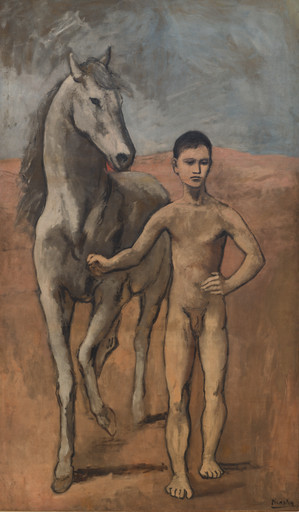
Six Sculptures
500Highlighting a small selection of works from the Museum’s collection, this gallery reflects the unfolding of new sculptural forms across the first half of the 20th century.
Learn more →


From MoMA Design Store


Installation views
We have identified this work in the following photos from our exhibition history.
Licensing
Artwork or archival images
If you would like to reproduce an image of a work of art in MoMA's collection, or an image of a MoMA publication or archival material (including installation views, checklists, and press releases), please contact Art Resource (publication in North America) or Scala Archives (publication in all other geographic locations).
Audio and film clips
MoMA licenses archival audio and select out of copyright film clips from our film collection. At this time, MoMA produced video cannot be licensed by MoMA/Scala. All requests to license archival audio or out of copyright film clips should be addressed to Scala Archives at [email protected]. Motion picture film stills cannot be licensed by MoMA/Scala. For access to motion picture film stills for research purposes, please contact the Film Study Center at [email protected]. For more information about film loans and our Circulating Film and Video Library, please visit Circulating Film and Video Library.
Text from a publication or the archives
If you would like to reproduce text from a MoMA publication, please email [email protected]. If you would like to publish text from MoMA's archival materials, please fill out this permission form and send to [email protected].
Feedback
This record is a work in progress. If you have additional information or spotted an error, please fill out this feedback form.