Panel with chalk drawing, felt, fat, taxidermied hare, and painted poles
Beuys often infused organic materials with symbolic meaning. Felt and fat, for example, which are materials with insulating properties, signified “spiritual warmth” for the artist, who considered himself a modern-day shaman. He used the objects displayed here as props for an action (the term he used for performances) in Berlin. Eurasia was a recurring theme in Beuys’s art; working in the context of a politically divided Germany, he felt that one of the defining issues of the postwar world was the division between Asia and Europe and between eastern and western ways of thinking. He viewed the hare as an animal that could jump figuratively between the two continents.
2025
Gallery label from Collection: 1940s—1970s, 2019
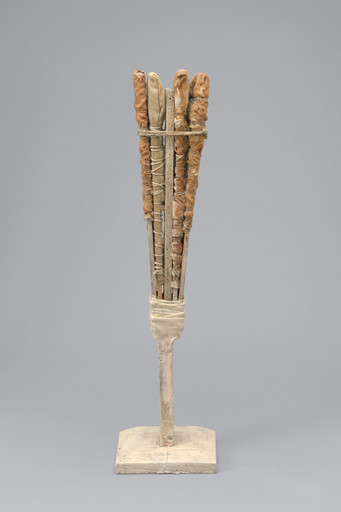
On October 31, 1966, Beuys tied a taxidermied hare to wooden sticks, using the dead animal as his companion in a performance, or “action,” staged in Berlin. The objects leaning against the wall were the props for his action. Beuys was known for infusing organic materials and ordinary language with symbolic meaning. Felt and fat, for example, which are materials with insulating properties, signified “spiritual warmth” for the artist.
Collection: 1940s—1970s, 2019
Publication excerpt from MoMA Highlights: 375 Works from The Museum of Modern Art, New York (New York: The Museum of Modern Art, 2019)
Assuming the multiple roles of artist, teacher, and modern-day shaman, Beuys developed a highly personal iconography for addressing the problems haunting postwar Germany. The objects in Eurasia Siberian Symphony 1963 are props from a 1966 performance he staged in Copenhagen and Berlin. They include an armature of intersecting poles, a taxidermy hare (for Beuys, a totemic animal), triangles of fat and felt, and a blackboard marked with chalk. Among the inscriptions, the word “Eurasia,” naming the continental landmass as well as the borderless state that Beuys often invoked, appears prominently. The truncated cross above represents division between East and West; the two numbers below indicate the angles of the felt and fat triangles, and a third corresponds to the temperature of a high human fever (42˚C).
One key to deciphering the cryptic presentation is Beuys’s oft-told autobiographical narrative of being shot down in Crimea during World War II and saved by local Tatars, who wrapped his body in fat and felt, materials he subsequently associated with Eastern methods of holistic healing. Although expressed in mythical terms, the work’s themes relate to Cold War politics of division. In the work’s title, “1963” may refer to the high note of hope struck that year by US president John F. Kennedy’s address to West Berliners. Beuys may have been suggesting that healing lay in such face-to-face encounters, which were then impeded by walls both physical and ideological.
MoMA Highlights: 375 Works from The Museum of Modern Art, New York (New York: The Museum of Modern Art, 2019)
Explore more
The Art of Assemblage
Gallery 408Everyday objects, popular consumer products, and other nontraditional materials had become, Seitz wrote, “the language for impatient, hypercritical, and anarchistic young artists,” who sought to create an art that—in its subject matter, materials, and making—was closely intertwined with life.
Learn more →
Audio
Audio from the playlist Collection 1950s–1970s
Audio from the playlist Verbal Descriptions
From MoMA Design Store


Installation views
We have identified this work in the following photos from our exhibition history.
Licensing
Artwork or archival images
If you would like to reproduce an image of a work of art in MoMA's collection, or an image of a MoMA publication or archival material (including installation views, checklists, and press releases), please contact Art Resource (publication in North America) or Scala Archives (publication in all other geographic locations).
Audio and film clips
MoMA licenses archival audio and select out of copyright film clips from our film collection. At this time, MoMA produced video cannot be licensed by MoMA/Scala. All requests to license archival audio or out of copyright film clips should be addressed to Scala Archives at [email protected]. Motion picture film stills cannot be licensed by MoMA/Scala. For access to motion picture film stills for research purposes, please contact the Film Study Center at [email protected]. For more information about film loans and our Circulating Film and Video Library, please visit Circulating Film and Video Library.
Text from a publication or the archives
If you would like to reproduce text from a MoMA publication, please email [email protected]. If you would like to publish text from MoMA's archival materials, please fill out this permission form and send to [email protected].
Feedback
This record is a work in progress. If you have additional information or spotted an error, please fill out this feedback form.