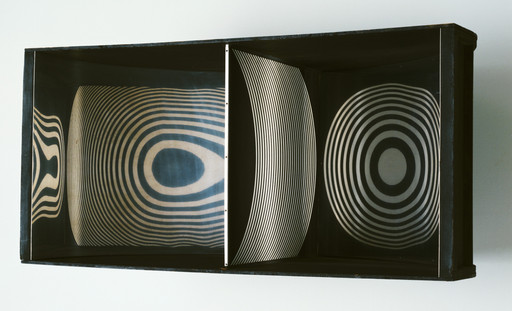
Black wood box, 21 x 19 3/4 x 5 5/8" (53.4 x 50 x 14.1 cm), with illuminated aperture, 7 7/8 x 8" (20 x 20.2 cm), in which fifty-four plastic squares, 1 1/2 x 1 1/2" (3.6 x 3.6 cm), are suspended from eighteen nylon threads; mirror backing, 11 7/8 x 16" (30.1 x 40.4 cm), two reflectors, three sets of interchangeable pierced metal screens, and two glass filters
Not on view
Le Parc studied at l'Académie des Beaux-Arts (Academy of fine arts) in Buenos Aires and received a scholarship to go to Paris in 1958, where he remained for much of his career. There, he developed friendships with Sérgio Camargo, Jesús Rafael Soto, and Carlos Cruz–Diez. In 1960 he became a founding member of the Groupe de Recherche d'Art Visuel (Visual art research group). In the late 1950s Le Parc began utilizing optical and kinetic techniques to achieve effects of light in motion. In Double Concurrence—Continuous Light, 2 the reflection and refraction of light is achieved through fiftyfour suspended plastic squares that are sensitive to the slightest movement, slits in the sides of the box, through which the squares are illuminated, and colored filters that can be placed at the front of the work.
Transmissions: Art in Eastern Europe and Latin America, 1960–1980, September 5, 2015–January 3, 2016.
Explore more
From MoMA Design Store


Installation views
We have identified this work in the following photos from our exhibition history.
Licensing
Artwork or archival images
If you would like to reproduce an image of a work of art in MoMA's collection, or an image of a MoMA publication or archival material (including installation views, checklists, and press releases), please contact Art Resource (publication in North America) or Scala Archives (publication in all other geographic locations).
Audio and film clips
MoMA licenses archival audio and select out of copyright film clips from our film collection. At this time, MoMA produced video cannot be licensed by MoMA/Scala. All requests to license archival audio or out of copyright film clips should be addressed to Scala Archives at [email protected]. Motion picture film stills cannot be licensed by MoMA/Scala. For access to motion picture film stills for research purposes, please contact the Film Study Center at [email protected]. For more information about film loans and our Circulating Film and Video Library, please visit Circulating Film and Video Library.
Text from a publication or the archives
If you would like to reproduce text from a MoMA publication, please email [email protected]. If you would like to publish text from MoMA's archival materials, please fill out this permission form and send to [email protected].
Feedback
This record is a work in progress. If you have additional information or spotted an error, please fill out this feedback form.