This illuminated, diorama-like construction contains eleven parallel painted-glass panels. Both pictorial illusion and actual depth produce the sense of receding space, from the proscenium arch on the front panel to the sky on the furthest, with various bizarre objects, figures, and scenarios sandwiched in-between. This unusual work may have been Dalí’s attempt to recreate “a large square box” he had seen as a boy: “It was a kind of optical theater, which provided me with the greatest measure of illusion of my childhood. I have never been able to determine or reconstruct in my mind exactly what it was like.”
2019
Gallery label from 2006.
This sculpture—part theatrical maquette, part multi-layered painting—is composed of eleven painted glass panes that juxtapose several distinct and peculiar worlds. At the margins the proscenium arch, receding stage floor, and inkwell evoke the stage and an unseen playwright, highlighting the orchestrated, artificial character of painting. Behind these Dalí contrasts an idyllic Arcadian scene with a barren, ruined landscape. Dalí's unique construction was inspired by his longstanding fascination with optical devices and with the theater.
2006.
Explore more
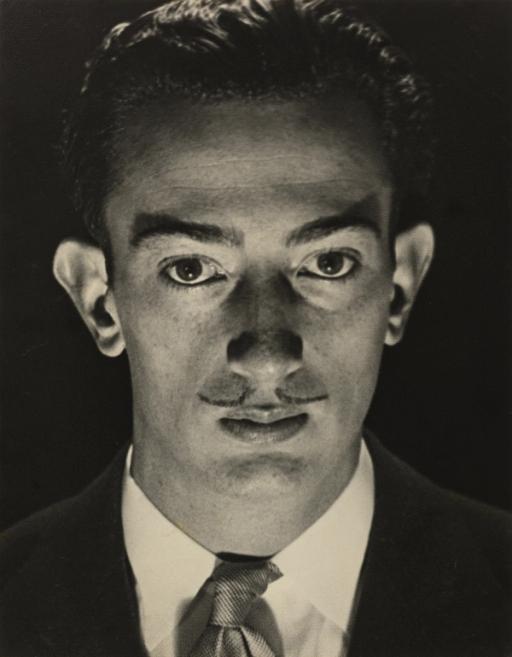
Salvador Dalí
Spanish, 1904–1989 114 works onlineThe artist, author, critic, impresario, and provocateur Salvador Dalí burst onto the art scene in 1929 and rarely left the public eye until his death six decades later.
Learn more →

A Surreal Lens
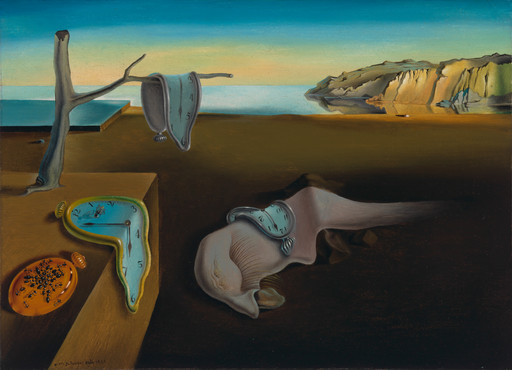
Gallery 517In 1924, André Breton published his Manifesto of Surrealism, which, guided by Sigmund Freud’s psychoanalytic theories, declared a radical break from the rationalism of modern society in favor of imagination, erotic desire, and unconscious thought.
Learn more →


Audio
Audio from the playlist Collection 1880s–1940s
From MoMA Design Store


Installation views
We have identified this work in the following photos from our exhibition history.
Provenance Research Project
This work is included in the Provenance Research Project, which investigates the ownership history of works in MoMA's collection.
[Galerie François Petit (André François Petit), Paris]
Emilio Terry, Paris.
? - 1974, Mme. [Emmy] de Martelaere, Paris.
1974 - 1981, Perls Galleries (stock no. 11471, photo no. P7655), New York, purchased from Mme. de Martelaere, Paris.
1981, The Museum of Modern Art, New York, purchased from Perls Galleries.
Provenance research is a work in progress, and is frequently updated with new information. If you have any questions or information to provide about the listed works, please email [email protected] or write to:
Provenance Research Project
The Museum of Modern Art
11 West 53 Street
New York, NY 10019
Licensing
Artwork or archival images
If you would like to reproduce an image of a work of art in MoMA's collection, or an image of a MoMA publication or archival material (including installation views, checklists, and press releases), please contact Art Resource (publication in North America) or Scala Archives (publication in all other geographic locations).
Audio and film clips
MoMA licenses archival audio and select out of copyright film clips from our film collection. At this time, MoMA produced video cannot be licensed by MoMA/Scala. All requests to license archival audio or out of copyright film clips should be addressed to Scala Archives at [email protected]. Motion picture film stills cannot be licensed by MoMA/Scala. For access to motion picture film stills for research purposes, please contact the Film Study Center at [email protected]. For more information about film loans and our Circulating Film and Video Library, please visit Circulating Film and Video Library.
Text from a publication or the archives
If you would like to reproduce text from a MoMA publication, please email [email protected]. If you would like to publish text from MoMA's archival materials, please fill out this permission form and send to [email protected].
Feedback
This record is a work in progress. If you have additional information or spotted an error, please fill out this feedback form.