In the 1980s Bourgeois began to construct enigmatic sculptural environments she calls "cells" that provide settings for her personal narratives. Here she explores the concept of the lair, a dwelling from the animal world. Bourgeois has said that a lair is "a protected place you can enter to take refuge," but she has also acknowledged the possibility of isolation: "The security of a lair can also be a trap."
Multiplex: Directions in Art, 1970 to Now, November 21, 2007-July 28, 2008.
Publication excerpt from The Museum of Modern Art, MoMA Highlights , New York: The Museum of Modern Art, revised 2004, originally published 1999, p. 320.
Articulated Lair, Bourgeois has said, is "a protected place you can enter to take refuge," but at the same time she allows that "the security of the lair can also be a trap." She separates this charged space from the world with a simple screen—a row of thin metal panels, hinged, or articulated, at their edges. There is an entrance at either end; no matter where Bourgeois's "invading, frightening visitor" enters, you have "a back door through which you can escape." Inside, for furniture, is a single small stool, as though the lair's resident were child-sized and sought no company. Yet there are other presences here, hanging against the walls: pendulous forms in black rubber, suggesting body parts. Perhaps a hunter is storing prey; or we could be inside some creature's stomach, among its internal organs.
These rubber shapes have ante-cedents in Surrealist biomorphism, and in the paintings of Arshile Gorky. At the same time, the anxiety over the integrity of the human body that runs through so much of Bourgeois's work anticipates the concerns of many younger artists of the 1980s and 1990s. Articulated Lair is simultaneously safe and ensnaring—a cryptic refuge for human frailty.
The Museum of Modern Art, MoMA Highlights, New York: The Museum of Modern Art, revised 2004, originally published 1999, p. 320.
Explore more
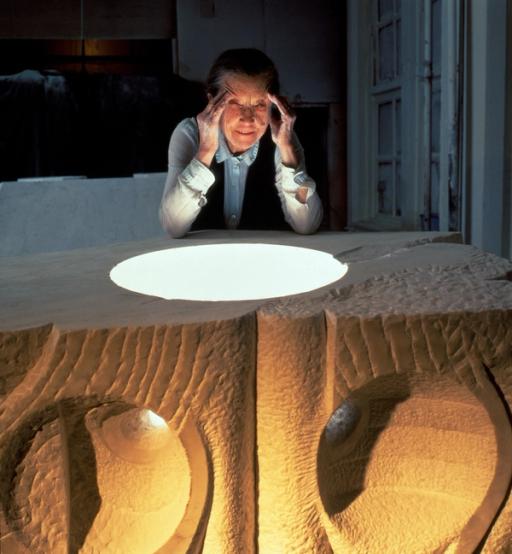
Louise Bourgeois
American, born France. 1911–2010 3040 works onlineBorn in Paris in 1911, Louise Bourgeois was raised by parents who ran a tapestry restoration business. A gifted student, she also helped out in the workshop by drawing missing elements in the scenes depicted on the tapestries.
Learn more →



From MoMA Design Store


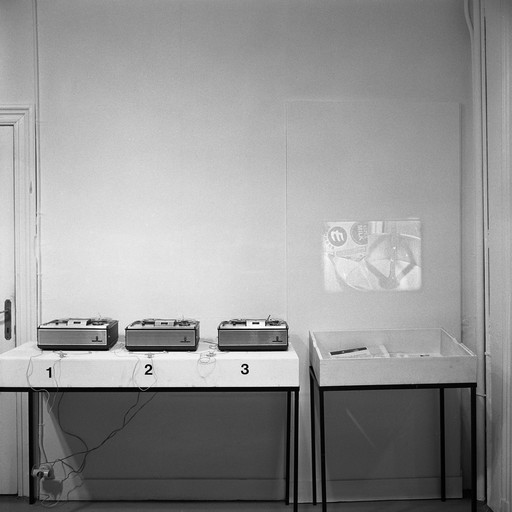
Installation views
We have identified this work in the following photos from our exhibition history.
Licensing
Artwork or archival images
If you would like to reproduce an image of a work of art in MoMA's collection, or an image of a MoMA publication or archival material (including installation views, checklists, and press releases), please contact Art Resource (publication in North America) or Scala Archives (publication in all other geographic locations).
Audio and film clips
MoMA licenses archival audio and select out of copyright film clips from our film collection. At this time, MoMA produced video cannot be licensed by MoMA/Scala. All requests to license archival audio or out of copyright film clips should be addressed to Scala Archives at [email protected]. Motion picture film stills cannot be licensed by MoMA/Scala. For access to motion picture film stills for research purposes, please contact the Film Study Center at [email protected]. For more information about film loans and our Circulating Film and Video Library, please visit Circulating Film and Video Library.
Text from a publication or the archives
If you would like to reproduce text from a MoMA publication, please email [email protected]. If you would like to publish text from MoMA's archival materials, please fill out this permission form and send to [email protected].
Feedback
This record is a work in progress. If you have additional information or spotted an error, please fill out this feedback form.