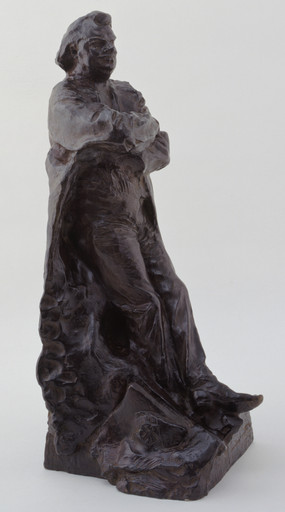
Commissioned to honor one of France's greatest novelists, Rodin spent seven years preparing for Monument to Balzac, studying the writer’s life and work, posing models who resembled him, and ordering clothes to his measurements. Ultimately, though, Rodin’s aim was less to create a physical likeness of Honoré de Balzac (1799–1850) than to communicate an idea or spirit of the man and a sense of his creative vitality: "I think of his intense labor, of the difficulty of his life, of his incessant battles, and of his great courage. I would express all that," he said. Several studies for the work are nudes, but Rodin finally clothed the figure in a robe inspired by the dressing gown that Balzac often wore when writing.
2007.
Publication excerpt from MoMA Highlights: 375 Works from The Museum of Modern Art, New York (New York: The Museum of Modern Art, 2019)
Commissioned to honor Honoré de Balzac, one of France’s greatest novelists, Rodin spent seven years preparing for this sculpture, studying the writer’s life and work, posing models who resembled him, and ordering clothes to his measurements. Ultimately, though, Rodin’s aim was less Balzac’s physical likeness than an idea or spirit of the man and a sense of his creative vitality: “I think of his intense labor, of the difficulty of his life, of his incessant battles and of his great courage. I would express all that.”
Several studies for the work are nudes, but Rodin finally clothed the figure in a robe inspired by the dressing gown that Balzac often wore when writing at night. The effect is to make the figure a monolith, a single upward-thrusting form crowned by the craggy ridges and cavities that define the head and face. Monument to Balzac is a visual metaphor for the author’s energy and genius, yet when the plaster original was exhibited in Paris in 1898, it was widely attacked. Critics likened it to a sack of coal, a snowman, and a seal, and the literary society that had commissioned the work dismissed it as a “crude sketch.” Rodin retired the plaster model to his home in the Paris suburbs. It was not cast in bronze until many years after his death.
MoMA Highlights: 375 Works from The Museum of Modern Art, New York (New York: The Museum of Modern Art, 2019)
Explore more
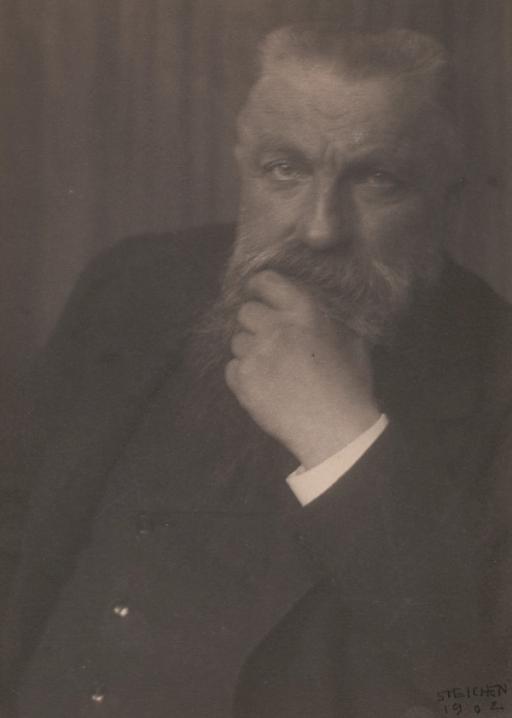
Auguste Rodin
French, 1840–1917 22 works onlineFor Auguste Rodin, the sculpture St. John the Baptist Preaching began with a knock on his studio door. The movement was so right, so clear, and so true that I cried out: ‘But it’s a man walking!
Learn more →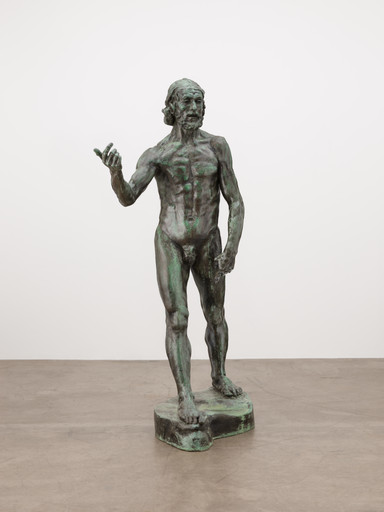
From MoMA Design Store


Installation views
We have identified this work in the following photos from our exhibition history.
Licensing
Artwork or archival images
If you would like to reproduce an image of a work of art in MoMA's collection, or an image of a MoMA publication or archival material (including installation views, checklists, and press releases), please contact Art Resource (publication in North America) or Scala Archives (publication in all other geographic locations).
Audio and film clips
MoMA licenses archival audio and select out of copyright film clips from our film collection. At this time, MoMA produced video cannot be licensed by MoMA/Scala. All requests to license archival audio or out of copyright film clips should be addressed to Scala Archives at [email protected]. Motion picture film stills cannot be licensed by MoMA/Scala. For access to motion picture film stills for research purposes, please contact the Film Study Center at [email protected]. For more information about film loans and our Circulating Film and Video Library, please visit Circulating Film and Video Library.
Text from a publication or the archives
If you would like to reproduce text from a MoMA publication, please email [email protected]. If you would like to publish text from MoMA's archival materials, please fill out this permission form and send to [email protected].
Feedback
This record is a work in progress. If you have additional information or spotted an error, please fill out this feedback form.