Not on view
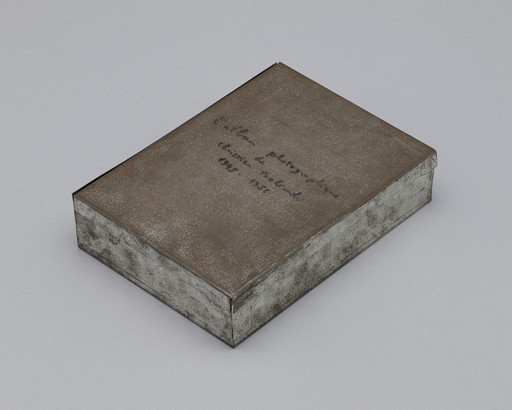
Enlarged photographs of seven young girls are propped atop a stack of unlabeled tin biscuit boxes containing scraps of fabric. These boxes are corroded as if marked by time and are infused with symbolic associations—they evoke reliquary boxes, archival containers, and funerary urns. The black-and-white photographs connote another era; out of focus, they constitute a visual analogy to memory, fading over time. Electric lights illuminate the seven faces like devotional candles, underscoring the effect of a memorial, an orchestration of signifiers indicating loss and remembrance. Old photographs, the tension between individuality and sameness, and the implication of vast numbers evoke the tragedy of the Holocaust.
However, the girls pictured are not victims of genocide: the photographs, of anonymous children, were culled from magazines and newspapers. The boxes are not truly old, and the cloth contained in them is generic and has no special origin. Boltanski creates an atmosphere of general, unspecified mourning through means—photographs, relics—traditionally valued for their privileged claim to specificity, uniqueness, and authenticity. A vocabulary of documentary signs is used movingly, but deceptively, for symbolic effect.
The Museum of Modern Art, MoMA Highlights since 1980, New York: The Museum of Modern Art, 2007, p. 86.
Explore more
From MoMA Design Store


Installation views
We have identified this work in the following photos from our exhibition history.
Licensing
Artwork or archival images
If you would like to reproduce an image of a work of art in MoMA's collection, or an image of a MoMA publication or archival material (including installation views, checklists, and press releases), please contact Art Resource (publication in North America) or Scala Archives (publication in all other geographic locations).
Audio and film clips
MoMA licenses archival audio and select out of copyright film clips from our film collection. At this time, MoMA produced video cannot be licensed by MoMA/Scala. All requests to license archival audio or out of copyright film clips should be addressed to Scala Archives at [email protected]. Motion picture film stills cannot be licensed by MoMA/Scala. For access to motion picture film stills for research purposes, please contact the Film Study Center at [email protected]. For more information about film loans and our Circulating Film and Video Library, please visit Circulating Film and Video Library.
Text from a publication or the archives
If you would like to reproduce text from a MoMA publication, please email [email protected]. If you would like to publish text from MoMA's archival materials, please fill out this permission form and send to [email protected].
Feedback
This record is a work in progress. If you have additional information or spotted an error, please fill out this feedback form.