By the late 1950s, de Kooning had turned away from the urban crush of Manhattan. In 1959, he purchased land in the hamlet of Springs, Long Island, where he lived from 1963 until his death in 1997. Inspired by the light and water of the Springs shoreline and the landscapes he saw while traveling in Italy, he produced a group of abstractions in the early 1960s in which he sought to capture the experience of seeing fleeting glimpses of nature. Among this group is A Tree in Naples. De Kooning was enjoying acclaim for his figurative work when he turned back to abstraction in these paintings. Simplifying his approach and utilizing the wide brushes he had used as a house painter. His work is often understood as a celebration of the transitory as a form of action painting, it is characterized as much by careful revision and planning as by fluid bursts of improvisatory movements.
In The Studio: Postwar Abstract Painting online course, Coursera, 2017
Gallery label from Abstract Expressionist New York , October 3, 2010-April 25, 2011.
This work belongs to a group of abstractions inspired by the landscape. In them de Kooning simplified his visual vocabulary to a few powerful, expansive brushstrokes that evoke the vistas of color found in the natural world. He described the experience that inspired these works: “Just coming around roads, some place, and having the sensation of a piece of it, a piece of nature, like a fence, something on the road. And I really get very elated by again looking, by again seeing that the sky is blue, that the grass is green.”
Abstract Expressionist New York, October 3, 2010-April 25, 2011.
Explore more
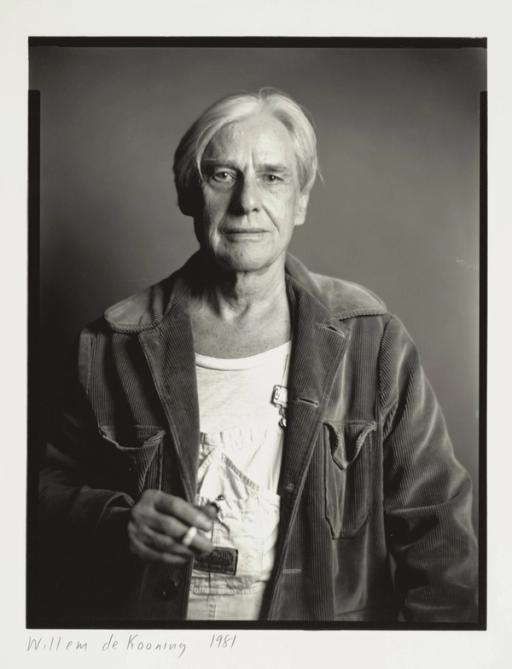
Willem de Kooning
American, born the Netherlands. 1904–1997 85 works onlineIf Jackson Pollock was the public face of the New York avant-garde , Willem de Kooning could be described as an artist’s artist, who was perceived by many of his peers as its leader.
Learn more →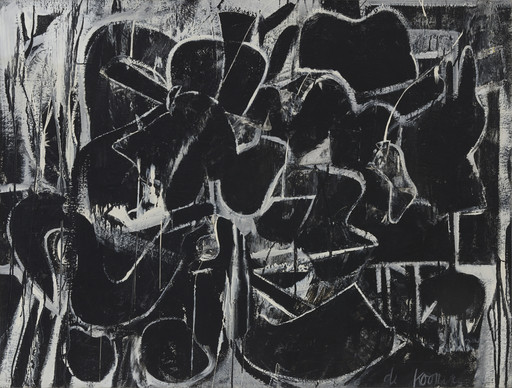
From MoMA Design Store


Installation views
We have identified this work in the following photos from our exhibition history.
Licensing
Artwork or archival images
If you would like to reproduce an image of a work of art in MoMA's collection, or an image of a MoMA publication or archival material (including installation views, checklists, and press releases), please contact Art Resource (publication in North America) or Scala Archives (publication in all other geographic locations).
Audio and film clips
MoMA licenses archival audio and select out of copyright film clips from our film collection. At this time, MoMA produced video cannot be licensed by MoMA/Scala. All requests to license archival audio or out of copyright film clips should be addressed to Scala Archives at [email protected]. Motion picture film stills cannot be licensed by MoMA/Scala. For access to motion picture film stills for research purposes, please contact the Film Study Center at [email protected]. For more information about film loans and our Circulating Film and Video Library, please visit Circulating Film and Video Library.
Text from a publication or the archives
If you would like to reproduce text from a MoMA publication, please email [email protected]. If you would like to publish text from MoMA's archival materials, please fill out this permission form and send to [email protected].
Feedback
This record is a work in progress. If you have additional information or spotted an error, please fill out this feedback form.