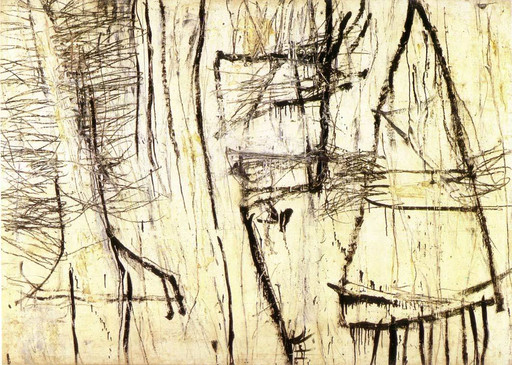
Oil, pencil, and crayon on canvas
Interest in the mural form was widespread among the Abstract Expressionists, who often worked on a scale far larger than that of most easel paintings. Twombly, a member of a younger generation, transposed that interest in the wall to a different register: no painter of his time more consistently invited association with the language of graffiti. His scrawled calligraphic markings may recall the automatic writing of Surrealism, another inheritance passed on to him through Abstract Expressionism, but they also evoke the scratches and scribbles on the ancient walls of Rome (his home beginning in 1957).
Rome supplied another touchstone for Twombly, who was fascinated by classical antiquity. Here he referred to the Roman myth in which Jupiter, lord of the gods, took the shape of a swan in order to ravish the beautiful Leda. (This violation ultimately led to the Trojan War, fought over Leda’s daughter Helen.) Twombly’s version of this old art-historical theme supplies no contrasts of feathers and flesh but an orgiastic fusion and confusion of energies within furiously thrashing overlays of crayon, pencil, and ruddy paint. A few recognizable signs—hearts, a phallus—fly out from this explosion.
MoMA Highlights: 375 Works from The Museum of Modern Art, New York (New York: The Museum of Modern Art, 2019)
Gallery label from 2007.
Rome, Twombly's home since the 1950s, has nurtured his fascination with classical antiquity. In this work he refers to the Roman myth in which Jupiter, lord of the gods, takes the shape of a swan in order to ravish Leda, the beautiful mother of Helen (over whom the Trojan war would be fought). Twombly's version of this old art-historical theme supplies no contrast of feathers and flesh but a fusion of violent energies in furiously thrashing overlays of crayon, pencil, and ruddy paint. A few recognizable signs—hearts, a phallus—fly out from this explosion, in stark contrast to the sober windowlike rectangle near the top of the painting.
Explore more

Gestural
Relating to methods of applying a medium, such as paint, to a surface, often with active or sweeping body movements.
Learn more →

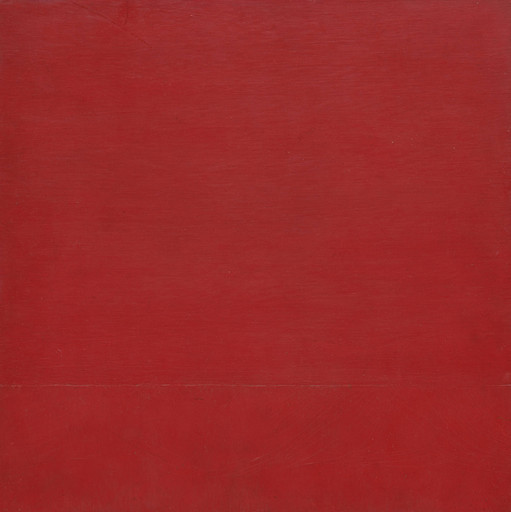
Arthur Jafa—Less Is Morbid
1 NorthOriginally from Tupelo, Mississippi, and trained as an architect and cinematographer, he has become well-known for his collages, montages, assemblages, and installations—combining images imbued with what he calls “affective capacity,” or the emotional power of association.
Learn more →


From MoMA Design Store


Installation views
We have identified this work in the following photos from our exhibition history.
Licensing
Artwork or archival images
If you would like to reproduce an image of a work of art in MoMA's collection, or an image of a MoMA publication or archival material (including installation views, checklists, and press releases), please contact Art Resource (publication in North America) or Scala Archives (publication in all other geographic locations).
Audio and film clips
MoMA licenses archival audio and select out of copyright film clips from our film collection. At this time, MoMA produced video cannot be licensed by MoMA/Scala. All requests to license archival audio or out of copyright film clips should be addressed to Scala Archives at [email protected]. Motion picture film stills cannot be licensed by MoMA/Scala. For access to motion picture film stills for research purposes, please contact the Film Study Center at [email protected]. For more information about film loans and our Circulating Film and Video Library, please visit Circulating Film and Video Library.
Text from a publication or the archives
If you would like to reproduce text from a MoMA publication, please email [email protected]. If you would like to publish text from MoMA's archival materials, please fill out this permission form and send to [email protected].
Feedback
This record is a work in progress. If you have additional information or spotted an error, please fill out this feedback form.