Synthetic polymer paint on board
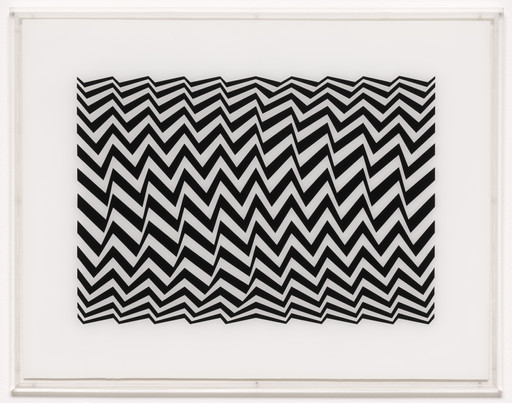
Riley hand-painted the lines in Current, which appear to vibrate and give the illusion of three-dimensional depth. Relying on her personal observations of how perception can arouse certain physiological sensations, Riley sought to create a “disturbance” in her early paintings—which, like this one, were primarily black and white. That high contrast helped her activate what she described as “the space between the picture plane and the spectator.”
2025
Gallery label from Making Space: Women Artists and Postwar Abstraction , April 19 - August 13, 2017
Current's hand-painted lines appear to vibrate and give the illusion of three-dimensional depth. Relying on her own observations of how perception can arouse certain physiological sensations, Riley sought to create a "disturbance" in her early paintings—which, like this one, were primarily black and whitein order to activate "the space between the picture plane and the spectator." Current was included in The Responsive Eye, the 1965 MoMA exhibition that helped to define a new style known as Op art, which exploited the optical effects of patterned abstractions and contrasting colors.
Making Space: Women Artists and Postwar Abstraction, April 19 - August 13, 2017
Kids label from 2025
Eye teaser!
Bridget Riley makes lines come alive. She painted long, wavy lines to create a sense of movement. Using your eyes, try following one line from top to bottom. Notice how it curves back and forth.
What happens when you stare at this painting for ten seconds?
2025
Explore more

Good Vibrations
Gallery 410Jesús Rafael Soto and Bridget Riley, the two artists paired in this gallery, never met. But they each emerged as a leader of the international Op art movement in the 1950s and ’60s.
Learn more →
Audio
Audio from the playlist Collection 1950s–1970s
From MoMA Design Store


Installation views
We have identified this work in the following photos from our exhibition history.
Licensing
Artwork or archival images
If you would like to reproduce an image of a work of art in MoMA's collection, or an image of a MoMA publication or archival material (including installation views, checklists, and press releases), please contact Art Resource (publication in North America) or Scala Archives (publication in all other geographic locations).
Audio and film clips
MoMA licenses archival audio and select out of copyright film clips from our film collection. At this time, MoMA produced video cannot be licensed by MoMA/Scala. All requests to license archival audio or out of copyright film clips should be addressed to Scala Archives at [email protected]. Motion picture film stills cannot be licensed by MoMA/Scala. For access to motion picture film stills for research purposes, please contact the Film Study Center at [email protected]. For more information about film loans and our Circulating Film and Video Library, please visit Circulating Film and Video Library.
Text from a publication or the archives
If you would like to reproduce text from a MoMA publication, please email [email protected]. If you would like to publish text from MoMA's archival materials, please fill out this permission form and send to [email protected].
Feedback
This record is a work in progress. If you have additional information or spotted an error, please fill out this feedback form.