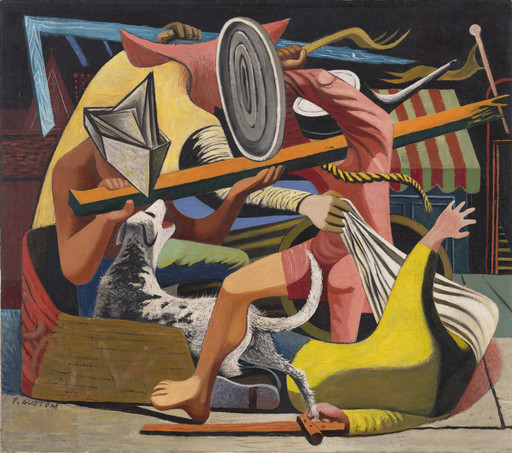
A three-man crew of slapstick thugs cruises a vacant metropolis in a beat-up jalopy. Wearing Ku Klux Klan hoods, they are plainly up to no good; but rather than invoking a specific evil, these men are symbolic embodiments of a general know-nothing violence. The principal story told here is that of an America run afoul of its democratic promise. Guston refused to exempt himself from responsibility: in other paintings he depicted an artist in Klan robes at his easel.
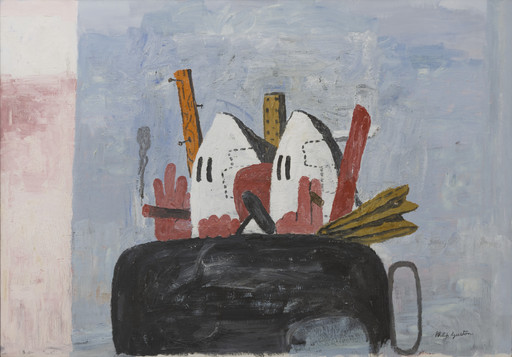
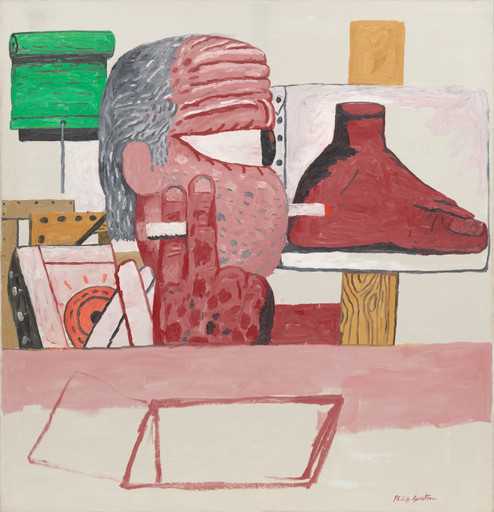
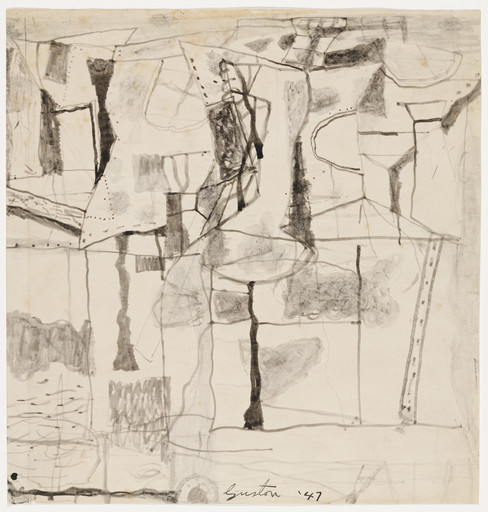
Guston began his career as a figurative painter, then, around mid-century, developed a lyrical Abstract Expressionism, a typical path for a member of the New York School. In the late 1960s, however, Guston made a surprising return to narrative painting—but not in the vein of the classic studio tradition in which he had trained. The art of Guston's last decade is antically cartoonlike. It has precedents in his earlier figurative period (and in his occasional satiric drawings of artists and writers), but rephrases them in a type of caricature dating to his childhood imitations of comic strips such as Krazy Kat. At the same time, paintings like City Limits have a strange baroque grandeur, and a bitter undertow—an insistence on the fascination of cruelty.
The Museum of Modern Art, MoMA Highlights, New York: The Museum of Modern Art, revised 2004, originally published 1999, p. 265.
Publication excerpt from MoMA Highlights: 375 Works from The Museum of Modern Art, New York (New York: The Museum of Modern Art, 2019)
Hooded Ku Klux Klan figures first appeared in Guston’s works in the early 1930s in portable murals that depicted the widespread violence against African Americans. Prompted in part by the violence and civil strife of the late 1960s, Guston returned to the subject in City Limits and other paintings. “They are self-portraits,” he reflected. “I perceive myself as being behind the hood. . . . The idea of evil fascinated me. . . . I almost tried to imagine that I was living with the Klan. What would it be like to be evil?” The principal story told here is that of an America run afoul of its democratic promise. Guston refused to exempt himself from responsibility: in other paintings, he depicted an artist in Klan robes at his easel.
Guston began his career as a figurative painter, then, around midcentury, developed a unique style of Abstract Expressionism. In the late 1960s, however, he made a surprising return to representation—but not in the classic studio tradition in which he had trained. His new paintings were scathing and satirical, often implicitly addressing current events. Guston’s switchover has served as an inspiration and a touchstone for generations of artists in the years since.
Explore more
From MoMA Design Store
Installation views
We have identified this work in the following photos from our exhibition history.
Licensing
Artwork or archival images
If you would like to reproduce an image of a work of art in MoMA's collection, or an image of a MoMA publication or archival material (including installation views, checklists, and press releases), please contact Art Resource (publication in North America) or Scala Archives (publication in all other geographic locations).
Audio and film clips
MoMA licenses archival audio and select out of copyright film clips from our film collection. At this time, MoMA produced video cannot be licensed by MoMA/Scala. All requests to license archival audio or out of copyright film clips should be addressed to Scala Archives at [email protected]. Motion picture film stills cannot be licensed by MoMA/Scala. For access to motion picture film stills for research purposes, please contact the Film Study Center at [email protected]. For more information about film loans and our Circulating Film and Video Library, please visit Circulating Film and Video Library.
Text from a publication or the archives
If you would like to reproduce text from a MoMA publication, please email [email protected]. If you would like to publish text from MoMA's archival materials, please fill out this permission form and send to [email protected].
Feedback
This record is a work in progress. If you have additional information or spotted an error, please fill out this feedback form.