Wood box 11 1/8 x 50 7/8 x 9" (28.2 x 129.2 x 22.7 cm), with three threads 39 3/8" (100 cm), glued to three painted canvas strips 5 1/4 x 47 1/4" (13.3 x 120 cm), each mounted on a glass panel 7 1/4 x 49 3/8 x 1/4" (18.4 x 125.4 x 0.6 cm), three wood slats 2 1/2 x 43 x 1/8" (6.2 x 109.2 x 0.2 cm), shaped along one edge to match the curves of the threads
Not on view
Duchamp described this work as the one that “opened the way—the way to escape from those traditional methods of expression long associated with art.” He was now at the point when “I didn’t want to do anything with my hands. I wanted things to get onto canvas or the surface by themselves, from my subconscious if possible.” According to Duchamp, he dropped a sewing thread measuring one meter in length from a height of one meter onto a painted canvas; the thread landed as a curving line, subject to the vagaries of gravity and air currents. Duchamp repeated the experiment twice more, producing differently curved lines each time—three of innumerable possible outcomes for deforming the standard meter. He then made wood templates of the three lines, allowing him to trace the curves in other works.
Marcel Duchamp, April 12–August 22, 2026
Publication excerpt from The Museum of Modern Art, MoMA Highlights , New York: The Museum of Modern Art, revised 2004, originally published 1999, p. 91.
A working note of Duchamp's describes his idea for this enigmatic work: "A straight horizontal thread one meter long falls from a height of one meter onto a horizontal plane twisting as it pleases and creates a new image of the unit of length." Here, three such threads, each fixed to its own canvas with varnish, and each canvas glued to its own glass panel, are enclosed in a box, along with three lengths of wood (draftsman's straightedges) cut into the shapes drawn by the three threads.
Duchamp later said that 3 Standard Stoppages opened the way "to escape from those traditional methods of expression long associated with art," such as what Duchamp called "retinal painting," art designed for the luxuriance of the eye. This required formal intelligence and a skillful hand on the part of the artist. The Stoppages, on the other hand, depended on chance—which, paradoxically, they at the same time fixed and "standardized." (Duchamp used the phrase "canned chance.") Subordinating art both to accident and to something approximating the scientific method (which they simultaneously parodied), 3 Standard Stoppages advanced a conceptual approach, an absurdist strain, and a way of commenting on both art and the broader culture that inspired countless later artists of many different kinds.
The Museum of Modern Art, MoMA Highlights, New York: The Museum of Modern Art, revised 2004, originally published 1999, p. 91.
Gallery label from 2020
It is “a joke about the meter,” Duchamp glibly noted about this piece, but his premise for it reads like a theorem: “If a straight horizontal thread one meter long falls from a height of one meter onto a horizontal plane twisting as it pleases [it] creates a new image of the unit of length.” Duchamp dropped three of these threads onto three stretched canvases, where they were then adhered, in order to preserve the random curves they assumed upon landing. The canvases were cut along those curves, creating a template for new units of measure that retain the meter’s length but undermine its rational basis.
2020
Explore more
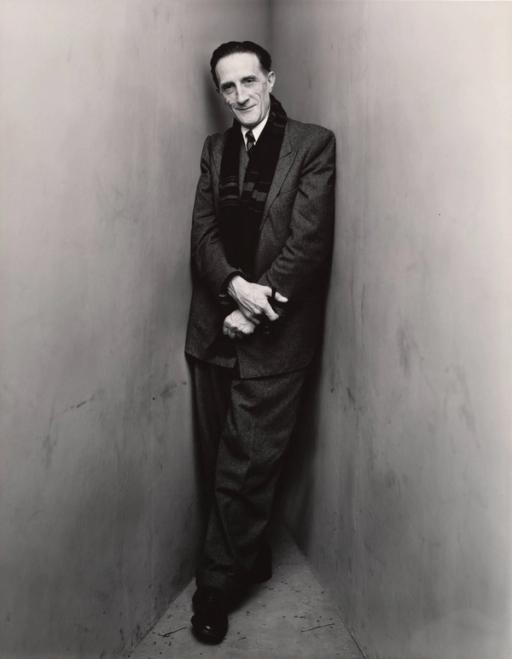
Marcel Duchamp
American, born France. 1887–1968 190 works onlineWhen Marcel Duchamp created his most famous work—the industrially produced urinal Fountain —it was largely ignored. Fountain was the high point of Duchamp’s campaign to dismantle and expand the boundaries of what constitutes a work of art; it had begun four years earlier, when he asked, “Can one make works that are not ‘of art’?
Learn more →

Audio
Audio from the playlist Marcel Duchamp
Articles and videos
From MoMA Design Store


Installation views
We have identified this work in the following photos from our exhibition history.
Provenance Research Project
This work is included in the Provenance Research Project, which investigates the ownership history of works in MoMA's collection.
The artist, 1914 – 1918
Katherine S. Dreier (1877-1952), West Redding, Connecticut. Purchased from Duchamp, 1918 – 1953
The Museum of Modern Art, New York. Katherine S. Dreier Bequest, 1953
Provenance research is a work in progress, and is frequently updated with new information. If you have any questions or information to provide about the listed works, please email [email protected] or write to:
Provenance Research Project
The Museum of Modern Art
11 West 53 Street
New York, NY 10019
Licensing
Artwork or archival images
If you would like to reproduce an image of a work of art in MoMA's collection, or an image of a MoMA publication or archival material (including installation views, checklists, and press releases), please contact Art Resource (publication in North America) or Scala Archives (publication in all other geographic locations).
Audio and film clips
MoMA licenses archival audio and select out of copyright film clips from our film collection. At this time, MoMA produced video cannot be licensed by MoMA/Scala. All requests to license archival audio or out of copyright film clips should be addressed to Scala Archives at [email protected]. Motion picture film stills cannot be licensed by MoMA/Scala. For access to motion picture film stills for research purposes, please contact the Film Study Center at [email protected]. For more information about film loans and our Circulating Film and Video Library, please visit Circulating Film and Video Library.
Text from a publication or the archives
If you would like to reproduce text from a MoMA publication, please email [email protected]. If you would like to publish text from MoMA's archival materials, please fill out this permission form and send to [email protected].
Feedback
This record is a work in progress. If you have additional information or spotted an error, please fill out this feedback form.