Chagall grew up in a Hasidic Jewish community in what is today Belarus. I and the Village, painted the year after he moved to Paris, evokes his memories of the place. He shows people and animals living side by side, their mutual dependence signified by the lines connecting the eyes of peasant and cow. The artist recalled of his childhood, “Lines, angles, triangles, squares carried me far away to enchanting horizons.” The vibrant colors and loose geometries Chagall used to render the scene nostalgic and magical signal his awareness, among other things, of the new fractured and fragmented visual language of Cubism, which he encountered in Paris.
2024
Publication excerpt from MoMA Highlights: 375 Works from The Museum of Modern Art, New York (New York: The Museum of Modern Art, 2019)
At the center of this painting, the faces of a goat and a man meet, their pupils connected by a faint and uneven white line. The contours of their noses, cheeks, and chins form the basis of a set of interlocking diagonals, concentric circles, planes of color, and fragmented forms. This central pair is joined by floating figures and vignettes that are interspersed, dreamlike, throughout the composition: at left, a woman milks a cow; above, a floating face appears in a church entrance; a row of houses features two that are upside down.
Chagall painted I and the Village one year after moving from [what is now Belarus] to Paris, where he joined a vibrant community of international artists known as La Ruche (The Beehive), so called for their proximity and productive exchange, which took place in the neighborhood of Montparnasse. Inspired in part by the recent development of Cubism, I and the Village displays Chagall’s distinct vocabulary of abstraction, characterized by fantastic colors and folkloric imagery drawn from memories of the artist’s Belarus home, a peasant town on the outskirts of Vitebsk. The title of this work, supplied by the poet Blaise Cendrars, Chagall’s close friend, evokes the relationship of the artist to his home and puns on the interpenetrating eyes of its central figures.
MoMA Highlights: 375 Works from The Museum of Modern Art, New York (New York: The Museum of Modern Art, 2019)
Kids label from 2025
Imagine you are inside this painting. What do you see, hear, or smell?
Marc Chagall made this painting after he moved away from his childhood home. He grew up in the Russian Empire (now Belarus). To depict his beloved home, Chagall combined scenes from his memories of the village.
2025
Explore more
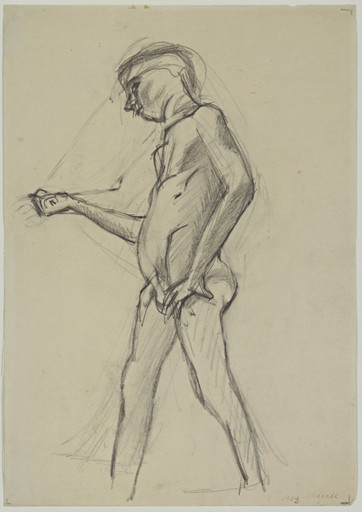
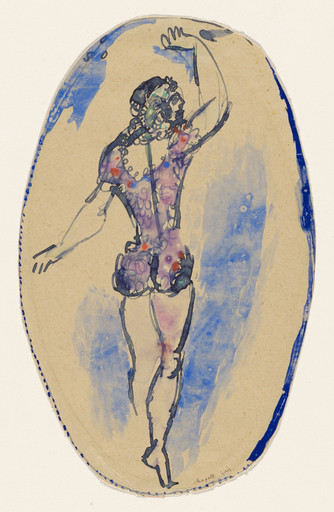

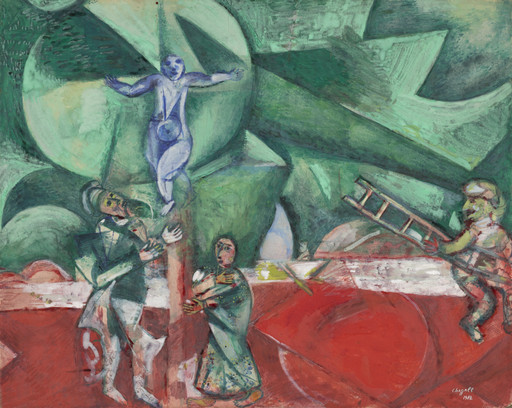
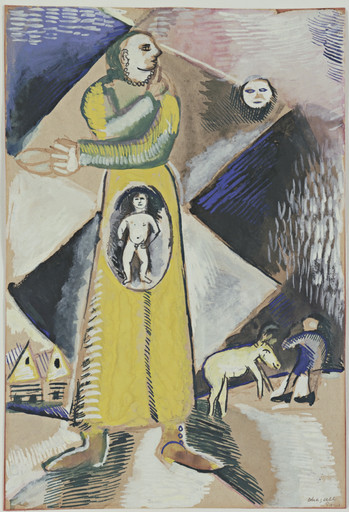
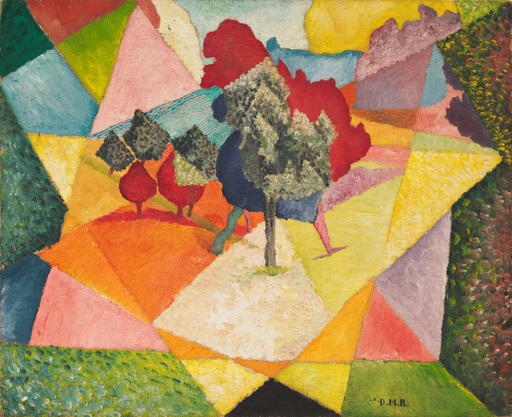
A Cubist Salon
Gallery 503What does Cubism look like? For the international network of artists who first engaged with this movement, it was a work in progress.
Learn more →


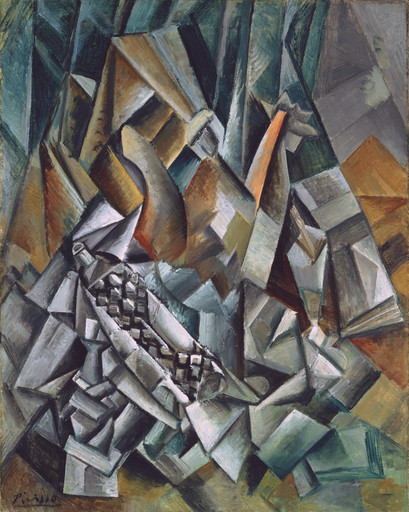
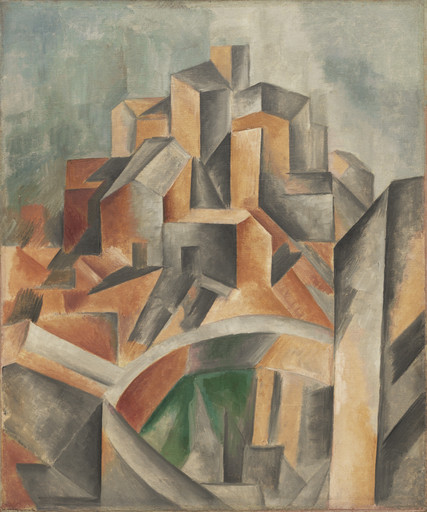

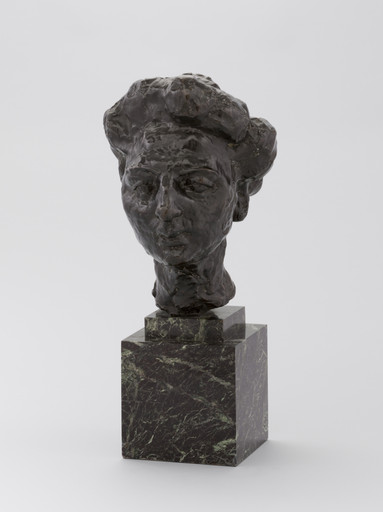

Audio
Audio from the playlist Collection 1880s–1940s
Audio from the playlist Kids
Audio from the playlist Verbal Descriptions
Articles and videos
From MoMA Design Store


Installation views
We have identified this work in the following photos from our exhibition history.
Provenance Research Project
This work is included in the Provenance Research Project, which investigates the ownership history of works in MoMA's collection.
Acquired by Nell Walden (1887-1975), Berlin, 1916 [1]; returned to Marc Chagall, Paris, 1926 [2]; purchased from the artist by René Gaffé, Brussels, February 22, 1926 [3]; acquired by The Museum of Modern Art, New York, June 13, 1945.
[1] Karoline Hille, Marc Chagall und das deutsche Publikum, Cologne: Böhlau, 2005, p. 55, p. 271, no. 15. Included in Chagall's solo exhibition at Herwarth Walden's Galerie Der Sturm, Berlin, [May/June] 1914. Herwarth Walden, Expressionismus: Die Kunstwende, Berlin: Der Sturm, 1918, p. 21.
[2] See letter Nell Walden, Schinznach to James Johnson Sweeney, New York, November 14, 1946, Collection files, Department of Painting and Sculpture, The Museum of Modern Art, New York.
[3] Reproduced in René Gaffé, "Réflexions d'un collectionneur," Cahiers de Belgique, vol. 2, no. 2 (February 1929), p. 60. Included in the exhibition Art In Our Time: 10th Anniversary Exhibiton, The Museum of Modern Art, New York, May 10-September 30, 1939, no. 184. On extended loan from Gaffé to The Museum of Modern Art, New York during the war.
Provenance research is a work in progress, and is frequently updated with new information. If you have any questions or information to provide about the listed works, please email [email protected] or write to:
Provenance Research Project
The Museum of Modern Art
11 West 53 Street
New York, NY 10019
Licensing
Artwork or archival images
If you would like to reproduce an image of a work of art in MoMA's collection, or an image of a MoMA publication or archival material (including installation views, checklists, and press releases), please contact Art Resource (publication in North America) or Scala Archives (publication in all other geographic locations).
Audio and film clips
MoMA licenses archival audio and select out of copyright film clips from our film collection. At this time, MoMA produced video cannot be licensed by MoMA/Scala. All requests to license archival audio or out of copyright film clips should be addressed to Scala Archives at [email protected]. Motion picture film stills cannot be licensed by MoMA/Scala. For access to motion picture film stills for research purposes, please contact the Film Study Center at [email protected]. For more information about film loans and our Circulating Film and Video Library, please visit Circulating Film and Video Library.
Text from a publication or the archives
If you would like to reproduce text from a MoMA publication, please email [email protected]. If you would like to publish text from MoMA's archival materials, please fill out this permission form and send to [email protected].
Feedback
This record is a work in progress. If you have additional information or spotted an error, please fill out this feedback form.