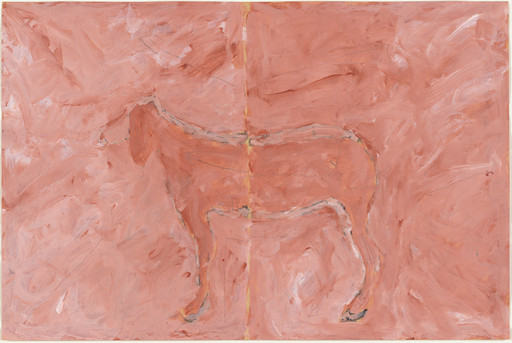
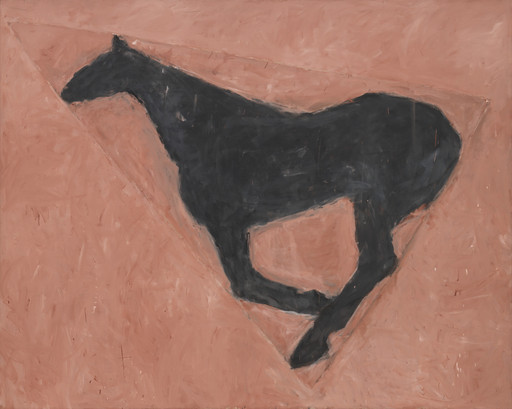
"By the middle of the '70s," Rothenberg has said, "I sensed that people were tired of Minimal and Conceptual art. It made sense to paint an image of something you could recognize and feel something about." Having found herself doodling a horse on a bit of canvas in 1973, Rothenberg shortly began a series of full-scale paintings of horses. These works anticipated the powerful return of figurative and subjective content in American and European art of the late 1970s and 1980s.
Rothenberg, however, runs the emotional immediacy of figurative art through the filter of abstraction. In Axes, her working of the paint favors its material presence over its illusionistic or expressive possibilities. The body of the horse is a largely flat white—there is little modeling to give it volume or detail to give it character. It shares that white with the ground around it, which it traverses improbably slantwise, and straight lines cross both body and ground, insisting that they are constituents of the same flat surface. The result is neither wholly representational nor wholly abstract, and reflects the ideas of its time even while it breaks from them: "I was able to stick to the philosophy of the day—keeping the painting flat and anti-illusionist—but I also got to use this big, soft, heavy, strong, powerful form."
Axes. 1976
The Museum of Modern Art, MoMA Highlights, New York: The Museum of Modern Art, revised 2004, originally published 1999, p. 290.
Explore more
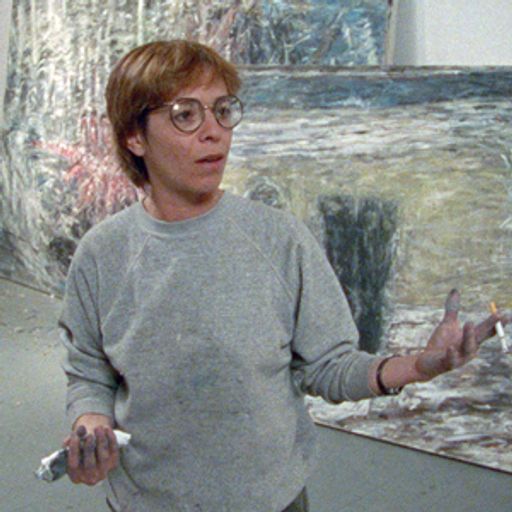
Susan Rothenberg
American, 1945–2020 44 works onlineBorn in Buffalo, New York, in 1945, Susan Rothenberg became interested in art at an early age, inspired by her grandfather, a house painter, and trips to Buffalo’s Albright-Knox Art Gallery.
Learn more →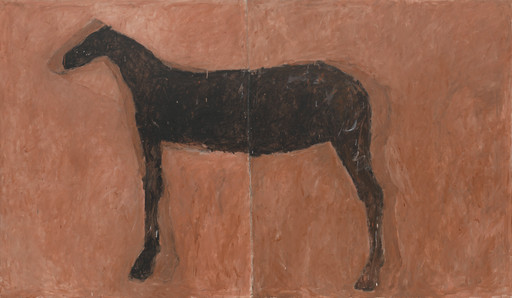

IMAGINE PEACE
Floor 1For decades, the multidisciplinary artist and activist Yoko Ono has created works that invite audiences to think about peace. In 1969, in response to the Vietnam War, Ono and John Lennon launched the campaign WAR IS OVER!
Learn more →
From MoMA Design Store


Installation views
We have identified this work in the following photos from our exhibition history.
Licensing
Artwork or archival images
If you would like to reproduce an image of a work of art in MoMA's collection, or an image of a MoMA publication or archival material (including installation views, checklists, and press releases), please contact Art Resource (publication in North America) or Scala Archives (publication in all other geographic locations).
Audio and film clips
MoMA licenses archival audio and select out of copyright film clips from our film collection. At this time, MoMA produced video cannot be licensed by MoMA/Scala. All requests to license archival audio or out of copyright film clips should be addressed to Scala Archives at [email protected]. Motion picture film stills cannot be licensed by MoMA/Scala. For access to motion picture film stills for research purposes, please contact the Film Study Center at [email protected]. For more information about film loans and our Circulating Film and Video Library, please visit Circulating Film and Video Library.
Text from a publication or the archives
If you would like to reproduce text from a MoMA publication, please email [email protected]. If you would like to publish text from MoMA's archival materials, please fill out this permission form and send to [email protected].
Feedback
This record is a work in progress. If you have additional information or spotted an error, please fill out this feedback form.