Not on view
In tailored suits and polished brogues, the artist duo Gilbert & George stares out of this artwork like mannequins from a shopwindow. They have placed themselves as saints or sinners in the center of their own universe; a chorus of casually dressed young men sporting red shirts, blue jeans, and yellow shoes are arrayed behind them like modern-day apostles. Incorporating bold, black outlines that frame each figure and wide panes of primary colors reminiscent of stained glass windows, Live’s functions in the straightforward graphic language of advertising. Gilbert & George came into prominence in 1969 while Proesch and Passmore were students at London’s St. Martin's School of Art. The two artists have appeared together in all their artistic productions (including drawings, photographs, installations, videos, and performances), dissolving the traditional boundaries between artist and artwork. Their identities are inseparable from their work: "To be with art is all we ask," they have proclaimed.
2013.
Publication excerpt from The Museum of Modern Art, MoMA Highlights since 1980 , New York: The Museum of Modern Art, p. 53.
In tailored suits and polished brogues, the artist duo Gilbert & George stare out of this artwork like mannequins from a shop window. They have placed themselves as saints or sinners in the center of their own universe; a chorus of casually dressed young men sporting red shirts, blue jeans, and yellow shoes are arrayed behind them like modern-day apostles. Incorporating bold black outlines that frame each figure and wide panes of primary colors reminiscent of stained glass windows, Live's functions in the straightforward graphic language of advertising. The work is constructed from twenty-eight separate photographs hand-colored with inks and dyes and embellished with aluminum foil.
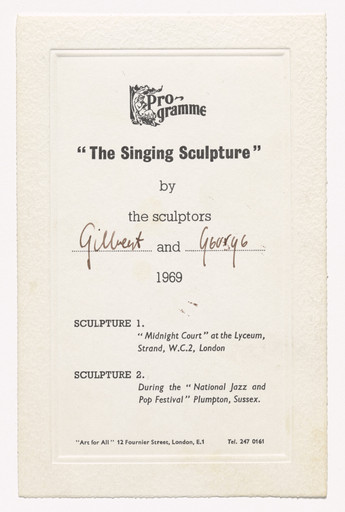
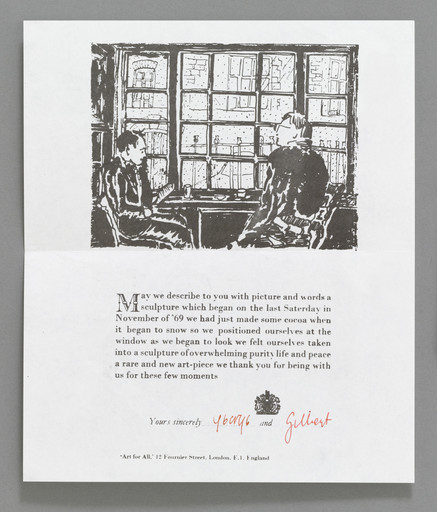
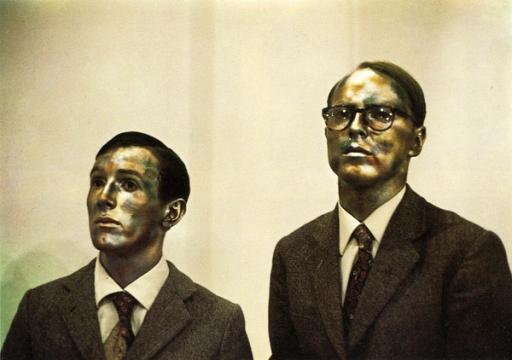
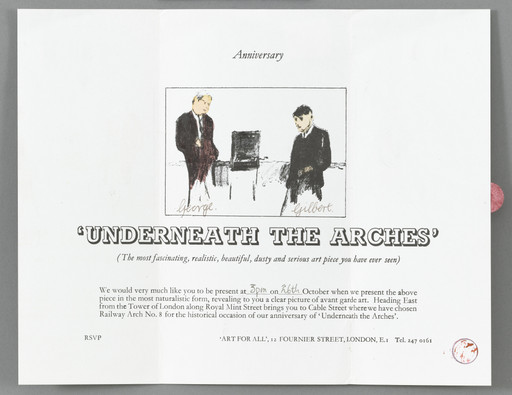
Gilbert and George came into prominence in 1969 while Proesch and Passmore were students at London’s St. Martin’s School of Art. In an attempt to create art that was accessible to a general audience, they developed a simple, robotic song–and–dance routine to the music-hall tune "Underneath the Arches," which they went on to perform as "living sculptures" to mesmerized audiences throughout Europe and the United States. From that point on, the two artists — dressed in their signature style — have appeared together in all their artistic productions (including drawings, photographs, installations, videos, and performances), dissolving the traditional boundaries between artist and artwork. Their identities are inseparable from their work: "To be with art is all we ask," they have proclaimed.
The Museum of Modern Art, MoMA Highlights since 1980, New York: The Museum of Modern Art, p. 53.
Gallery label from Multiplex: Directions in Art, 1970 to Now , November 21, 2007-July 28, 2008.
In the late 1960s and early 1970s, Gilbert & George were among the artists creating alternatives to traditional painting and sculpture. Donning conservative business suits, they became "living sculpture," giving performances and generally considering everything they did to be an artwork. They often poke fun at proper behavior in a deadpan fashion and include references to drunkenness, sexuality, and other bodily functions.
Multiplex: Directions in Art, 1970 to Now, November 21, 2007-July 28, 2008.
Explore more
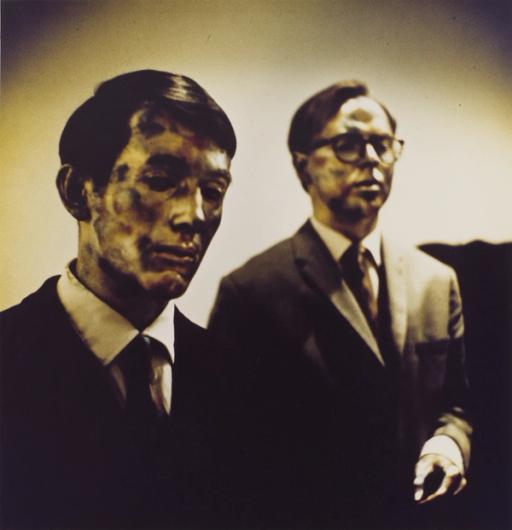
Gilbert & George
British 83 works onlineDescribing their relationship in life and work, Gilbert & George have said, “It’s not a collaboration….We are two people, but one artist.
Learn more →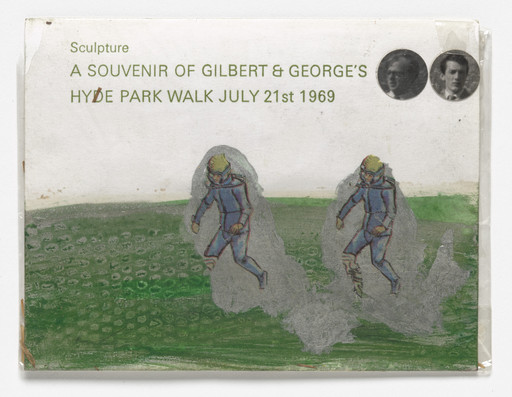
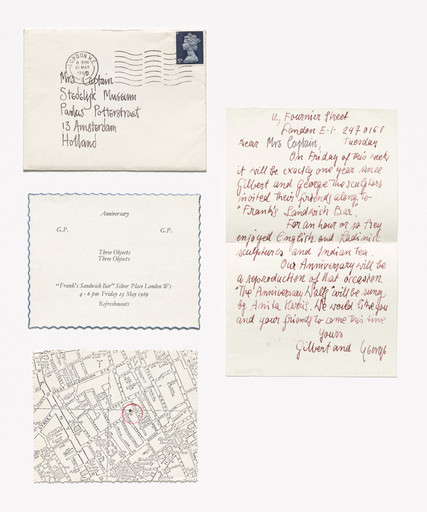
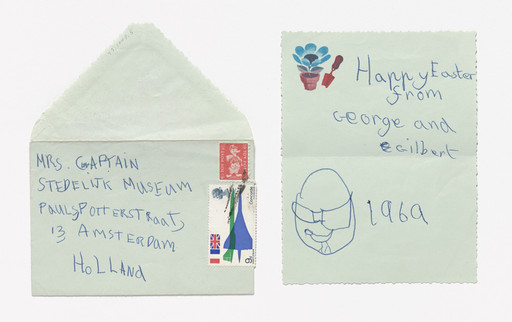
Gilbert Proesch
British, born Italy 1943 53 works onlineDescribing their relationship in life and work, Gilbert & George have said, “It’s not a collaboration….We are two people, but one artist.
Learn more →

George Passmore
British, born 1942 53 works onlineDescribing their relationship in life and work, Gilbert & George have said, “It’s not a collaboration….We are two people, but one artist.
Learn more →
From MoMA Design Store


Installation views
We have identified this work in the following photos from our exhibition history.
Licensing
Artwork or archival images
If you would like to reproduce an image of a work of art in MoMA's collection, or an image of a MoMA publication or archival material (including installation views, checklists, and press releases), please contact Art Resource (publication in North America) or Scala Archives (publication in all other geographic locations).
Audio and film clips
MoMA licenses archival audio and select out of copyright film clips from our film collection. At this time, MoMA produced video cannot be licensed by MoMA/Scala. All requests to license archival audio or out of copyright film clips should be addressed to Scala Archives at [email protected]. Motion picture film stills cannot be licensed by MoMA/Scala. For access to motion picture film stills for research purposes, please contact the Film Study Center at [email protected]. For more information about film loans and our Circulating Film and Video Library, please visit Circulating Film and Video Library.
Text from a publication or the archives
If you would like to reproduce text from a MoMA publication, please email [email protected]. If you would like to publish text from MoMA's archival materials, please fill out this permission form and send to [email protected].
Feedback
This record is a work in progress. If you have additional information or spotted an error, please fill out this feedback form.